MNJ01-001
You are sitting in respiratory OPD of your hospital , 8 years old child Rajeev came with his lung function report.
| Predicted | Measured | ||
|---|---|---|---|
| FVC | 2.07 | 1.31 | (63%) of best |
| FEV1 | 1.85 | 1.08 | (51%) of best |
| PEF | 275 | 210 |
- Which type of pulmonary function this result reflecting?
- What may be the possible causes (write 2)?
- What type of pulmonary function result you will get ina child with cystic fibrosis?
Answer
- Restrictive type
-
- Kyphoscoliosis, muscular dystrophy
-
- Mix type in cystic fibrosis
- "Both FCV and FEV1 are markedly reduced in restrichve type of pattern.
- * FCV near normal but FEV1 are markedly reduced in obstructive type of pattern. (Asthma)
- ** FCV is low but FEV1 muchmarkedly reduced in mix type of pattern. (cystic fibrosis)
MNJ01-002
A7 years old girl Rajni reviewed in respiratory clinic. Here is her flow volume graph.
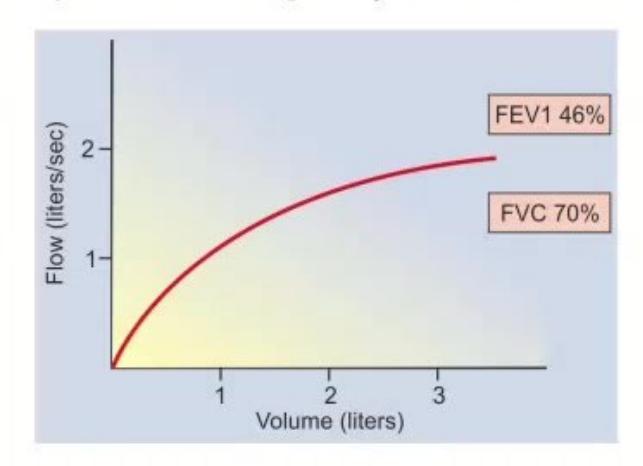

- Which type of pattern this graph is reflecting and what 1s most common diagnosis?
- What genetic mutation she may have?
- Which drugs for nebulisation you will prescribe if she had recurrent culture positive pneumonia?
Answer
1 . Mix type, cystic fibrosis
- 2 . Delta 508 mutation for CFTR gene
- a Colistin
MNJ01-003
You are sitting in respiratory OPD of your hospital, 14 years old child Rahul came with his lung function report.
| Predicted | Measured | ||
|---|---|---|---|
| FVC | 4.07 | 3.6 | (84%) of best |
| FEV1 | 3.90 | 2.24 | (56%) of best |
| PEF | 490 | 260 | (54%) of best |
| FEF (25-75%) | 4.07 | 1.68 | (42%) of best |
- Which type of pulmonary function this result reflecting and what 1s most common diagnosis?
- What may the other possible causes (write 2 other than most common)?
- What 1s best lung function parameter measurement is best for this child in future?
Answer
1 . Obstructive, most common—Asthma
- Z . Pneumonia, bronchiolitis
- 3 . FEF( 25-75%)—best to measurement of small airway disease Peak flow 1s best for large airway disease follow-up
MNJ01-004
A 2 years old non-cyanotic child came to you with her cardiac catheter result.
| Saturation (%) | Pressure (mm Hg) | ||
|---|---|---|---|
| 5A | 79 | ||
| RA | 8&8 | ||
| RV | 56 | ||
| PA | 86 | ||
| LA | 96 | -/6 | |
| LV | 96 | ||
| A | 96 |
- Is this catheter report 1s normal? if not, what is possible diagnosis?
- What 1s normal saturation in RA and RV?
- What pressure will you expect in RA in this child?
Answer
- ASD
-
- 50, 81
- 2 —/6 (normal 1s —/ 4)
HOW TO SOLVE CARDIAC CATHETER QUESTIONS
- Made a schematic heart
| RA | LA |
|---|---|
| RV | LV |
| PA |
- *RA. Right atrium, LA. Left atrium, RV Right ventricle, LV Left ventricle, PA. Pulmonary artery, A. Aorta
-
- Mark the saturation m heart areas
- * Are the saturations on left greater than 90% (Yes) Normal
- * Are the saturations on right less than 80%0(Yes): Normal
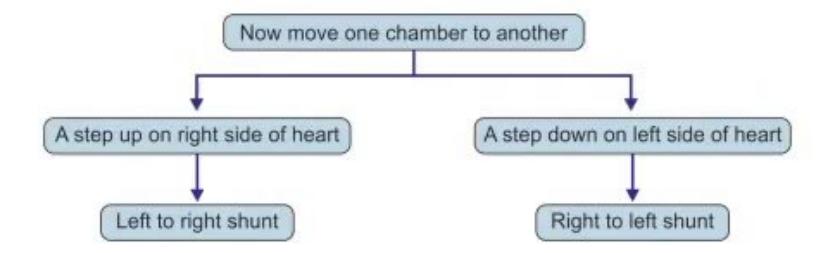
-
- Now mark the pressure in heart chambers
- * all mght sides should be less than left-normal
- * if there 1s equality at any level-(mixing) cardiac shunt
- * if pressure fall across a valve-valve stenosis
Examples:
1. Saturation
| 80% | 96% | 80% | 96% |
|---|---|---|---|
| 81% | 95% | 79% | 95% |
| 80% Normal |
96% | 96% TGA |
80% |
| 81% | 96% | 87% | 96% |
| 88% | 96% | 87% | 96% |
| VSD | ASD |
| 80% | 96% | |
|---|---|---|
| 79% | 95% | |
| 96% | 80% | |
| TGA | ||
| 87% | 96% | |
| 87% | 96% | |
| ASD | A.S. |
2. Pressures (mm Hg)
| -/4 | -/{7 | -/7 | -/7 |
|---|---|---|---|
| 20/4 | 100/10 | 20/4 | 100/10 |
| 20/10 (PA) Normal |
100/70(A) | 20/10 (PA) ASD |
100/70(A) |
| —/4 | -{7 | ||
| 60/30 | 100/10 | ||
| 20/10 (PA) | 100/70(A) |
| -/7 | -/7 | |
|---|---|---|
| 20/4 | 100/10 | |
| 20/10 (PA) ASD |
100/70(A) |
Pulmonary stenosis
MNJ01-005
A5 years old child came to you with her cardiac catheter result. He was born as a preterm baby.
| Saturation (%) | ||
|---|---|---|
| 8 | ||
| 8 | ||
| 2 S |
||
| S | ||
| & |
- Whatis possible system affected—lung or heart?
- Whatis possible diagnosis?
Answer
- Lung 2. BPD
MNJ01-006
A4 years old child came to you with her cardiac catheter result.
| Saturation (%) | Pressure (mm Hg) | ||
|---|---|---|---|
| RA | 74 | —/4 | |
| RV | 74 | 70/30 | |
| PA | 74 | 22/12 | |
| LA | 96 | ||
| LV | 96 |

- Whatis diagnosis of this catheter report?
- Write 2 ECG changes.
Answer
- Pulmonary stenosis
-
- Right ventricular hypertrophy—upright T wave in V1 Tall R wave in V1 Right axis deviation
Ans.7. 1. Coarctation of aorta (COA)
| Saturation % | Pressure (mm Hg) | |||
|---|---|---|---|---|
| LA | 96 | —/10 | ||
| LV | 96 | 150/70 | ||
| Ascending aorta | 96 | 150/70 | ||
| Descending aorta | 96 | 70/30 |
" Acyanotic lesion-COA. So there is no drop in saturation.
MNJ01-007
You are asked to see a7 years old boy who has been suffering from headache. His blood pressure is 160/96 mm Hg. You also noticed murmur on examination.
| Saturation (%) | 'Pressure (mm Hg) | |
|---|---|---|
| LA | 96 | -/10 |
| LV | — | = |
| Ascending aorta | — | — |
| Descending aorta | = | = |
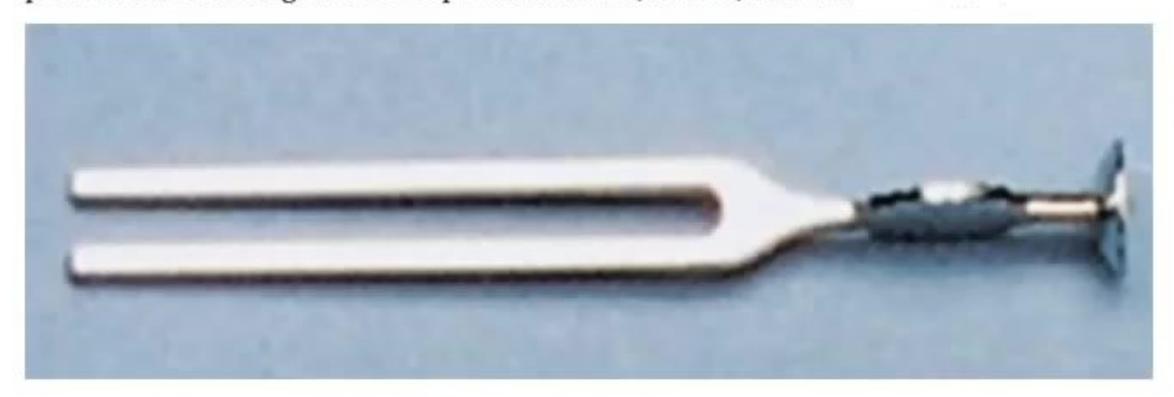
OQ. 8. Test hearing in the 13 years old boy, describing at each step the procedure. (You are provided with tuning fork of frequencies 128 Hz, 256 Hz, 512 Hz.)
- What is possible diagnosis m this child?
- Draw most appropriate pressure and saturation in blocked heart chambers.
Answer
No model answer in source material.
MNJ01-008
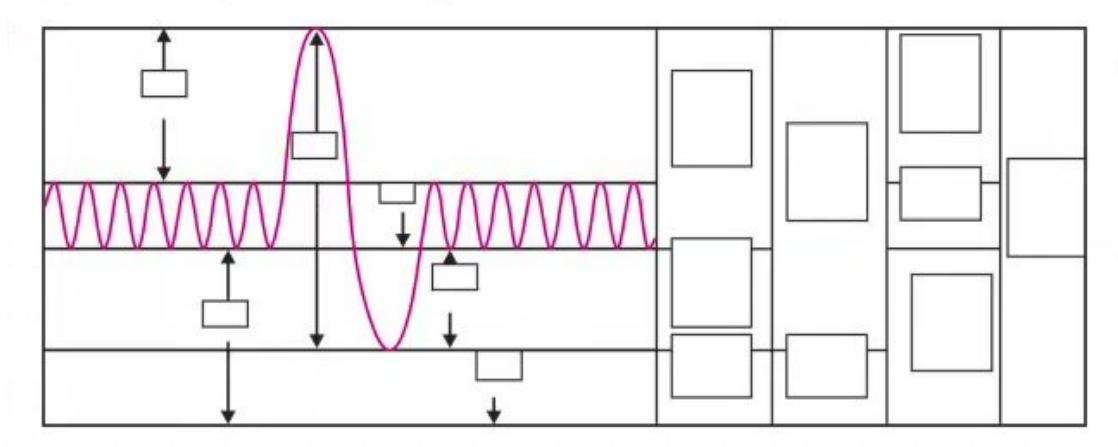
Mark the lung volumes and capacities
Answer
No model answer in source material.
MNJ01-009
Theme: Interpretation of amino acids
- A. Phenylketonuria
- B. Tyrosinaemia
- C. Non-ketotic hyperglycinaemia
- D. Ormthine transcarbamylase deficiency (OTC deficiency)
- E. Maple syrup urine disease (MSUD)
For each of the following amino acid results, select from the list above the most likely diagnosis.
|---------------|----------------|------------------------|
| Serine | 129 | 51-230 |
| Glutamine | 453 | 300-760 |
| Glycine | 222 | 80-300 |
| Leucine | 1137 | 55-60 |
| Isoleucine | 457 | 25-150 |
| Valine | 826 | 90-550 |
| Arginine | 104 | 20-180 |
| Phenylalanine | 76 | 30-100 |
| Tyrosine | 60 | 20-150 |
|---------------|----------------|------------------------|
| Serine | 124 | 51-230 |
| Glutamine | 4122 | 300-760 |
| Glycine | 301 | 80-300 |
| Leucine | 230 | 55-60 |
| Isoleucine | 75 | 25-150 |
| Valine | 300 | 90-550 |
| Arginine | 70 | 20-180 |
| Phenylalanine | 50 | 30-100 |
| Tyrosine | 280 | 20-150 |
|---------------|---------------|-----------------------|
| Serine | 190 | 51-230 |
| Glutamine | 340 | 300-760 |
| Glycine | 310 | 80-300 |
| Leucine | 120 | 55-60) |
| Isoleucine | 65 | 25-150 |
| Valine | 200 | 90-550 |
| Arginine | 30 | 20-180 |
| Phenylalanine | 1500 | 30-100 |
| Tyrosine | 50 | 20-150 |
a. Phenylketonuria
b. Tyrosinaemia
c. Non-ketotic hyperglycinaemia
d. Ormthine transcarbamylase deficiency (OTC deficiency)
e. Maple syrup urine disease (MSUD)
Answer
- Maple syrup urine disease: The branch-chain amino acids, leucine, isoleucine and valine, share a common enzyme at the start of their catabolic pathway. Deficiency of branched-chain oxo acid dehydrogenase results in increases in all three amino acids.
- Ornithine transcarbamylase deficiency: This amino acid profile suggests a defect of the urea cycle. Ammonia is 'mopped up' by glutamate with a resultant increase in glutamine, which is then transported to the liver for conversion to urea.
- Phenylketonuria. This is the basis of the newborn screening test for PKU
phenylalanine hydroxylase converts phenylalanine to tyrosine, and therefore the
ratio of phenylalanine to tyrosine is increased. Classic PKU is defined as a
phenylalanine level greater than 1000 μmol/L.
Ans. 11.1. Adrenoleukodystrophy
- The Synacthen test shows a flat response, with no increase in cortisol. the VLCFAs (very long chain fatty acids) are increased, consistent with adrenoleukodystrophy.
-
- X-linked
MNJ01-010
A6 years old girl Ritu was found to have a poor cortisol response when hypoglycaemic. On the basis of the results of further investigations shown below, what is the most likely diagnosis?
| Synachthen test | ||||
|---|---|---|---|---|
| Time (min) | 0 | 30 | 60 | |
| Cortisol (nmol/'T) | 101 | o4 | 89 | |
| Very-long-chain fatty acids | ||||
| (24/22 ratio | 1.54 | (NR < 0.96) | ||
| C26 / C22 ratio |
0.056 | (NR < 0.022) |

- What 1s possible diagnosis Addision disease or adrenoleukodystrophy?
- What 1s this test results showing?
- What 1s genetic inheritance of this disease?
Answer
No model answer in source material.
MNJ01-011
Theme: Hepatitis B
| ALT | HBV/DNA | cAb | HBsAg | Anti-HBsAg | eAg | ||
|---|---|---|---|---|---|---|---|
| A | Tf | Detectable | IgM | Fs | = | + | |
| B | fT | Detectable | IgM | i | |||
| i | Detectable | IgG | - | — | + | ||
| DN | High | IgG | i | - | + | ||
| E | N | Undetectable | IgG | + | =_— | ||
| F | WN | Undetectable | IgG | + |
cAb, core antibody, eAb, envelope antibody, eAg, envelope antigen, HBV
For each of the serologies above, select the correct diagnosis from the following:
- Chronic hepattis B infechon, non-rephcative phase
- Acute hepatitis B infection with pre-core mutant
- Chronic hepatitis B infection, immune clearance phase
- Immune tolerant
Answer
- F, 2.B, 3.C, 4 D
The following phases of hepatitis B virus infection are recognised:
| Host HBV status | ALT | HBV DNA | cAb | sAg | sAb | eAg* | eAb |
|---|---|---|---|---|---|---|---|
| A. Acute B. Chronic |
1 | Detectable | IgM then IgG | + | - | + | - |
| 1. Immune tolerance | N | High | IgG | + | _ | + | _ |
| 2. Immune clearance | 1 | Detectable | IgG | + | _ | + | _ |
| 3. Non-replicative | N | Undetectable | IgG | + | - | - | + |
| C. Resolved | N | Undetectable | IgG | - | + | - | + |
*eAg absent in pre-core mutant. ↑, increased, ALT, alanine aminotransferase, cAb, core antibody, eAb, envelope antibody, eAg, envelope antigen, HBV, hepatitis B virus, N, normal, sAb, surface antibody; sAg, surface antigen.
Clues to remembering:
| Hep Bc IgM +ve | Acute infection |
|---|---|
| Hep Be IgG +ve with HBsAg +ve | Chronic infection |
| Presence of HBeAg | Infective and therefore absent in non-replicative and resolved states (except when there is a pre-core mutant) |
| Abnormal liver function tests | Only occurs during acute infection and clearance of virus |
HBeAg, hepatitis B envelope antigen, HBsAg, hepatitis B surface antigen, Hep Be, hepatitis B virus core antigen.
Ans. 13. 1.C, 2. A,3.E
MNJ01-012
Theme: Blood and coagulation values
| Hb (g/dl) | Platelets lacks |
Total WCC/nn? |
Neutrophils (%) | INR | ||
|---|---|---|---|---|---|---|
| 10.5 | 0.44 | 10,000 | 1.1 | |||
| HArmamoOnNnaS | 12.2 | 3.2 | 6,000 | 38 | 1.1 | |
| 6.2 | 0.4 | 15,000 | " | 1.15 | ||
| a | 0.2 | 2,200 | 1.15 | |||
| 18.5 | 15 | 18,000 | S | 1.3 | ||
| 10.1 | 13 | 5,500 | 0.9 | |||
| 10.6 | 0.3 | 14,000 | S | 25 |
For each patient below, select the appropriate haematological parameters listed above
- A2 years old girl with haemolytc uraemic syndrome
- A3 years old boy with Wiskott-Aldrich syndrome
- Anormal 1 day old newborn baby.
Answer
No model answer in source material.
MNJ01-013
A 3 years old child present with UTI. On urine culture report you found multiple sensitive antibiotics against E. coli. Compare the MIC (minimum inhibitory concentration) report of finally chosen two antibiotics among all and select the best one as per report given below:
In vitro efficacy of amoxicillin (predicts ampicillin)
| Sensitive (MIC) | Intermediate | Resistant |
|---|---|---|
| 16 | 32 |
Tested concentrations of amoxicillin (ug/ml) Breakpoint
| 8 OSCE Clinical Pediatrics
In vitro efficacy of cefovecin
| Sensitive (MIC) | Intermediate | Resistant |
|---|---|---|
| @) (B) |
' | 8 |
Tested concentrations of cefovecin (g/ml) Breakpoint
- Whatis MIC?
- What antibiotic you will choose among these two and why?
- What 1s eagle effect while using antibiotics?
Answer
-
In vitro lowest concetration of an anbbiotic agent which completely prevents visible growth of an organism (mg/l or pg/ml).
-
Resistant value of amoxicilline 1s four times dilution (32) away from MIC value (2) and two times dilution (4) away from MIC value (2) of cefovecin. So im this case amoxicilline is the best choice.
-
Paradoxical reduced killing activity at antibiotics concentrations above its MIC or OBC (supra MIC). (If you use very high dose of antibiotics, 1t may be less effective than usual dose)