VVK16-001
Select the answers.
a. Measure development of a 1-year-old
b. Measure intelligence of a 10-year-old
c. Detection of hemiparesis in a 3-month-old
d. Detection of blindness or deafness in 2-month-old
i. Clinical neurological examination
v. Wechsler intelligence scale (WISC) test.
Answer
- a. 3
- b. 5
- c. 1
- d. 1.
VVK16-002
Select the answers.
a. Suicidal behavior
b. Gender identity
c. Oedipal years
d. Latency
i. 0–2 years
v. 14–16 years.
Answer
- a. 5
- b. 1
- c. 2
- d. 3.
VVK16-003
For each description of development accomplishments, select the earliest most appropriate age.
a. Walk if led and is able to talk a few steps unsupported, demonstrates a good pincer grip, drinks from a cup.
b. Copies a circle, hold on one foot, recognizes colors.
c. Smiles responsively, follows a moving object or face with turning of the head.
d. Kicks a ball, builds a tower of six 1-in cubes, combines two different words.
e. Sits without support, pulls to a stand, babbles loudly and happily, grabs a block with the entire hand.
f. Startles at sudden noise.
g. Draws a triangles, uses past and future tense in language.
i. 2 Months
v. 12 Months
Answer
- a. 5
- b. 8
- c. 1
- d. 7
- e. 4
- f. 1
- g. 9.
VVK16-004
Nutrition reserve in adult and children—survival without food.
How long can a given subject survive without food?
a. Adults
b. 1 year old
c. Term infant
d. Preterm infant 2 kg
e. Preterm infant 1 kg
i. 1 year
v. 45 days
x. 12 hours
Answer
- a. iii
- b. v
- c. vii
- d. vii
- e. viii
VVK16-005
The following food substances, which contain vitamin A, need to be arranged based on vitamin A content from low to high.
a. Papaya
b. Guava
c. Drumstick leaves
d. Egg
e. Human milk
f. Carrot.
Answer
| a. | Guava | 0 |
|---|---|---|
| b. | Human milk | 38 |
| c. | Papaya | 118 |
| d. | Egg | 140 |
| e. | Drumstick leaves | 300 |
| f. | Carrot. | 1167 |
VVK16-006
Write the calorie value of
a. Rice—1 cup
b. Puri—1
c. Upma—1 cup
d. Idli—1
e. Dosa—1
f. Kichidi—1 cup
g. Boiled egg—1
h. Vada—1
i. Pizza—1 slice
j. Oil—1 tbsp
k. Ice cream—½ cup
l. Peanuts—50 nos
m. Banana—1
n. Cashew nuts—10
o. Milk chocolate—25 g.
Answer
| a. | Rice—1 cup | - 170 |
|---|---|---|
| b. | Puri—1 | - 100 |
| c. | Upma—1 cup | - 270 |
| d. | Idlli—1 | - 75 |
| e. | Dosa—1 | - 125 |
| f. | Kichidi—1 cup | - 200 |
248 OSCE in Pediatrics
g. Boiled egg—1 - 90 h. Vada—1 - 70 i. Pizza—1 slice - 200 j. Oil—1 tbsp - 60 k. Ice cream—½ cup - 200 l. Peanuts—50 nos - 90 m. Banana—1 - 90 n. Cashew nuts—10 - 95 o. Milk chocolate—25g - 140
VVK16-007
A 6-year-old girl comes in OPD with complain of difficulty in vision. The child has a history of recurrent episodes of loose stools and pneumonias. Her weight is 8 kg and height is 82 cm. Her eye examination findings are shown below.
Study the photograph and answer the questions:
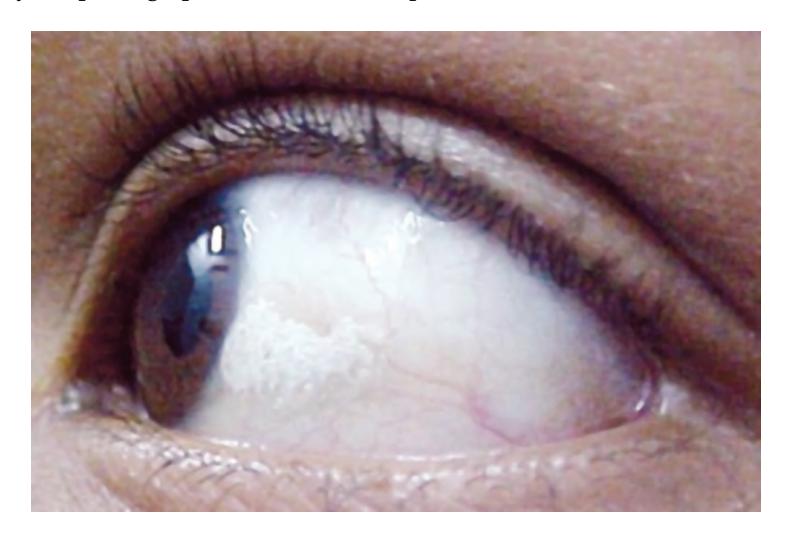
a. What is the positive finding seen in the photograph?
b. What is the most likely diagnosis?
c. Enumerate the WHO staging.
d. What is the staging of the disease in this child?
e. How can you treat this problem at early stages?
Answer
- a. Bitot's spot.
- b. Vitamin A deficiency.
- c. WHO staging:
Primary signs
X 1 A : Conjunctival xerosis
X 1 B : Bitot's spots X2 : Corneal xerosis
X3A : Corneal ulceration (<1/3rd)
X3B : Keratomalacia.
Secondary signs
XN : Night blindness
XF : Xerophthalmia fundus
XS : Corneal scars.
- d. Stage X1B
- e. Xerophthalmia is treated by giving 1,500 µg/kg body weight orally for 5 days followed by intramuscular injection of 7,500 µg of vitamin A in oil, until recovery.
VVK16-008
Answer the following questions.
a. What are WHO-MGRS charts?
b. List 2 exclusion criteria used in these charts.
c. List 2 advantages of these charts over the CDC/NCHS charts.
Answer
- a. WHO—Multicentric growth reference study charts, developed in 2006.
- b. Exclusion criteria:
- • Formula fed infants
- • Children of mothers who smoked during or after the pregnancy
- • Morbidities that affect growth (repeated bouts of diarrhea).
- c. Advantages:
- • The growth charts show how children should grow in all countries.
- • MGRS are a standard rather than a reference.
- • Any deviation from suggested pattern is evidence of abnormal growth.
- • MGRS provide a solid foundation for development of a standard because they are based on healthy children living under condition likely to favor achievement of their full genetic potential.
VVK16-009
Waterlow classification of malnutrition.
An 8-year-old boy is noted to have weight of 67% of expected and height of 83% of expected.
a. What is the degree of malnutrition according to Waterlow Classification?
b. Give details of Waterlow classification of malnutrition.
Answer
- a. Severe wasting and severe stunting.
- b. Waterlow classification.
| Weight for height (wasting) | Height for age (stunting) | |
|---|---|---|
| Normal | > 90 | > 95 |
| Mild | 80–90 | 90–95 |
| Moderate | 70–80 | 85–90 |
| Severe | < 70 | < 85 |
VVK16-010
The IQ of a 7-year-old child is 40.
a. What is his degree of severity of mental retardation?
b. How do you classify MR on basis of degree of severity?
Answer
a. Moderate mental retardation
b. Mild mental retardation : IQ level 50–55 to > 70 Moderate mental retardation : IQ level 35–40 to 50–55 Severe mental retardation : IQ level 20–25 to 35–40 Profound mental retardation : IQ level below 20–25
Mental retardation, severity unspecified : When there is a strong presumption of mental retardation but ; this is untestable by standard
tests.
VVK16-011
Gomez classification of malnutrition.
A 6-year-old boy is noted to have a weight of 61% of expected and height of 90% of expected.
a. What is the degree of malnutrition according to Gomez classification?
b. Give details of Gomez classification of malnutrition.
c. How do you define mild, moderate and severe malnutrition according to Gomez classification?
Answer
a. Grade 2 malnutrition
| b. | Gomez | Weight for age (WHO) |
|---|---|---|
| Normal | >90% | |
| I degree malnutrition | 75–90% | |
| II degree malnutrition | 60–75% | |
| III degree malnutrition | < 60% | |
| c. | I degree malnutritionMild malnutrition |
II degree malnutrition Moderate malnutrition III degree malnutrition Severe malnutrition.
VVK16-012
At what age does child copy following figures.
| a.Square | |
|---|---|
| b. Circle |
|
| c. Diamond |
|
| d. Vertical stroke |
Answer
- a. 4 years
- b. 3 years
- c. 5 years
- d. 2 years (imitates at 18 months).
VVK16-013
A 9-month-old girl is seen in paediatric OPD for routine measles immunization. She is noted to have a large head with head circumference plotting above 91st centile. During her previous visit her head circumference has been between 75th to 91st centile. Her weight and height is plotted on 50th centile. She is standing with support with no obvious developmental concerns. There are no parental concerns. Her systemic and neurological
examination is entirely normal.
a. Is there reason to be concerned about this child's head growth?
b. What physical findings not present in this case might suggest serious pathology?
c. What is the next step in the evaluation of this baby?
d. What is the most likely diagnosis?
e. What are some additional differential consideration?
Answer
-
a. Yes. The fact that the head size is showing a progressive increase is more concerning than the size alone.
-
b. 1. Bulging fontanelle
-
- Spread sutures
-
- Lethargy
-
- Neurologic abnormalities: sun-setting of eye, abnormal tone, delayed development
-
-
c. Measure head sizes of parents and siblings
-
d. Familial macrocephaly
-
e. Hydrocephalus
-
Mucopolysaccharide storage disease
-
Syndromic, i.e. Sotos syndrome (cerebral gigantism).
VVK16-014
A 10-year-old boy is seen in pediatric OPD with parental concerns of being under weight. He has a weight of 39.2 kg and a height of 140cm.
a. What is the formula for calculating BMI?
b. Calculate the BMI of this child.
c. What is your impression about this child's BMI?
Answer
Weight in kg a. ___________________________
(Height in meter)2
- b. 20 kg/m2
- c. Normal BMI
VVK16-015
Given below is the BMI centile chart for boys.
Based on the chart below define:
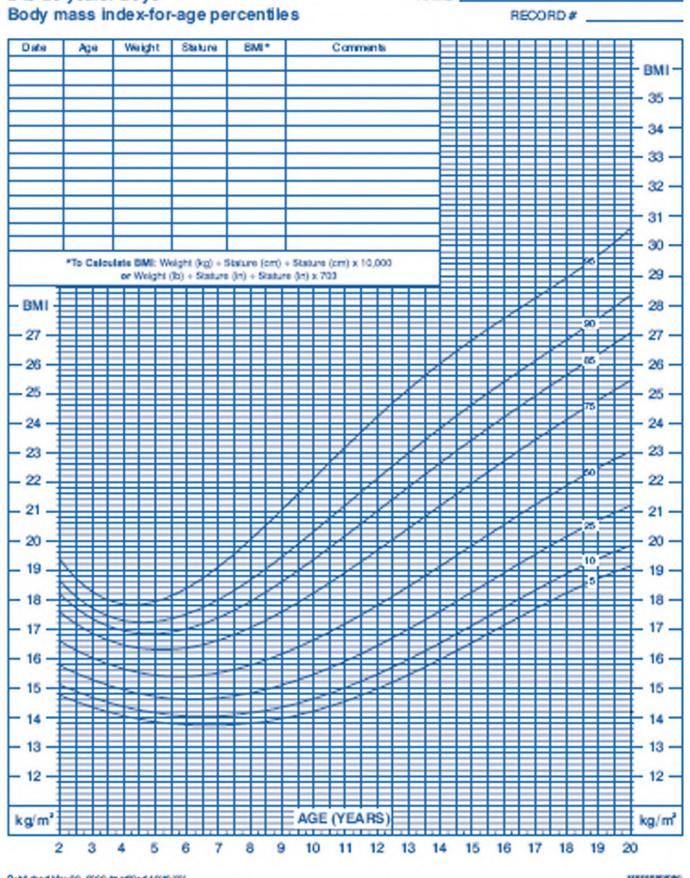

a. Underweight
b. Normal weight
c. At risk for overweight
d. Overweight.
Answer
- a. Underweight: < 5th percentile.
- b. Normal weight: 5th to 84th percentile.
- c. At risk for overweight: 85th to 94th percentile.
- d. Overweight: > 95th percentile.
VVK16-016
Wellcome classification of malnutrition.
A 5-year-old boy is noted to have a weight of 70% of expected and height of 93% of expected. There is no edema.
a. What is the degree of malnutrition according to Wellcome classification?
b. Give details of Wellcome classification of malnutrition.
Answer
- a. Undernutrition
- b. Wellcome classification: evaluates the child for edema and with the Gomez classification system.
| Weight for age (Gomez) | With edema | Without edema |
|---|---|---|
| 60–80% | Kwashiorkor | Undernutrition |
| < 60% | Marasmic-kwashiorkor | Marasmus |
VVK16-017
A 14-year-old boy is brought to pediatric OPD with concerns of delayed puberty. On examination, he has preadolescent male genitalia with scanty axillary hairs, and few fine pubic hairs.
a. What is the tanner staging of this child?
i. Stage 1–2
b. What is the first visible sign of puberty in males?
c. At what tanner stage does a male child achieve peak growth velocity?
i. Stage 1–2
Answer
- a. Stage 1–2.
- b. Testicular enlargement.
- c. Stage 3–4.
VVK16-018
A 11-year-old girl is brought to pediatric OPD with concerns of early signs of puberty. On examination, she has well formed breasts with areola and papilla forming a secondary mound and projecting nipples. She has adult distribution pubic hairs.
a. What is the tanner staging of this child?
b. What is the first visible sign of puberty in females?
c. At what tanner stage does the female attain menarche?
d. Define precocious puberty in girls and boys.
Answer
- a. Stage 5.
- b. Appearance of breast buds.
- c. Stage 3–4.
- d. Precocious puberty is defined as the onset of secondary sexual characteristics before 8 years of age in girls and 9 years in boys.
VVK16-019
A 14-month-old male toddler is brought to a pediatrician with parental concerns of delayed eruption of tooth.
a. What is delayed tooth eruption?
b. List 2 common causes.
c. Which is commonly the first tooth to appear?
d. At what age are the following deciduous teeth shed:
i. First molar.
Answer
- a. Delayed eruption is usually considered when there are no teeth by approximately 13 month of age (mean + 3 standard deviations).
- b. Hypothyroidism.
Hypoparathyroidism
Familial
Idiopathic (the most common).
- c. Central incisors.
- d. i. 10–12 years
- ii. 7–8 years
VVK16-020
Match the following micronutrient with their effects of deficiency.
| Micronutrient | Effects of deficiency | ||
|---|---|---|---|
| a. | Selenium | i. | Hypercholesterolemia |
| b. | Manganese | ii. | Impaired glucose tolerance |
| c. | Fluoride | iii. | Night blindness |
| d. | Chromium | iv. | Dental caries |
| e. | Molybdenum | v. | Cardiomyopathy |
Answer
| Micronutrient | Effects of deficiency | ||
|---|---|---|---|
| a. | Selenium | • | Cardiomyopathy |
| b. | Manganese | • | Hypercholesterolemia |
| c. | Fluoride | • | Dental caries |
| d. | Chromium | • | Impaired glucose tolerance |
| e. | Molybdenum | • | Night blindness |
VVK16-021
IAP Classification of malnutrition.
A 3-year-old girl is noted have a weight of 55% of expected and height of 91% of expected.
a. What is the degree of malnutrition according to IAP classification?
b. Give details of IAP classification of malnutrition.
c. How do you define severe malnutrition according to IAP classification?
Answer
a. Grade 3 malnutrition
b. Grade Weight for age Normal >80% Grade 1 71–80% Grade 2 61–70% Grade 3 51–60% Grade 4 <50%
c. Grade 3–4
VVK16-022
Fill in the following table regarding developmental reflexes in normal children.
| Reflex | Age of appearance | Age of disappearance |
|---|---|---|
| Rooting | ||
| Moro | ||
| Landau | ||
| Parachute |
Answer
| Reflex | Age of appearance | Age of disappearance |
|---|---|---|
| Rooting | Birth | 3 months |
| Moro | Birth | 5-6 months |
| Landau | 10 months | 24 months |
| Parachute | 8-9 months | Persists |
VVK16-023
A 14-year-old girl presents in pediatric OPD clinic with complaint of short stature. Her height is 154 cm. Her mother's height is 156 cm and father's height is 167 cm.
a. What is the formula for calculating the mid parental height for girls?
b. What is the mid parental height for this girl?
Answer
Father Ht + Mother Ht – 13 a. ____________________________________________
2
b. 155 cm
VVK16-024
A 2-month-old infant born at 32 weeks gestation is suspected to have vitamin E deficiency.
a. Name two manifestations which will make you think of vitamin E deficiency in this baby.
b. What is the role of vitamin E in humans?
c. How will you diagnose vitamin E deficiency?
d. Give the content of vitamin E in evion drops.
Answer
- a. Thrombocytosis, edema, hemolysis or anemia.
- b. Antioxidant.
- c. Vitamin E to serum lipids ratio; a ratio <0.8 mg/g is abnormal.
- d. 50 mg/mL.
VVK16-025
An 8-month-old boy is reviewed in paediatric OPD for acute gastroenteritis. On detailed history he was noted to have mild developmental delay. No other significant factor was noted in history. On examination, he was noted to have microcephaly. His remaining general and systemic examination was noted to be normal.
a. How do you define microcephaly?
b. List 2 most important investigations for this child.
c. List 4 non-genetic causes of microcephaly.
Answer
- a. Microcephaly is defined as a head circumference that measures more than three standard deviations below the mean for age and sex.
- b. CT/MRI.
TORCH screening.
Metabolic screening.
Chromosomal analysis.
252 OSCE in Pediatrics
c. Congenital infections—CMV, rubella, toxoplasmosis.
Meningitis/encephalitis.
Hypoxic-ischemic encephalopathy.
Metabolic.
Drugs, e.g. fetal alcohol.
Radiation exposure.
VVK16-026
A 10-year-old girl presents in pediatric OPD with short stature.
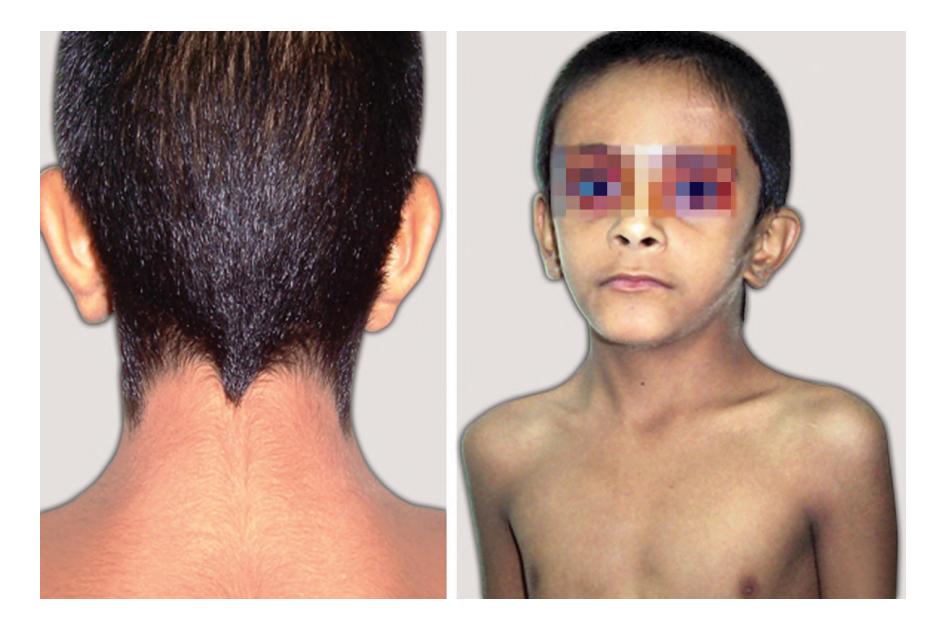
a. List 3 positive findings seen in the photographs.
b. What is the most likely diagnosis?
c. How would you manage her short stature?
Answer
a. Low hair line/trident hairline. Web neck. Widely spaced nipples.
- b. Turner syndrome.
- c. GH supplementation.