MNJ22-001
A 9-year-old girl Ritu presents with high irregular fever for 3 weeks, each episode associated with erythematous rashes over the trunk and proximal extremities, pain and swelling of right knee and easy fatigability. Has leucocytosis, raised ESR, normal chest skiagram and negative mantoux test:
- Give most probable diagnosis.
- List other expected systemuc clinical findings.
- Give value of serology in diagnosis
- Outline steps in management.
- List prognostic factors
Answer
- JRA—systemuc type
-
- Systemic exam findings
- a. Hepatosplenomegaly
- b. Lymphadenopathy
- c Serous cavity effusions
- 4 Serology
- a. ANA Negative
- b. RF Negative
- 4 Management
NSAIDs, methotrexate, azathioprine
- a. Steroids
- b. TNF-o receptor antagonists
- Number and severity of jomt involvement
MNJ22-002
A child has chronic polyarthritis of 4 joints and is ANA positive:
- What arthritis is it hkely to be?
- What complication should we anhcipate?
- In which type of JRA is HLA B,, positive?
- A child with JRA presents with fever, leukopenia and hepatosplenomegaly and lymphadenopathy. What is the diagnosis?
- What drug 1s indicated 1n treatment of Q,?
Answer
JIA pauciarticular type I
- Chronic uveitis
- Pauciarticular type I
- MAS
- Cyclosporin
MNJ22-003
A 35-day-old male child came with complaints of rash over the face from last 4 weeks.
On examination, HR was 58/min but child is not in CHF. Face picture is given below:
- 3, What 1s prognosis of skin and cardiac disease
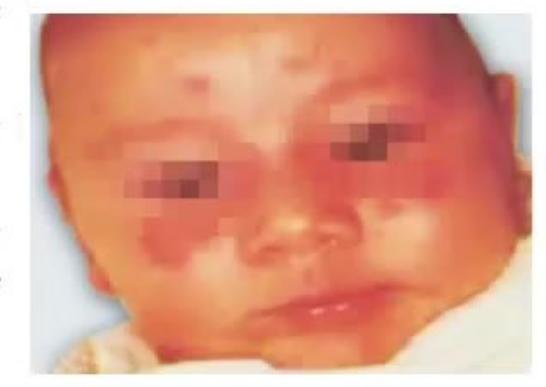

- What 1s diagnosis?
- What is clinical condition in mother you will see?
- When you will diagnosis of this earliest in antenatal period? And what test you will do?
- What treatment you will offer to mother if condition diagnosis of antenatal?
- What 1s risk in next pregnancy?
- What is probable diagnosis and what are diagnosis criterias?
- What 1s indication for steroid?
- Unit head advice at discharge to monitor ure protein. What 1s importance of this?
- What antibiotic use for this condition?
- Write 2 disease with small vessel vasculitis.
Answer
Neonatal lupus
- SLE
- Skin lesion will resolve mm 6 months but cardiac conduction defect is irreversible
- At 16 weeks Ant-Ro/La AB
- Steroid, immunoglobulin
- 15%
MNJ22-004
A 4-year-old male child presents with complaints of fever for 5 days with all feature shown in picture. Antibiotic was given but no response. Coronary angiogram was done:
Image: Dr Manoj Sharma

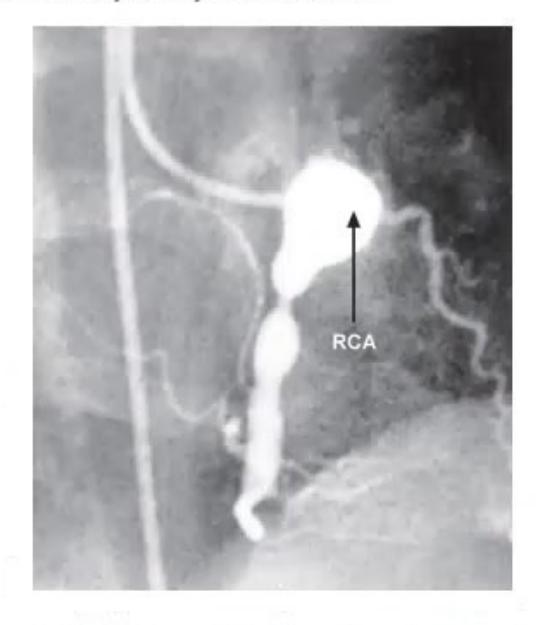
- Whats probable diagnosis?
- Diagnostic criteria?
- What are ECHO criteria for this disease?
- What are DDs? At least 4
- What is treatment?
- What 1s follow-up plan for a child with single coronary artery involvement?
Answer
Kawasaki disease
- Fever >5 days, unilateral LAP, B/L bulbar conjunctival ingestion without exudate, oral mucosa, redness with strawberry tongue, polymorphic rash.
- Z-score of left ant descending coronary artery (LAD) or RCA >2.5 SD, perivascular bnghtness, lack of tapering, decrease LV function, mitral regurgitation.
- . Scarlet fever, SSSS, TEN, measles, Rocky Mountain spotted fever
- . Treatment—IVIg 2 g/kg single dose, aspirin 100 mg/kg/day 6 hourly till 48 hours of fever subside than 3-5 mg/kg/day for 6 weeks than later depend on ECHO finding.
- . See Table 22.1.
| Risk stratification of Kawasaki disease (AHA 2004) Table 22.1: |
||||
|---|---|---|---|---|
| Risk level | Pharmacological therapy |
Physical activity diagnostic testing |
Follow-up | Invasive testing |
| I. artery involvement) |
(Nocoronary None beyond Ist 6-5 weeks |
Norestrictions beyond Ist 6-8 weeks |
Cardiovascular risk assessment, counseling at 5-year intervals |
None |
| (Transient Il. coronary artery ectasia disappears within 1st 6-8 weeks) |
None beyond Ist 6-8 weeks |
Norestrictions beyond Ist 6-8 weeks |
Cardiovascular risk assessment, counseling at 3— 5-year intervals |
None |
| (1 small- Tif. medium coronary artery aneurysm / major coro- nary artery) |
Low-dose aspirin (3-5 mg/kg until aneurysm regression documented |
For patients <11-year-old) no restriction beyond 1st follow-up with aspirin /d), at least 6-8 weeks; patients 11—20-year-old, physical activity guided by biennial stress test, evaluation of myocardial counseling; perfusion scan; contact or high-impact sports discouraged for patients of myocardial taking antiplatelet agents |
Annual cardiology Angiography, if echocardiogram + suggests ischemia ECG, combined with cardiovascular risk assessment, biennial stress test/evaluation perfusion scan |
noninvasive test |
| (1 large or IV. giantcoro- nary artery aneurysm, or multiple orcomplex same coro- nary artery, truction) |
Long-term anti- platelet therapy and) warfarin (target INR) because of risk of 2.0-2.5) or low- heparin (target: 0.5-1.0 U/ml) should be com- without obs- bined in giant aneurysms |
Contact or high-impact sports should be avoided} bleeding; other physical evaluation of molecular-weight activity recommendations! myocardial perfu- indicated; guided by stress test/ aneurysms in Antifactor Xa level evaluation of myocardial perfusion scan outcome |
Biannual follow-up] with ECHO + ECG;) annual stress test/ sooner if sion scan |
Ist angiography at 6-12 mo or clinically repeated angiography if noninvasive test, clinical, or laboratory findings suggest ischemia |
| (Coronary V. artery obs- truction) |
Long-term low- farin or LMWH reduce myocardial O, consumption |
Contact or high-impact dose aspirin; war- sports should be avoided) other physical activity if giant aneurysm recommendations guided) persists; consider by stress test/myocardial of myocardial use of f-blockers to} perfusion scan outcome perfusion scan |
Biannual follow-up) with ECHO and ECG; annual stress address test/evaluation |
Angiography recommended to therapeutic options |
MNJ22-005
A 7-year-old male child presents with complaints of knee joint swelling for 2 weeks duration with limitation of movement, there is history of gastroenteritis 2 weeks back, CBC— Normal, X-ray knee—normal:
- What 1s probable diagnosis?
- Whats HLA associated with this? And how many % patient associated with this?
- What 1s causative agents 4 bacteria and 2 virus?
- What is prognosis?
Answer
- Post-infectious reactive arthritis
-
- HLA B-27, 75%
-
- Campylobacter, Salmonella, Shigella, Yersinia, CMV, VZ, herpes simplex, rubella
-
- Usually resolve without complication.
MNJ22-006
A 13-year-old female presents with fever for 10 days, swelling of feet and pain abdomen. One episode of seizure present 2 days back, on examination, free fluid is present in abdominal cavity with pallor and rash over face given below:
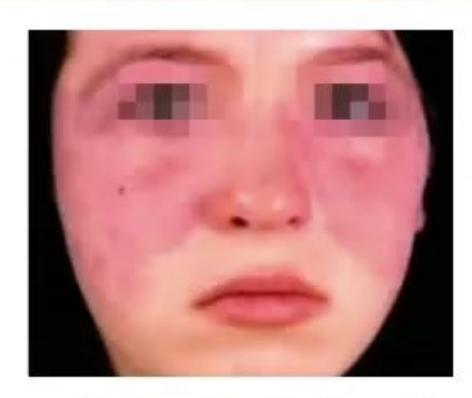
- What investigation will you order to confirm the diagnosis?
- What are 4 drugs that lead to this disease?
- What are treatment options?
- What HLA is associated with this?
Answer
- SLE
-
- Anti-disease DNA, anti-Smith AB
-
- SHIP: Sulphonamide, hydralazine, isoniazid, procanamide
-
- NSAIDs, hydroxycloroquine, steroid, azathioprine
-
- HLA B-8. HLA DR2, HLA DR3
MNJ22-007
True/False
- Serum level of CH50, C3, C4 decrease in active disease.
- Congenital deficiency of C1 q, C2, C4 associated with SLE
- Positive lupus anticoagulant/anticardiolipin AB are also associated with SLE.
- ANA is good screening test for SLE because it is associated with 95% cases of SLE.
- MC causes of death is infection, GN, neuropsychiatric disease
- Hip joint never involves in oligoarticular arthritis.
Answer
- True, 2. True, 3 False, 4 True, 5. True 6. True See Nelson for all explanation.
MNJ22-008
Match the following drugs according to their action:
- Methotrexate A. Anti CD20
2 Adaluzimab B: Interleukin 1 receptor antagonist
- Abatacept C. DMARD
4 Rituximab D Anti-tumor necrosis factor alpha
5 Anakınra E: Anti-cytotoxic T-lymphocyte associated antigen 4 Ig
Answer
- C, 2. D, 3. E, 4. A, 5. B
MNJ22-009
A 4-year-old child presents with complaints of fatigue and weakness during walking, child also develop red rash around eyes and hand. He has history of gastroenteritis 4 weeks back:
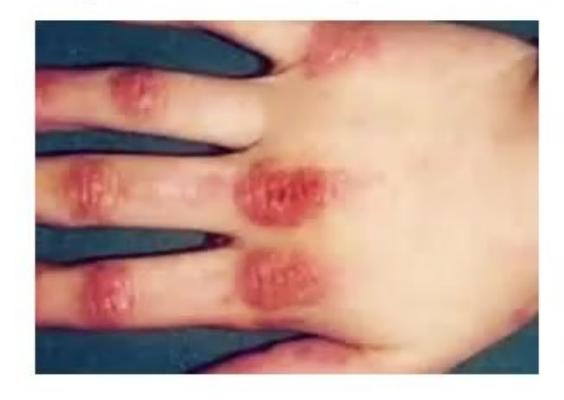
- What is probable diagnosis?
- What is sign shown in this picture? And what is presents over face?
- What serum enzyme level you will advice for diagnosis?
- What antibody present in serum?
- What drug use for these skin lesion with dose and side effect?
Answer
- Juvenile dermatomyositis
-
- Gottron papule at MCP joint, heliotrope rash over nose and per orbital area
-
- CPK, SGOT, LDH, aldolase
-
- Anti-RNP antibody
- Hydroxycloroquine 4–6 mg/kg/day per oral, side effect—retinal toxicity, color vision
MNJ22-010
A 9-year-old female child presents with complaints of fever, malaise, weight loss, headache and cloudication for last 2 months, on examination, child has high BP and low pulse. Angiography done that is shown below:
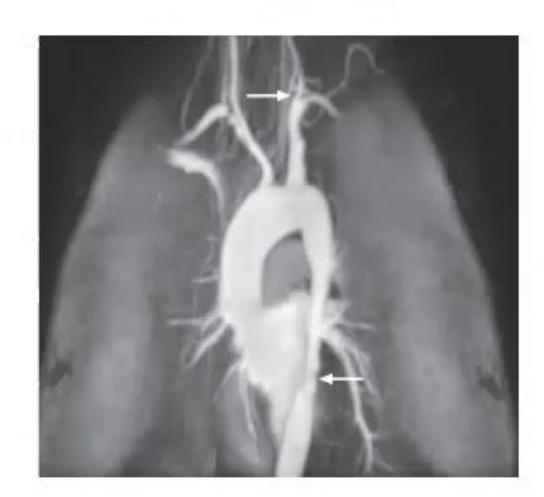
- Whats probable diagnosis?
- What is most common artery involve in this?
- What is criteria for diagnosis?
- What 1s prognosis?
Answer
- Takayasu arteritis or pulseless disease.
-
- Aorta
- Criteria for diagnosis of—decrease peripheral artery pulse/claudication BP difference in limbs >10 mm Hg bruit over the aorta hypertension.
-
- 20% has monophasic disease, but most suffer relapse.