MNJ36-001
Examine the abdomen of this child.
Answer
No model answer in source material.
MNJ36-002
Take the BP of this 10-year-old child and mention on the answer paper provided.
Answer
No model answer in source material.
MNJ36-003
Perform lumbar puncture on this 1-year-old child.
Answer
No model answer in source material.
MNJ36-004
A 13-year-old boy presented with ataxia. How would you examine his gait?
Answer
No model answer in source material.
MNJ36-005
Do motor system examination of the right hand of child?
Answer
No model answer in source material.
MNJ36-006
* Do volume assessment with a normal volunteer (volume depletion or overload)?
Answer
No model answer in source material.
MNJ36-007
* Administer MMR vaccine to this 16-month-old child.
Answer
No model answer in source material.
MNJ36-008
Do the musculoskeletal examination of this 8-year-old boy?
Answer
No model answer in source material.
MNJ36-009
Measure weight, length, head circumference of the newborn.
Answer
No model answer in source material.
MNJ36-010
* Kindly do the developmental assessment of this boy (4 years). Age of child is not given in exam *you should tell the examiner inlast.
Answer
No model answer in source material.
MNJ36-011
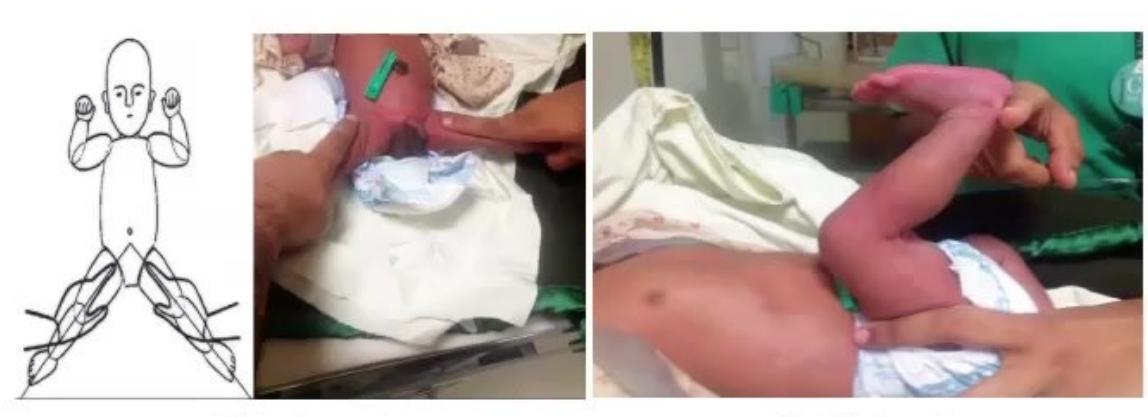
- Perform Amiel-Tison angle in baby
- Write down the normal Amiel-Tison angle.
- Whats use of examining these angles?
Answer
No model answer in source material.
MNJ36-012
- a Perform soft neurological sign.
- b Whatis use of this soft neurological sign.
Answer
No model answer in source material.
MNJ36-013
A child admitted in your hospital and suspected as a case of infective endocarditic. Do a focused examination of this child assuming his neurological examination is normal.
Answer
No model answer in source material.
MNJ36-014
Examine the child with hydrocephalus and do commentary while doing examination.
Answer
No model answer in source material.
MNJ36-015
Do palpation of the child for respiratory system examination (imagine a 5-10 years old child is standing in exam).
Answer
No model answer in source material.
MNJ36-016
A 12 years old child of Marfan syndrome is admitted in your unit. You found murmur while examine the child and ordered a echo. Echo reported as aortic regurgitation. Perform the physical signs of AR in this boy.
Answer
No model answer in source material.
MNJ36-017
A 13 years old child admitted with Jaundice. Perform the physical examination of liver failure in this child.
Answer
No model answer in source material.
MNJ36-018
Perform higher mental functions in this girl.
Answer
No model answer in source material.
MNJ36-019
Do focused clinical examination in this child for his motor and sensory component of 7th cranial nerve.
Answer
No model answer in source material.
MNJ36-020
Localize the dermatome segment from C2 to C8 and L1 to L5 in this child with your index finger and tell the sezment to examiner while touching the segment level.
Answer
No model answer in source material.
MNJ36-021
Examine 3 years old child with tremors.
Answer
No model answer in source material.
MNJ36-022
Examine § years old female child with short stature.
Answer
No model answer in source material.
MNJ36-023
Examine the inguinal, axillary and epitrochlear lymph nodes systems of 6 years old boy.
ANSWERS
-
Ans. 1. 1. Introduces and asks for permission
-
- Exposes the entire abdomen including genitals for inspection.
-
- 1st: Inspection—see size, shape, vein, lump, movement, distension.
-
- 2nd: Superficial palpation—temp, lump, tenderness, sinus, vein blood direction.
-
- 3rd. Deep palpation of liver and spleen, kidney.
- Assess the liver span by percussion and palpation.
- · Does bimanual palpation for kidney.
- · Examines genitalia.
-
- 4th: Auscultates for bowel sounds
-
- 5th: Percussion—performs shifting dullness +/- elicits fluid thrill.
-
- 6th: Examines back and anus
-
- 7th: Measure AG
-
- Covers the abdomen
-
- Thanks the mother/child
-
- Tell your finding to examiner
-
-
Ans. 2. 1. Introduce, rapport, keep the child calm.
-
- Explain the procedure to mother and child.
-
- Choose proper size cuff.
-
- Put the cuff 2-3 cm above the cubital fossa
-
- Inflate the reading 20-30 cm above the systolic (when sound stop).
- Deflate the cuff slowly.
-
- Note the reading on paper.
-
- Take in all 4 limbs until unless not ask to take in one limb.
-
- Palpatory and auscultatory methods.
-
- Check with WHO chart and put the reading.
-
- Help child to wear cloth.
-
- Thanks mother and child
-
- Tell the examiner the result
-
-
Ans. 3. 1. Introduces
-
- Explain to parents and consent
-
- Checks or asks for blood glucose level
- Keeps resuscitation equip ready
-
- Checks vitals and AF
-
- Universal precaution for self
-
- Clean/drape
-
- Identifies the site
-
- Sedation and position
-
- Local anesthesia
-
- Correct direction and "give way" mentioned
-
- Will send for cells/biochemistry/culture
-
- Post-procedure advise to mother
-
- Instructions to monitor this child
-
-
. Biowaste disposal
-
. Thanks the mother
-
. Introduces himself and establishes rapport with patent
- Takes permission to examine
- Undresses the child before exammnation
- No need to take history just examine
- Can patient walk at all does he walk in straight line does he tend to fall? On which side?
- Look for local cause—hip joint, knee joint, local pain in leg, pelvis spastic gait feet glued to ground, narrow base gait stamping gait—sensory ataxia drunken gait—cerebellar ataxia, other cerebellar signs waddling gait—feet apart, body sways, hip dislocation bilateral high stepping gait—avoid tripping weak extensor muscles, common peroneal nerve palsy.
- Thanks
Ans. 5. Introduces
-
Explain to parents and consent
-
Warms hand before examination (keep in mind-examine only right hand)
-
So A Bee oe Posture /tone—position of limb, shaking limb test
-
Nutrition (wasting—compare from left side), MUAC (1-6 years)
-
Power: Fingers /wrist/elbow /shoulder in all movements
-
Deep reflexes: Biceps, triceps, supinator
-
Coordination of movement of upper limb—finger nose test
-
Help the child to manage his cloth if you expose mght hand during examination
-
= Thanks the mother and child
-
. Introduction, rapport, expose the neck, abdomen, chest, hands
- . Assess tissue signs Check if the tongue and axallae are mosst; if they are, the patient 18 unlikely to be significantly volume depleted.
- . Check the ankles and sacrum for edema—its presence would suggest that the patient either 1s volume overloaded or has vascular leakage, which is allowing salt and water to escape into the tissues.
- . Examine the jugular venous pressure: Visible pulsation up to 2cm above the manubriosternal angle suggests the patent 1s normovolemic condition.
- uF Examine the arterial compartment. Measure the pulse and blood pressure with the patient lying flat Stand them up, then measure again after 2? minutes standing.
- Measure HR, RR, pulse
- Check: CRT >3 or <3 secs
- Skin pinch
- Thanks mother and child
- Tell the finding to examiner.
Introduces
-
. Explaim to parents about vaccine/cost/side effect
-
. Asks regarding any allergy in child
-
. Wash hands (otherwise you will loss the marks)
-
ah oe Take 2 ml syringe and needle to withdraw diluent and mix it with the lyophilized powder.
-
Changes the needle
-
Identify the site. Anterolateral thigh, middle one-third
-
Clean the site without spirit
-
Correct direction (at 45 degree angle)
-
Withdraw and press at the injection site
-
. Post-procedure advise to mother
-
. Instructions to wait 30 mins and inform on case of problem
-
. When to come for the next dose, proper documentation.
-
. Biowaste disposal (very important)
-
. Thanks the mother
-
. Introduction and rapport, permission for examination
- . Inspection—observe child sit, stand, walk looks and reports obvious abnormalites in gait, muscle
- . Palpation—swelling tenderness deformities, abnormal curvatures in spine
- Range of movements in major joints of UL and LL.
- Spine—inspection, palpation of spine, forward bending (touching toes without bending knees) assess flexion, extension, lateral flexion, rotation.
- Reflex—do DTR in upper and lower limbs.
- Pee ee Me Reporting impression to examiner
- Thanking child and parents
-
Ans. 9. Introduction and rapport
- Check all instrument you need, if anything missing than demand for that.
- See all the chart available, if not than demand for that
- Take permission for examunation to mother, washes hands (must)
- * Weight—removes cloth adjusts, removes parallax, reports weight to examiner (minimum cloth as need according to temp).
- * Length—head to movable end at feet, reports L to examiner.
- * HC—alwaysin last as HC measurement can irritate the baby uses nonstretchable tape, covers areas of max protuberance of occiput and point just above glabella, reports to examiner
- * Thanking mother
- * Check your reading with chart**
- * Tell the examiner about result in way of percentile
Ans. 10. 1. Introduction, rapport
-
. Gross motor
- * Walks up and down staurs by alternate feet
- * Hops on one feet
- * Throws ball overhead
-
. Fine motor:
-
* Draws a man with 2—4 parts besides head
-
* Copies a square
-
* Cube-make bridge
-
* Tells a story
-
* Knows three colors
-
* Gives an account of recent experience and events
-
* Washes face, feet and brushes teeth.
-
-
Ans. 11.1. **Amiel-Tison angles are very important for exam (asked many time in exam)
-
- We do these angles testing in baby age 0-12 months.
-
- These angles testing useful in assessment of neurodevelopement of baby.
-
Adductor angle Popliteal angle
| Age | Adductor angle | Foot dorsiflexion | Popliteal angle | Scarf sign |
|---|---|---|---|---|
| (+3months | 40-80 degree | 60-70 degree | 80-100 degree | Not cross midline |
| 46 m | 70-110 | 60-70 | 100-120 | Cross midline |
| 7-9 m | 110-140 | 60-70 | 120-150 | Goes beyond axillary line |
| 10-12 m | 140-160 | 60-70 | 1504-170 | Same |
Ans. 12. (a) Soft neurological signs
-
· Tell child to undress any cloth
-
· Tell child to dress that cloth again
-
· Tell child to do any alternative movement—supination-pronation
-
Special sense testing—touch the baby at palm after closing the eye and ask him that what body part you touched.
-
Orientation of space—tell child to make imaginary figure in space with index finger and thumb
(b) Soft neurological sign useful in diagnosis of: (1) Cerebral palsy and (2) ADHD
Ans. 13. *Do commentary while doing examination
-
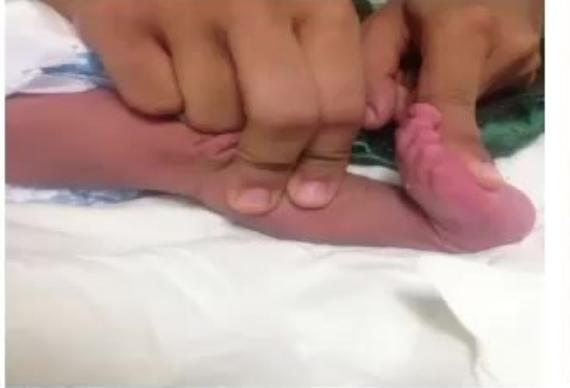
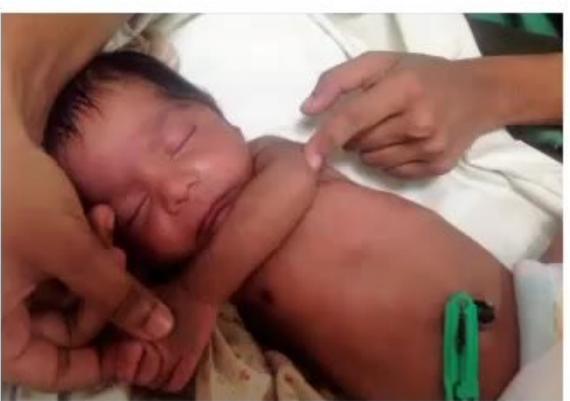
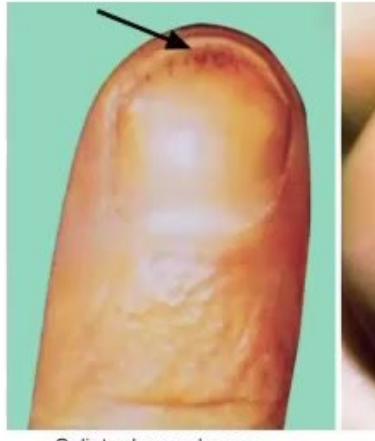
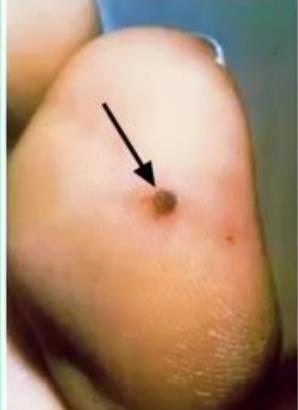
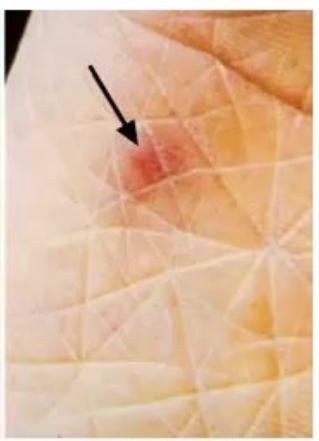
See petechiae over body, splinter hemorrhage at subungual area, osler nodes over pads of digits, janeway lesion over palm and sole, Conjunctival hemorrhage
-
See sign of CHF-hepatomegaly, tachycardia, tachypnea, Enlarge neck veins, edema over legs
Janeway lesion
- Ans. 14.1. Greet, introduce with parents and take permission for examination
-
- Take permission and undress the child appropriately
-
- Head circumference measurement and plot that on chart and tell the percentile
-
- Palpate the suture lines-open
-
- Dilated scalp veins: The scalp is thin and shiny with easily visible veins.
-
- Palpate the anterior fontanelle-tense and open, take the measurement and tell the
- Setting-sun sign: Ocular globes are deviated downward, the upper lids are retracted, and the white sclera may be visible above the iris.
-
- Increased limb tone: Spasticity preferentially affects the lower limbs.
-
- Fundus examination for-Papilledema
-
- Macewen sign: "cracked pot" sound is noted on percussion of the head
-
- Look for Unilateral or bilateral sixth nerve palsy is secondary to increased ICP.
- Check reflexes may be increased, and the Babinski response may be found in one or both feet
-
- Examine the back for any maningocele or other finding
-
- Loom for any neurocutaneous marker like cafe au lait spot
-
- Thanks the parents and help the child to get dressed again
-
- Tell your finding to examiner
-
- Thanks
-
Ans. 15. *Do commentary while doing examination
- First inspect the child chest wall from front and back (because inpalpation be conform the inspection finding).
Maximal inhalation
Exhalation
Maximal inhalation
- Tactile vocal fremitus: Place both hands on either side of chest, now ask the child the counts number hke 91,91, 91....feel the vibration on both side with your hands and assess asymmetry, if any.
- . Get dress the child properly
Ans. 16. *Do commentary while doing exarmnation
-
Greet, introduce and ask about the language
-
Take permission of undressing with parents/child
-
Tell the child that you will do examination without any harm to him
-
Look for pulse and see water hammer pulse is present or not
-
Hill sign: Take BP of both upper and lower limb. Hill sign 1s positive if lower lamb BP 2 upper hmb by 15 mmHg.
-
Pistol shot sign: Auscult bracheal and femoral pulse by the bell of the stethoscope.
-
Landolfi sign: Look for pupils on both side and see the Rhythmue dialation and contrachon.
-
. Corrigan sign: Inspect both carotids and see the dancing carotids
-
. DeMusset sign: Look for head nodding with each cardiac cycle
-
. Light house sign: Look for flushing of the face with each cardiac cycle
-
. Quincke sign: Feel the pulsation with your finger on nail bed of the child.
-
. Rosenbach sign: Palpate the liver, if enlarge then hold you fingers there and feel the pulsation.
-
. Gerhardt sign: Palpate the spleen, if enlarge then hold you fingers there and feel the pulsation.
-
Muller sign: Open the child mouth and inspect the pharynx. Look for uvular pulsation.
Ans. 17. *Do commentary while doing examination
Ans. 18. *Do commentary while doing examination
-
General behavior and appearance: Talk with the child about her name, habits, school, games and observe is she is interested in answering and look for her activity, body language, eye contact.
-
Attention span: Tell the child that I am going to say some numbers. Listen carefully
and repeat after me. Tell her 3, 5, 7, 9 (child age should be more than 6 years to
perform this). -
Speech and language: Comment on her speech volume, articulation and understanding of language while interecting with her. Ask the child some basic questions like open your mouth, watch the pen and ask her to name that.
-
Memory: Immediate, recent and remote. Ask her to repeat number will give idea
of immediate number. Ask her what did you have for lunch today, this will give
you idea of recent memory. For remote memory ask her that what you done on
last Diwali.
Ans. 19. *Do commentary while doing examination
Motor system
- Inspection: Examine the facial symmetry at rest and during talking, smiling. Look for folds in the forehead, eyelid position Look for symmetry of nasolabial folds bilaterally. Look for angle of mouth.
Sensory testing
Ask the child to protruded the tongue and instruct him that he should only raise his hand or can write on paper when taste is perceived. Now take a stick (ear bud)
-
coated with sweet, salt, bitter and sour and put then on dorsal surface of anterior and middle two-thirds of tongue Taste should be checked bilaterally. Rinsed the mouth everytime between each testing Bitter should be tested in the end.
-
Tell your finding to examiners and make a final interpretation about the nerve palsy, which type (LMN/UMN) or normal.
Ans. 20. *Do commentary while doing examination
- Tell the child that I will touch you with my index finger at your different parts of body so be comfortable and tell me if you have any problem Undress the child after taking permission.
Ans. 21. First 30 sec think possible D/Ds which can have tremors in 3 years old child
- Nebulisation with asthalin
- · Hypoglycemia
· Cerebellar disorder
- · Metabolic encephalopathy
- Greet and obtain consent from parent and explain child.
Ans. 22. First think of DDs
-
Farmilial short stature * Consttutional
-
Syndromic « GHD
-
Hypothyroidism . Cushings syndrome
-
Nutritional * Chronic diseases
-
Zz First take anthropometric measures or make an attempt to prove it as short stature, also ask for parents height and previous height records.
-
US: LS ratio affected (skeletal dysplasias, hypothyroidism)
-
Short stature with obesity is always endocrinal or syndromic and never nutritional
-
Vitals-PR-(low in hypothyroidism), RR
-
BP-(affected in cushings, CRF)
-
Se oe Dysmorphic features (genetic syndromes)
-
Midline detects like cleft palate, micropemis, single central incisor-Grow th hormone deficiency
-
Webbed neck, wide spaced nipples with increased carrying angle in female child-Turners syndrome
-
. Coarse skin, neck swelling-Hypothyroidism
-
. Jaundice, spider nevi, bleeding tendancies-Chronic liver failure
-
. Purplsh stnae, central obesity, buffalo hump,proximal muscle weakness- Cushings
-
. Signs of vit deficrencies-Malabsorption, Rickets.
-
. CN5-Low intelligence-hypothyroidism
-
. Delayed relaxation of tendon jerks-hypothyroidism
-
. R5-Pattern of breathing-acidotic in metabolic acidosis.
-
. GIT-palpate for liver and look for fluid
-
. Thanks parents
-
. Tell your findings to examiner
-
Greet and obtain consent from parent and explain child
- . Wash hands thoroughly and dry them
- . Exposure: Instruct the patient to remove all clothing covermg the examination areas
- , Lymph nodes in the inguinal region
- * Fully expose the inguinal region
- * Lay supine
- * Flex the contra-lateral knee
- * Palpate above and below the inguinal ligament
- * Examine both sides and note your findings on paper
- . Lymph nodes in the examination in axilla
- * With the patients arm adducted, rest his/her left forearm on your right forearm
- * Insert your nght hand into the patent's left axilla
- * Slide the fingers against the chest wall
- * Palpate the anterior axillary fold
-
* Palpate the lateral axillary wall, using the tips of your fingers, use the left hand for the patient's left side With the palm directed laterally against the upper end of the humerus, palpate for the lymph nodes
-
* Palpate the postenor axillary fold from behind
-
. Epitrochlear lymph node examination
- * Place the patient's elbow in a sermflexed position
- * For examining the right side, pur your right palm over the posterior aspect of the patient's nght elbow Do the opposite when examining the left side.
- * Using the thumb for palpation, roll the epitrochlear lymph node agamst the bone in an antro-posterior direction
-
Describe your finding to examiner 1n following poits: Location, diameter in cm, character (firm, rubbery), fix or non-fix, overlying erythema and tenderness
-
. Any node > 1 cm can be sigmificant but epitrochlear lymph node > 5 cm, inguinal lymph node > 1.5 em and cervical > 1 cm significant Tell the finding to examiner accordingly.
-
. Get dressed the child and thank him.




- Exposes the entire abdomen including genitals for inspection.
- 1st: Inspection—see size, shape, vein, lump, movement, distension.
- 2nd: Superficial palpation—temp, lump, tenderness, sinus, vein blood direction.
- 3rd. Deep palpation of liver and spleen, kidney.
- 4th: Auscultates for bowel sounds
- 5th: Percussion—performs shifting dullness +/- elicits fluid thrill.
- 6th: Examines back and anus
- 7th: Measure AG
- Covers the abdomen
- Thanks the mother/child
- Tell your finding to examiner
- Explain the procedure to mother and child.
- Choose proper size cuff.
- Put the cuff 2-3 cm above the cubital fossa
- Inflate the reading 20-30 cm above the systolic (when sound stop).
- Note the reading on paper.
- Take in all 4 limbs until unless not ask to take in one limb.
- Palpatory and auscultatory methods.
- Check with WHO chart and put the reading.
- Help child to wear cloth.
- Thanks mother and child
- Tell the examiner the result
- Explain to parents and consent
- Checks or asks for blood glucose level
- Checks vitals and AF
- Universal precaution for self
- Clean/drape
- Identifies the site
- Sedation and position
- Local anesthesia
- Correct direction and "give way" mentioned
- Will send for cells/biochemistry/culture
- Post-procedure advise to mother
- Instructions to monitor this child
- Tell your finding to examiner* (otherwise you will not get the marks)
- Language
- Social:
- Age of this child is around 4 years always tell the examiner
- We do these angles testing in baby age 0-12 months.
- These angles testing useful in assessment of neurodevelopement of baby.
- Introduction, rapport
- Take permission
- Fine motor coordination—finger tapping on table
- Laterality testing—ask the child about which is right hand, left toe, right ear
- Foot tapping—tell child to tap the foot on ground alternatively.
- Hopping—if child age is >4 years old than tell him to hope.
- Thanks to mother
- Greet, introduce and ask about the language
- Take permission of undressing with parents/child
- Tell the child about that you will do examination with any harm to him
- See the general condition of child, any rash over body
- See pallor over conjunctiva
- Take temp with thermometer-fever +/-
- Palpate spleen-+/-
- Auscultation of chest rales+/-, pleural rub
- Auscultation of heart sounds- gallop, pericardial rub, murmur
- See the joint movement if painful
- **Help the child to get dressed again (MUST)
- Thanks to child and parents
- Tell your finding to examiners
- Take permission and undress the child appropriately
- Head circumference measurement and plot that on chart and tell the percentile
- Palpate the suture lines-open
- Dilated scalp veins: The scalp is thin and shiny with easily visible veins.
- Palpate the anterior fontanelle-tense and open, take the measurement and tell the
- Increased limb tone: Spasticity preferentially affects the lower limbs.
- Fundus examination for-Papilledema
- Macewen sign: "cracked pot" sound is noted on percussion of the head
- Look for Unilateral or bilateral sixth nerve palsy is secondary to increased ICP.
- Examine the back for any maningocele or other finding
- Loom for any neurocutaneous marker like cafe au lait spot
- Thanks the parents and help the child to get dressed again
- Tell your finding to examiner
- Thanks
- Greet, introduce and ask about the language
- Take permission of undressing with parents/child (undress only shirt)
- Tell the child that you will do examination without any harm to him
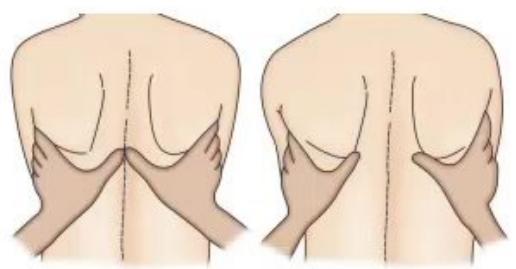
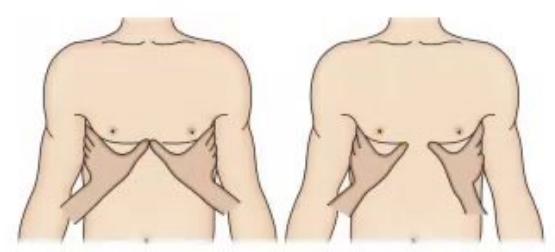
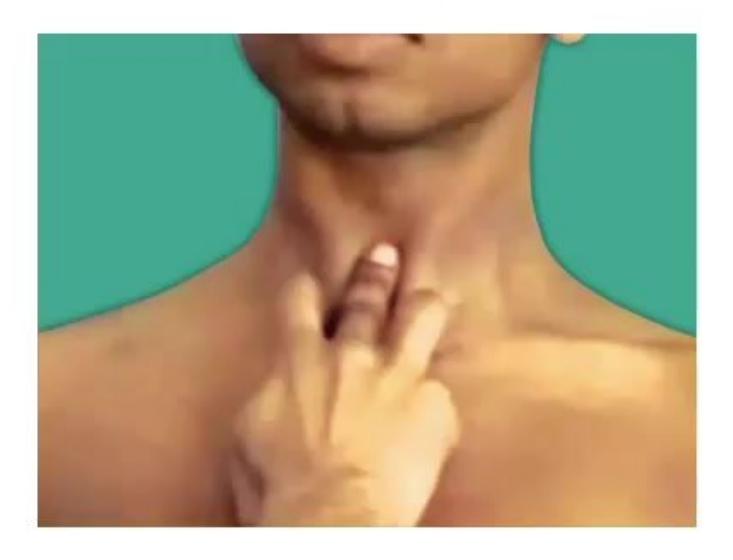
- Chest expansion: Place your palms on either side of thorax at the level of nipples and gently apposing the thumbs in midline. The thumb sepate during inspiration and this gives an approximate estimation of the degree of chest expansion. Use a tape to measure the expansion (normal 3–5 cm) (see image below for front and back chest expansion).
- Thanks to child and parents
- Tell your finding to examiners
- Get dress the child properly
- Thanks to child and parents
- Tell your finding to examiners
- Greet, introduce and ask about the language
- Take permission of undressing with parents/child
- Tell the child that you will do examination without any harm to him
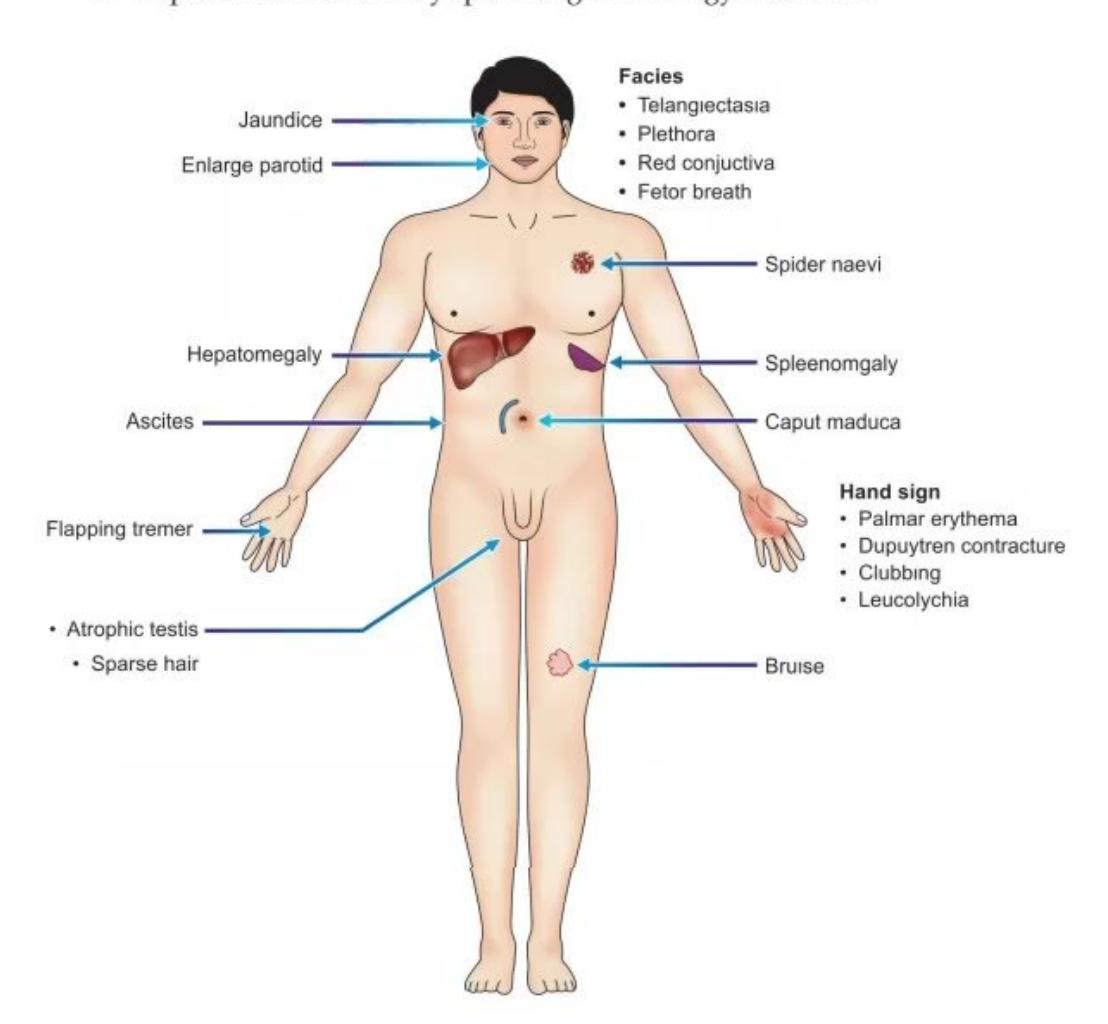
- Look at sclera and comment on Jaundice
- Look at both palm and see the erythema. Palmer erythema
- Talk with child and comment on his mental status
- Ask the child to make any imaginary letter in air with his finger
- Look bilateral parotid area for any swalling
- Inspect chest wall for any spider angioma and gynecomastia
- Palpate the liver and spleen and comment if enlarge
- Inspect hand for clubbing, dupuytren's contractures and white color of nails
- Inspect genital area for any testicular atrophy and spars pubic hair
- Ask the child to stretch his hand and look for flapping tremers
- Get dress the child properly
- Thanks to child and parents
- Tell your finding to examiners
- Greet, introduce and ask about the language
- Orientation: Ask about her date of birth, which season, month and year is this, aks her school, mother, father and friends name.
- Intelligence: Give some numbers for calculation like, add 4 + 6, 10 + 7.
- Add some other points if you want.
- Thanks to child and parents
- Tell your finding to examiners
- Examination: Ask the child to wrinkle his forehead by looking upwards (comment is he able to make wrinkle–for frontalis muscle). Ask the child to close his eyes while you attempts to open to them. If orbicularis occuli is paralyzed; child is not able to clsoe the eyes. Ask the child to hold water in his mouth, if water escapes through affected side suggest paralysis of buccinator. For levator anguli oris ask the child to show her teeth, if there is paralysis the facted side would not move out as the normal side.
- Thanks to child and parents
- Greet, introduce and ask about the language
- C2: Touch your index finger at occiput
- C3. Touch your index finger at ear
- C4: Touch your index finger at spine of scapula
- C5. Touch your index finger at lateral side of upper arm
- C6. Touch your index finger at lateral side of forearm and thumb
- C7 Touch your index finger at index and middle finger
- C8: Touch your index finger at ring and little finger
- L1: Touch with index finger at inguinal region
- L2. Touch with index finger at upper anterior thigh
- L3. Touch with index finger at knee
- L4. Touch with index finger at great toe
- L5. Touch with index finger at lateral side of dorsum of foot
- Get dress the child fully
- Thanks to child and parents
- General exam for titubations/swaying/tremors/nystagmus/other associated abnormal involuntary movements
- Look for sensorium-agitated-Asthama, CO2 retention
- Dull-metabolic encephalopathy
- Vitals-PR/RR-tachypnea in asthama/BP.
- Skin-for neuro cuteneous markers/signs of liver cell failure.
- CNS-all cerebellar signs/tone/power/reflexes/speech/gait
- RS-air entry-asthama
- Pattern of breathing-acidotic in metabolic acidosis.
- GIT-palpate for liver and look for fluid
- Thanks parents
- Tell your findings to examiner
- Greet and obtain consent from parent and explain child
- Tell your finding comprehensively to examiner.
Answer
No model answer in source material.