THG02-001
Growth chart of a child on follow-up in the growth clinic is presented here.
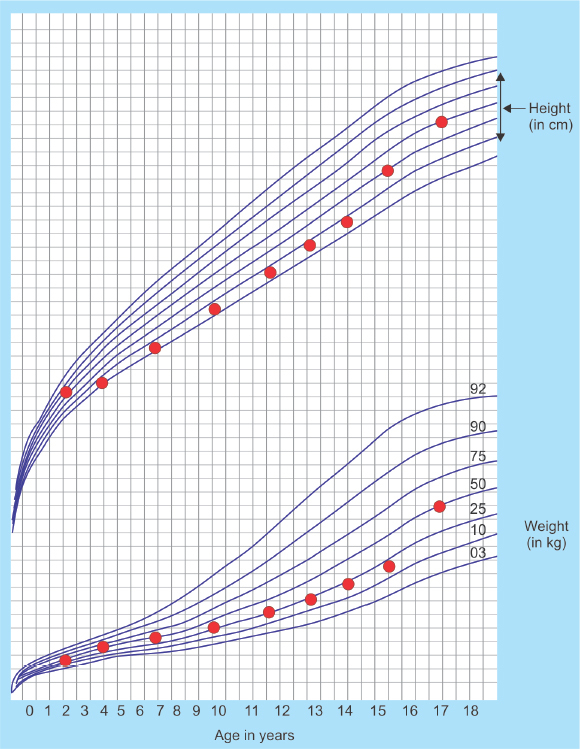
a. What is your diagnosis based on growth chart?
i. Growth hormone deficiency
b. What is the birth weight and birth length of the child in this condition?
i. Normal
c. How would you describe the growth of this child in childhood years?
i. Persistent deceleration
d. How is the growth spurt anticipated in this child?
i. Normal
e. How is the skeletal maturity of this child expected?
i. Normal
f. What is the age of preferred testosterone replacement?
i. 13 years
Answer
| a. | Constitutional delay of growth and puberty |
| b. | Normal |
| c. | Sustained close to the 3rd percentile |
| d. | Delayed |
| e. | Delayed by 2 years |
| f. | 14 years |
For your knowledge:
What is the cause/physiological basis of this condition?
| • | Persistent hypogonadism state of childhood |
| • | Measurement of insulin-like growth factor-1 (IGF-1) is low for chronological age (CA) and normal for bone age (BA) |
THG02-002
List eight Food and Drug Administration (FDA) approved indications for growth hormone.
Answer
| 1. | Growth hormone deficiency |
| 2. | Turner syndrome |
| 3. | Idiopathic short stature |
| 4. | Chronic renal failure (before transplantation) |
| 5. | Small for gestational age with short stature |
| 6. | Prader–Willi syndrome |
| 7. | SHOX gene defect |
| 8. | Noonan syndrome |
THG02-003
Answer the following questions on Growth Hormone?
a. What is the weekly dose of this medication in mg/kg/week?
b. What is the daily dose of this medication in µg/kg/day?
c. What is the route of administration of this drug?
d. What is the frequency of administration of this drug?
e. What is the biomarker of adherence to this drug?
f. Mention the skeletal age up to which this drug causes growth augmentation in males.
g. Mention the skeletal age up to which this drug causes growth augmentation in females.
h. Which year of therapy has maximum auxological response?
i. Mention any two side effects of this drug.
Answer
| a. | 0.16–0.24 mg/kg/week |
| b. | 22–35 µg/kg/day |
| c. | Subcutaneous |
| d. | Once a day |
| e. | IGF-1 |
| f. | 16 years |
| g. | 14 years |
| h. | First year |
| i. | Type 2 diabetes mellitus, slipped capital femoral epiphyses, gynecomastia, scoliosis, and pseudotumor cerebri |
THG02-004
A 10.5-year-old child with height <1st percentile, bone age (BA) 1 year and the below finding:
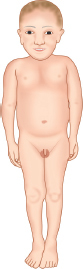
a. Mention the likely diagnosis.
b. How is the weight for height in this child expected to be?
c. How does one expect the voice of this child to be?
d. Mention any two associated endocrine deficiencies that may be associated?
e. How is the IQ of this child expected to be: normal or subnormal?
f. Mention any two neonatal features of this condition.
g. Mention two biochemical screening tests to diagnose this condition.
Answer
| a. | Hypopituitarism, growth hormone deficiency |
| b. | Normal |
| c. | High pitched |
| d. | Cortisol deficiency, thyroxine deficiency, gonadotropin deficiency |
| e. | Normal |
| f. | Hypoglycemia, neonatal cholestasis |
| g. | IGF-1, IGFBP-3 (insulin-like growth factor-binding protein 3) |
THG02-005
A 10-year-old girl presents in the growth clinic with height of 100 cm and weight of 25 kg. BA assessment done shows 2 years.
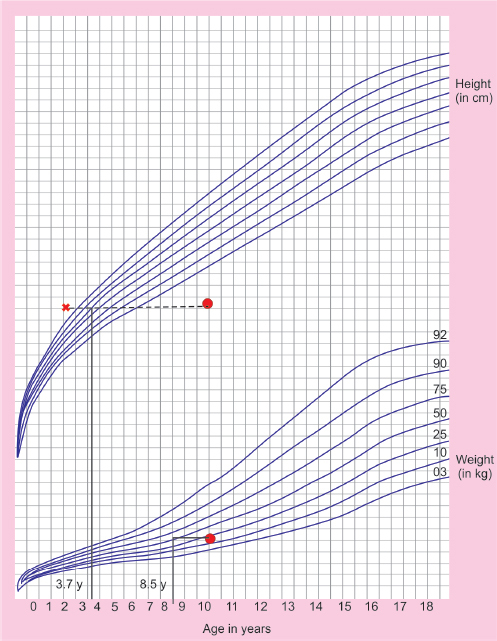
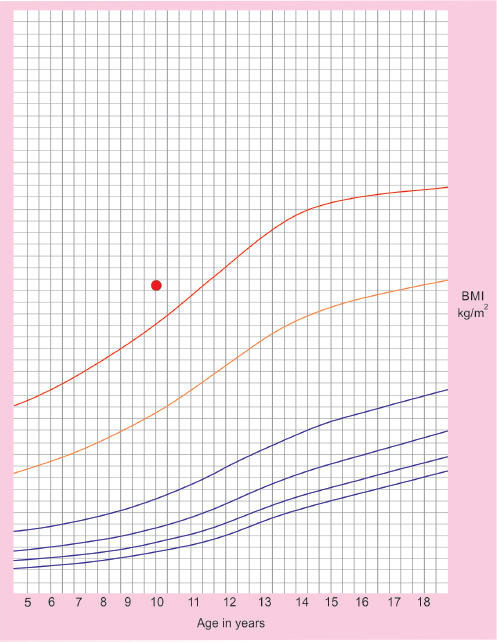
a. Plot the height and weight on the growth chart.
b. Calculate body mass index (BMI) and plot the BMI on the growth chart.
c. Calculate the weight age (WA).
d. Calculate the height age (HA).
e. Plot the BA.
f. Arrange chronological age (CA), HA, WA, and BA in chronological order.
g. Provide any two differential diagnoses for this girl.
Answer
| a. | Plotted as a dot as depicted above |
| b. | BMI is 25 kg/m2 and plotted as above |
| c. | Weight age = 8.5 years |
| d. | Height age = 3.7 years |
| e. | Bone age plotted as above using a cross and joined with a dotted line to the height plot |
| f. | CA > WA > HA > BA |
| g. | Endocrine short stature—growth hormone deficiency, hypothyroidism, and Cushing’s syndrome |
THG02-006
A 10-year-old female child presents with a known case of type 1 diabetes mellitus on insulin therapy. The summary of growth parameters is as below:
a. Calculate the growth velocity.
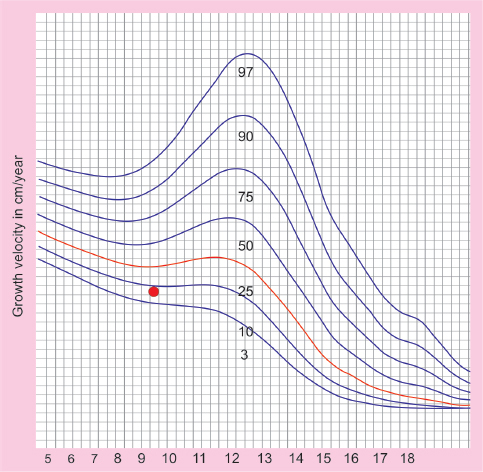
b. Plot the growth velocity on the growth velocity chart provided.
c. Interpret the plot on the growth velocity chart.
d. Mention two causes for the same.
Answer
| a. | Growth velocity 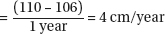 |
| b. | Plot the growth velocity on the midpoint of the two points: 4 cm should be plotted at 9.5 years |
| c. | As the growth velocity if <25th percentile, it is abnormal growth velocity. |
| d. | Causes: Celiac disease, hypothyroidism, and poor glycemic control |
THG02-007
State whether the following are true or false (pertaining to Tanner stage).
a. Pubarche appears 6–12 months after onset of thelarche in girls.
b. Menarche in girls usually occurs 2–2.5 years after onset of thelarche.
c. Pubarche precedes the growth of penis in boys.
d. Axillary hair appears during late puberty in boys.
e. Thickening of scrotum is a sign of puberty in boys.
f. Growth acceleration is observed during Tanner stage 2 in boys.
Answer
| a. | True |
| b. | True |
| c. | False (pubarche usually follows the growth of penis in boys) |
| d. | False (axially hair appears during midpuberty in boys) |
| e. | False (thinning of scrotum is a sign of puberty in boys) |
| f. | False (growth acceleration is observed during Tanner stage 4 in boys) |
THG02-008
A tool is provided below. Please answer the following questions:
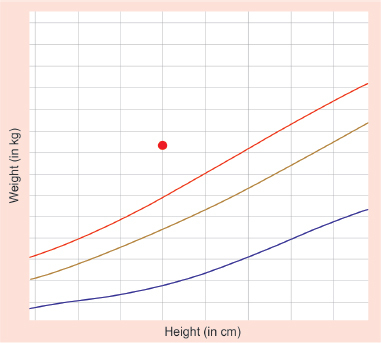
a. Identify the tool that is provided.
b. What is the starting age the tool can be used?
c. Is the tool gender specific or gender neutral?
d. A 10-year-old girl has a height of 145 cm and 65 kg. Please plot it on the tool.
e. What is your interpretation of the plot on the chart?
Answer
| a. | BMI look up tool |
| b. | 8 years |
| c. | Gender-specific (separate tool for boys and girls) |
| d. | Plot as depicted at the point of intersection of weight on the Y-axis and height on the X-axis |
| e. | Obesity |
THG02-009
Fill up the blanks:
a. ________ depicts the position of the child in the reference population.
b. An equivalent percentile for a Z-score of 0 is _____ percentile.
c. The percentile of 97.2 is equivalent to a Z-score of _______.
d. BMI below the 3rd percentile in a 7-year-old child is termed: __________.
e. A weight for height Z-score of +2.3 in a 3-year-old child is classified as ___________.
f. Weight for age Z-score of -3.8 in a 2-year-old child is classified as ______________.
g. BMI above _____________ is termed as obesity in a 10-year-old child.
h. Rapid crossing of _____ major percentiles rapidly warrants evaluation.
Answer
| a. | Percentile |
| b. | 50th |
| c. | +2 |
| d. | Thinness |
| e. | Overweight |
| f. | Severe underweight |
| g. | 27th adult equivalent |
| h. | Two |
THG02-010
Match the following:
| Formula | Diagnosis |
|---|---|
| a. CA > HA > WA = BA | 1. Precocious puberty |
| b. CA > WA > HA > BA | 2. Nutritional deprivation |
| c. WA > HA > BA > CA | 3. Endocrine short stature |
| d. WA > CA > HA > BA | 4. Nutritional obesity |
| e. BA > HA > WA > CA | 5. Nonnutritional obesity |
Answer
| Formula | Diagnosis |
|---|---|
| a. CA > HA > WA = BA | 2. Nutritional deprivation |
| b. CA > WA > HA > BA | 3. Endocrine short stature |
| c. WA > HA > BA > CA | 4. Nutritional obesity |
| d. WA > CA > HA > BA | 5. Nonnutritional obesity |
| e. BA > HA > WA > CA | 1. Precocious puberty |
THG02-011
A 10-year-old girl child with short stature and this clinical finding:
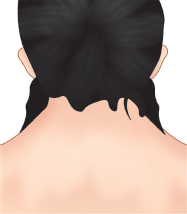
a. Identify the clinical finding.
b. Name the likely diagnosis.
c. Name the most common cardiac condition in this girl.
d. Name the most common autoimmune disorder in this girl.
e. Name one renal disorder that can be associated with the child.
f. Name the starting dose of transdermal estrogen for this girl.
g. Name two drugs that can be given to improve the stature.
Answer
| a. | Webbing of neck |
| b. | Turner syndrome |
| c. | Bicuspid aortic valve |
| d. | Hypothyroidism |
| e. | Horseshoe kidney, unilateral renal agenesis, pelviureteric junction obstruction, double collecting system |
| f. | 6.25 µg |
| g. | Growth hormone, oxandrolone |
THG02-012
An 8-year-old girl with: Height: 117 cm, Weight: 18 kg, Mother’s height: 150 cm, Father’s height: 163 cm.
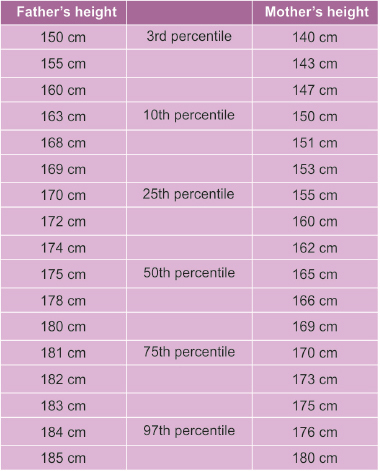
a. Identify the tool above.
b. Calculate the target height.
c. Mention the target range.
d. Calculate the midparental height (MPH) percentile using the above tool.
e. The girl is at the 10th percentile of height on Indian Academy of Pediatrics (IAP) charts. Does this child warrant any intervention?
f. How many percentile line discrepancies between target height and child’s height are considered as significant?
Answer
| a. | Midparental height percentile calculator |
| b. | 150 cm |
| c. | Target range = 143.5–156.5 cm |
| d. | 10th percentile |
| e. | No intervention needed |
| f. | Two major percentile line discrepancy are considered as significant |
THG02-013
A 10-year-old boy is assessed for growth: Height is 122 cm and weight is 55 kg. BA is 4 years. Answer the following questions:
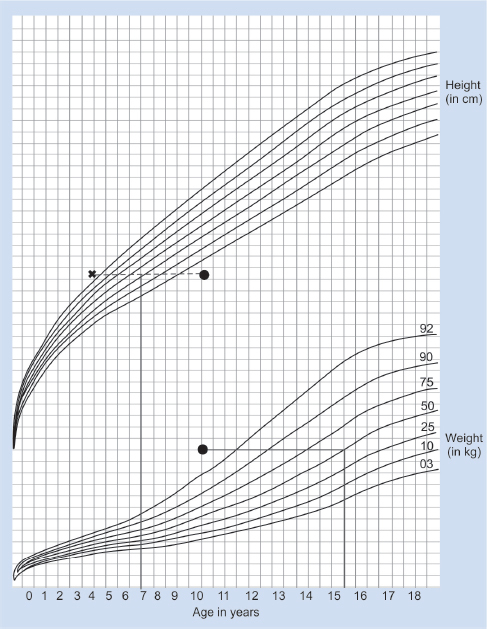
a. Plot the height and weight.
b. Calculate the BMI.
c. What is the HA?
d. What is the WA?
e. Plot the BA on the growth chart.
f. Arrange the CA, HA, WA, and BA in ascending order.
g. What is your diagnosis?
h. Mention one differential diagnosis for this boy.
Answer
| a. | Plotted as above |
| b. | BMI = 36.9 kg/m2 |
| c. | Height age is 7 years. |
| d. | Weight age is 15.6 years. |
| e. | Plot as a cross at the point of intersection of 122 cm and 4 years and join with a dotted line to the height plot |
| f. | BA < HA < CA < WA |
| g. | Endocrine obesity |
| h. | Differential diagnosis: Cushing’s syndrome, growth hormone deficiency, and hypothyroidism |
THG02-014
A 5-year-old child presents with tall stature. His Tanner stage is testes 3 mL (right), 3 mL (left), Tanner stage 4 genital stage, pubic hair Tanner stage 4. Bone age assessed by Greulich and Pyle atlas is advanced—11 years.
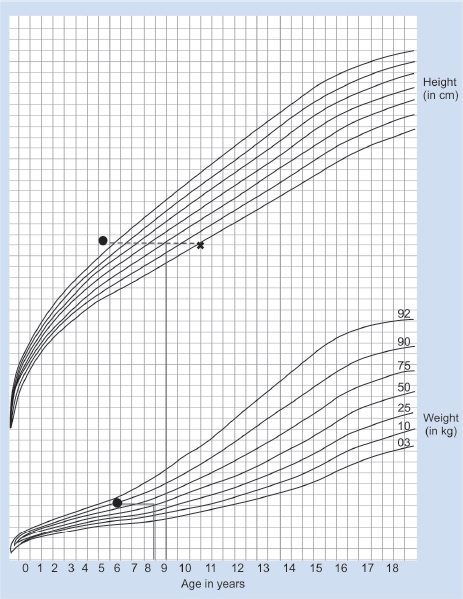
a. What is your diagnosis?
b. Mention two clues to your diagnosis from the growth chart.
c. Mention two clues to your diagnosis from the Tanner’s stage.
d. What is the method to estimate final height in this method of BA assessment?
e. The estimated final height will be higher than the target height in this boy—true or false.
Answer
| a. | Precocious puberty |
| b. | Tall stature, advanced BA, BA > HA > WA > CA |
| c. | Onset of genital enlargement below 9 years, onset of pubic hair before 9 years |
| d. | Bayley-Pinneau table |
| e. | False |
THG02-015
Fill up the table with appropriate terminologies and diagnosis:
Proportionate short stature, short-limbed dwarfism, short-trunk dwarfism, achondroplasia, growth hormone deficiency, and mucopoly-saccharidosis
| US:LS ratio | Terminology | Example |
|---|---|---|
| 3 years male with ratio of 1.9:1 | ||
| At birth with 1.1:1 | ||
| 6 years with 1.2:1 | ||
| (US:LS: upper segment: lower segment) |
Answer
| US:LS ratio | Terminology | Example |
|---|---|---|
| 3 years male with ratio of 1.9:1 | Short limb | Achondroplasia |
| At birth with 1.1:1 | Short trunk | Mucopolysaccharidosis |
| 6 years with 1.2:1 | Proportionate | Growth hormone deficiency |
Figure Sources
Figures of Q2.1, Q2.4, Q2.5, Q2.8, Q2.11, Q2.13 and Q2.14 are redrawn by artist.