VVK14-001
Designing of Pediatric ICU's in India- IAP-Recommendations
a. What is the recommended noise level during daytime?
b. What is the recommended noise level during night time?
c. What is the recommended floor area per patient?
d. What is the recommended minimal distance between two bed center?
e. What is the ideal bed strength for economic viability of each PICU?
f. What is the Ideal and minimal nurse to patient ratio?
Answer
- a. Should not exceed 40 dB
- b. Should not exceed 20 dB
- c. 200 sq feet
- d. Minimum 3m
- e. 8–12 beds
- f. 1:1, 1:2.
VVK14-002
a. How do you classify dental fracture?
b. A child falls and knocks out his front tooth. How would the treatment differ in a 4 year old and 14 year old?
c. Enlist 3 mediums to transport avulsed tooth.
Answer
- a. Ellis Class 1: Fracture involving enamel
- Ellis Class 2: Fracture involving enamel and dentin
Ellis Class 3: Fracture involving enamel, dentin and pulp
- b. 4 year old: no attempt of reimplantation 14 year old: Reimplantation as soon as possible
- c. Hank's Solution
Milk
Underneath patients tongue- provided patient is able to keep from aspiration.
VVK14-003
| Site of sample collection |
Earliest gestation age to perform the test |
|
|---|---|---|
| CVS or CVB | ||
| Amniocentesis | ||
| Cordocentesis |
Answer
| Site of sample collection |
Earliest Gestation age to perform the test |
|
|---|---|---|
| CVS or CVB | Small piece of placenta | 11 weeks |
| Amniocentesis | Amniotic fluid | 15 weeks |
| Cordocentesis | Fetal blood | 18 weeks |
VVK14-004
Yes/No
a. In general, do minor have the right to give consent for their own treatment?
b. In an emergency, is it necessary to obtain consent in order to treat a child?
c. Can a child who lives away from home, is no longer subject to parental control, is economically self-supporting
d. Can a child who is sufficiently mature to understand the nature of his/ her illness and the potential risks and benefits of proposed therapy, give or refuse consent to treatment?
e. May Jehovah's witness parents refuse blood transfusion for their minor children?
Answer
- a. No
- b. No
- c. Yes
- d. Yes
- e. No
VVK14-005
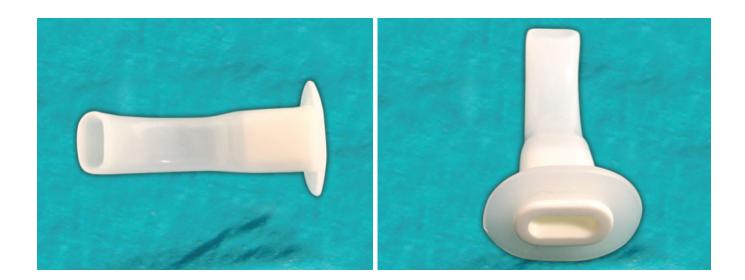
a. What is the device shown?
b. What is the usage of device?
c. How is the correct size measured?
d. How do you insert the device?
e. Enlist 2 complication associated with the usage of the device.
Answer
- a. The Guedel airway
- b. Maintain a patent airway
- c. Size is equal to distance between the lips (or incisors) and the tip to the angle of the jaw
- d. Inserted into the patient's mouth upside down: Once contact is made with the back of the throat, the airway is rotated 180 degrees
- e. Can be inserted right side up Gag reflex and induced vomiting Obstruction of airway if size too big Damage to teeth.
VVK14-006
A 2-year-child presents with the following:
- • 5 episodes of abscesses in 6 months
- • Photosensitivity
- • Photophobia
- • Light skin and silvery hair.
Peripheral smear shows large inclusions in all nucleated blood cells.
a. What is the diagnosis?
b. What is the mode of inheritance?
c. What is the neurological manifestation?
d. What is the treatment?
Answer
- a. Chediak: Higashi syndrome
- b. Autosomal recessive. Mutated gene- CHS1 gene
- c. Peripheral neuropathy and ataxia
- d. Non specific: High-dose ascorbic acid.
VVK14-007
Select the answers
a. Small (pinhead to 1 cm), pearly papules with translucent tops and waxy, whitish material inside, distributed on the face and anterior trunk. Some lesions are umbilicated.
b. Soft, flesh-colored papular or pedunculated lesions around the genitalia and rectum.
c. Oval, maculopapular lesions oriented with the long axis along skin tension lines.
d. Characteristically pruritic.
i. Miliaria rubra
v. Pityriasis rosea.
Answer
- a. 4
- b. 3
- c. 5
- d. 5
VVK14-008
Study the photograph shown below and answer the following questions.
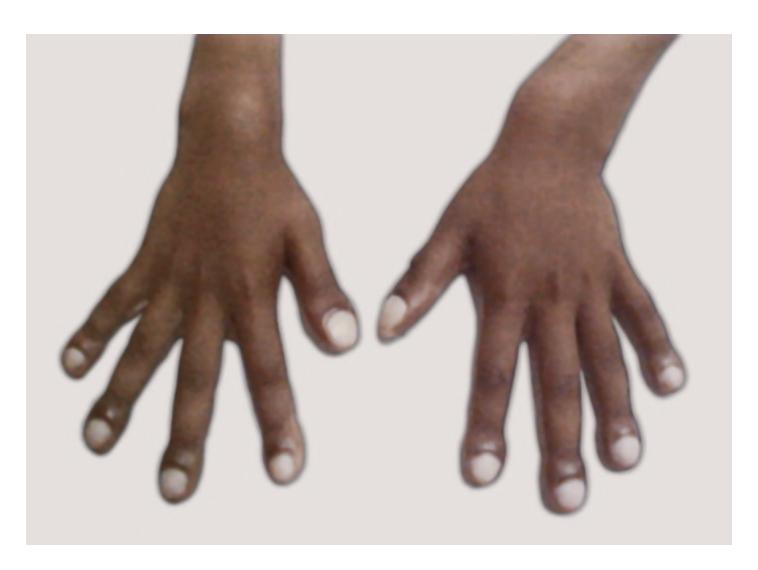
a. Identify the spot with its grade.
b. Give the grading of this condition.
Answer
- a. Grade 4: Clubbing
- b. Grade 1: Fluctuation and softening of the nail bed
- Grade 2: Obliteration of normal angle between nail and nail bed
- Grade 3: Accentuated convexity of the nail; drumstick appearance
- Grade 4: Broadened terminal pulp of the digit; pulmonary osteoarthropathy.
VVK14-009
A 2-month-old girl is admitted with acute viral myocarditis. She is on dopamine, amrinone, ranitidine and cefotaxime. Her platelet count has reduced from 200,000 to 50000/cu mm over past 5 days.
a. This thrombocytopenia is most likely due to:
i. Ranitidine.
v. Vascular congestion of spleen from right heart failure.
b. On what two factors does the severity of thrombocytopenia depend upon in this case?
c. What class of drug is this?
d. What is the mechanism of action of this drug?
Answer
- a. Amrinone.
- b. Rate of infusion of the drug (amrinone) and duration of therapy.
- c. Phosphodiesterase inhibitor.
- d. Increases cellular levels of cAMP.
VVK14-010
Give the best possible answer to the following questions.
a. A 7-month-old male baby has just returned from operating room after complete repair of tetralogy of Fallot. Patient is mottled and has cool extremities. He has good chest rise with ventilator breaths. CVP is 6cm, blood pressure is 64/40 mm Hg and heart rate is 165/min. He is on dobutamine at 10 mic/kg/min and nitroglycerine at 1mic/kg/min. His Hb is 12 g/dL. Oxygen saturation is 95% on 60% oxygen. Most appropriate first step would be:
i. Give 10 mL/kg fluid.
v. Hyperventilate the patient.
b. What is the commonest ingredient in mosquito repellants?
i. Pyrethroids.
c. Which of the following is not useful in acute methemoglobinemia?
i. Oxygen therapy.
d. Activated charcoal is effective for all of the following except:
i. Phenobarbitones.
Answer
- a. Give 10 mL/kg fluid.
- b. Pyrethroids.
- c. Exchange transfusion.
- d. Hydrocarbon and organophosphates.
VVK14-011
a. A 4-year-old child is brought to ER 15 minutes after he has accidentally ingested around one teaspoon of kerosene oil. Which of the following will you do?
i. Gastric lavage and start antibiotics + steroids.
b. When do you order for X-ray chest in this case?
c. What is the role of prophylactic antibiotics in a case of kerosene poisoning?
d. What is the most important complication of this condition?
Answer
- a. Observe the child for at least 6 hours.
- b. Preferably after 6 hours.
- c. Prophylactic antibiotics should not be given as bacterial pneumonia occurs in very small percentage of cases.
- d. Aspiration pneumonitis.
VVK14-012
Organophosphate poisoning.
a. Organophosphate poisoning is characterized by all of the following except*:*
i. Miosis.
b. Name two antidotes for treatment of this poisoning.
c. What is the mechanism of organophosphate poisoning?
d. Enlist four symptoms of cholinergic excess.
Answer
- a. Urinary retention (in fact urinary incontinence occurs).
- b. Atropine and pralidoxime.
- c. Accumulation of acetyl choline at peripheral nicotinic and muscarinic synapses in CNS.
- d. D diarrhea/defecation
- U urination
- M miosis
218 OSCE in Pediatrics
B – bronchorrhea B – bradycardia E – emesis L – lacrymation
S – salivation.
VVK14-013
A 7-year-old child has come to pediatric emergency room with bizarre behavior, vomiting and respiratory distress. On examination, child has lots of oral secretions, HR–60/min, BP–90/62 mm Hg and pupils are small.
a. Which toxicity does this child probably has?
b. Write two most common causes of this.
c. What are the four most important steps in the management of this child?
d. What is the commonest delayed complication?
Answer
- a. Cholinergic (organophosphorus) toxicity.
- b. Organophosphates and carbamates.
- c. Air way, breathing, circulation.
Gastric lavage/activated charcoal.
Atropine.
PAM.
d. Peripheral neuropathy.
VVK14-014
A 5-year-old child is caught in a house fire and brought to ER with 60% burns. His weight is around 16 kg.
a. What most likely immediate complication is expected in this case and how will you identify this complication?
b. What are the 4 most important steps in the management of this child?
c. Write fluid therapy for first 24 hours for this child.
Answer
- a. Airway obstruction and inhalational injury (Singed nasal hairs, carbonaceous material in throat, hoarseness of voice, persistent cough, stridor).
- b. • Air way, breathing, circulation
- • I/V access and fluids
- • Pain management
- • Management of hypothermia.
- c. Parkland formula: Ringerlactate (4 mL/kg/% burn) + Maintenance fluids.
VVK14-015
A 2½-year-old child is evaluated by a neurologist because of difficulty in walking. Neurological examination documents ataxia and mental retardation. The neurologist notes the presence of multiple telangiectasias involving the conjunctiva, ears and antecubital fossae. The child also has a history of multiple respiratory tract infections.
a. What is the likely diagnosis?
b. What is the mode of inheritance for this disease?
c. Give 3 other clinical features of this disease.
d. Immunoglobulin studies on the child would most likely demonstrate an absence of which immunoglobulin?
Answer
- a. Ataxia telangiectasia.
- b. Autosomal recessive.
- c. Choreoathetoid movements, slurred speech, ophthalmoplegia, sinopulmonary infections, cutaneous anergy, endocrine disorders, leukemias, gastric cancers, brain tumors.
- d. IgA and IgE.
VVK14-016
A child weighing 12 kg is admitted with 25% burns.
a. What is the total volume of fluid and what fluid is required for resuscitation?
b. What is the duration for replacement of this fluid?
c. How is it spaced?
d. Is colloid indicated in this child?
e. When is colloid indicated?
Answer
- a. 3300 mL of ringer lactate.
- b. 24 hours.
- c. 50% in the first 8 hours. 50% in the next 16 hours.
- d. No
- e. Burns more than 85% BSA; started after 8–24 hours of injury.
VVK14-017
Match the following.
| a. | Physostigmine | i. | Mushroom, INH, ethylene glycol | ||
|---|---|---|---|---|---|
| b. Pyridoxine ii. Diazepam c. Diphenylhydramine iii. Clonidine d. Dimercaptosuccinic acid iv. Dystonia e. Flumazenil v. Beta blocker f. Naloxone vi. Arsenic g. EDTA vii. Lead | |||||
| h. Glycogen viii. Anticholinergic agent |
Answer
a. Physostigmine : Lead
b. Pyridoxine : Mushroom, INH, ethylene glycol
c. Diphenylhydramine : Dystonia d. Dimercaptosuccinic acid : Arsenic e. Flumazenil : Diazepam f. Naloxone : Clonidine
g. EDTA : Anticholinergic agent
h. Glycogen : Beta blocker
VVK14-018
Answer the following questions on drowning.
a. Define:
i. Drowning
b. List 2 electrolyte disturbances and 1 hematological complication of near drowning.
c. What is the commonest radiological finding?
Answer
- a. i. Process of experiencing respiratory impairment from submersion or immersion in liquid. The outcome may be death, survival with morbidity or survival without morbidity.
- ii. Any survival from an immersion event.
- b. Electrolyte:
- • Hypernatremia
- • Hyperkalemia
- • Hypercalcemia
- • Hypermagnesemia.
Hematological:
• Hemolysis
Pulmonary edema
VVK14-019
Answer the following questions.
a. What is pulse oximetry?
b. What is the principle behind it?
c. Mention three limitations of its use.
d. How does it corelate with PO2 ?
Answer
- a. Pulse oximetry is a non-invasive method of measuring the oxygen saturation of hemoglobin in arterial blood.
- b. Red and infrared light of different wavelengths when transmitted through the capillary have differential absorption by oxyhemoglobin and reduced hemoglobin. This ratio is then detected by a transducer and displayed as oxygen saturation.
- c. False values occur in:
- i. Poor perfusion
- ii. Ambient light
- iii. Presence of carboxy hemoglobin/methemoglobin
- iv. Movement
- d. As per the oxyhemoglobin dissociation curve.
VVK14-020
A 6-year-old male child is rushed to casualty at night with chief complaint of altered sensorium and cold peripheries since evening (for last 5 hours). According to the parents, he was playing in the garden and suddenly complained of severe pain at the left dorsum of foot. His condition deteriorated over the next 4 hours. Clinically, child had to be intubated and was found to have tachycardia with frothy secretions in the endotracheal tube and shock. Liver was palpable 3.5 cm below the RCM in midclavicular line and B/L crepts were present in the lungs.
a. What is the most probable diagnosis?
b. What management will you give for pain relief?
c. What is the life-saving measure you will take in this patient (other than airway, breathing and circulation)?
d. What is contraindicated as a treatment modality in this patient?
e. What would be the pressor agent of choice to start with?
Answer
- a. Scorpion sting with autonomic dysfunction.
- b. Xylocaine for local infiltration (if wound identified) and ice application.
- c. Prazocin (30 mic/kg at 0, 6, 12 and 24 hours irrespective of blood pressure).
- d. Digoxin for CHF.
- e. Dobutamine infusion.
VVK14-021
You are sitting in a PHC and a child presents to you with alleged history of snake bite. Local examination seems consistent with snake bite. As per the national protocol for snake bite in children.

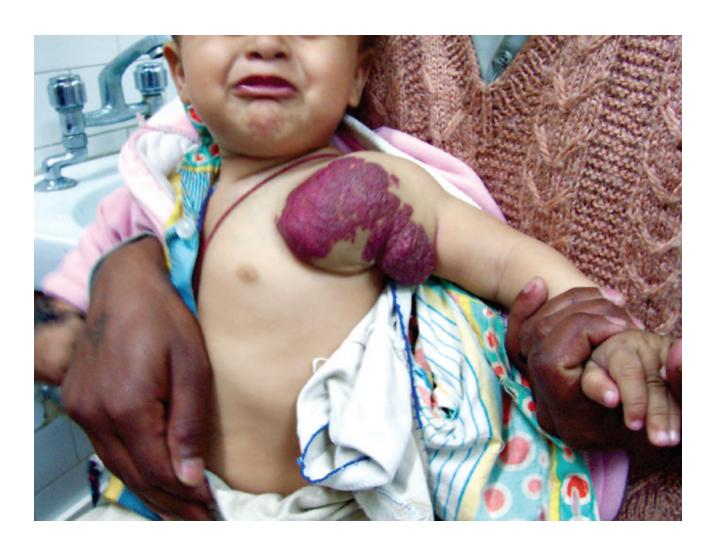
a. What is "Do it RIGHT"?
b. What is the standard test for coagulopathy?
c. What is the indication for ASV administration?
d. What will be the initial dose of ASV in a child with severe systemic envenomation?
a. What is the best description of this lesion?
b. How do you classify these lesions?
c. Name the immunohistochemical marker that separates hemangiomas from other vascular tumors of infancy.
d. Give two complications of this condition.
Answer
a. R = Reassurance.
I = Immobilize the limb (as in fracture, do not put tourniquet).
G H = Get hospitalized.
T = Tell the doctor regarding any symptoms (e.g. ptosis).
b. The 20 minute whole blood clotting test (20 WBCT) is adopted as the standard test for coagulopathy in snake bites.
- c. The only indication is systemic envenomation (altered 20 WBCT, or spontaneous bleeding or any neurological impairment).
- d. 8–10 vials in any case of systemic envenomation.
VVK14-022
Answer the following questions.
a. Define and elaborate the nerve involved in:
i. External ophthalmoplegia.
b. Define internuclear ophthalmoplegia and name the tract involved.
Answer
- a. i. External = Extraocular muscle palsy due to 3rd, 4th or 6th nerve palsy.
- ii. Internal = 3rd nerve palsy (sphincter pupillae and ciliaris muscle palsy); Pupil fixed and dilated (no light, consensual or accommodation reflex).
- b. Internuclear = Lesion between midbrain and pons, so there will be lesion in the medial longitudinal bundle leading to palsy of conjugate movement.
A 24: Immediate esophagoscopy to retrieve the battery. Hearing aid batteries are highly corrosive and must be removed as early as possible.
VVK14-023
A 2-year-old boy swallowed a hearing aid battery 4 hours back. Chest X-ray done after 4 hours showed battery located in the upper third of the esophagus. Child is playful and stable hemodynamically with no clinical symptomatology. What will be next step in your management and why?
Answer
No model answer in source material.
VVK14-024
Answer the following questions.
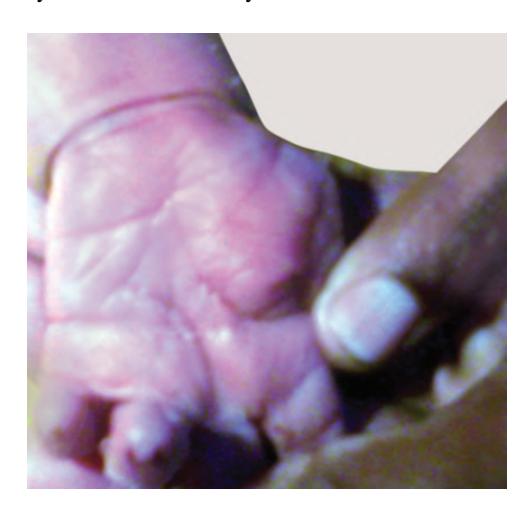
a. What is dermatoglyphics?
b. What are ulnar loops and what is its significance?
c. What is a triradius and where is it formed?
d. What is the normal 'atd' angle? What happens to the angle in Down's syndrome?
e. What is Sydney line and Kennedy crease?
Answer
- a. Dermatoglyphics are the configuration formed by fine ridges, on the palmar surface of the hands and fingers.
- b. Ulnar loop is formed by ridges entering and leaving the skin surface over the finger tip on the ulnar side.
- c. Tri radius is formed at the junction of three sets of converging epidermal ridges, normally tri radii are formed on the palm beneath each finger and in axial plane of palm.
- d. Atd angle: Normally = 40o ; In Down's syndrome ~ 75o or more.
- e. Sydney line: Two transverse crease in palm, proximal extends from radial to ulnar border.
Kennedy crease: Deep sole crease between the first and second toe.
VVK14-025
Answer the following questions on Horner syndrome.
a. What are its components? (Name four).
b. What is the cause for this diagnosis?
c. How do you confirm your diagnosis?
Answer
- a. • Partial ptosis.
- • Miosis.
- • Anhidrosis.
- • Enophthalmos.
- • If paralysis of ocular sympathetic fibres occurs before 2 years of age, heterchromia iridis with hypopigmentation of iris may occur on the affected side.
- b. Sympathetic denervation of eyes (lesions of superior cervical ganglion or sympathetic trunk).
- c. Cocaine test—Normal pupil dilates within 20–45 minutes afterinstillation of 1–2 drops of 4%cocaine whereas the miotic pupil of an oculosympathetic paresis dialates poorly, if at all with cocaine.
VVK14-026
Study the smear shown below and answer the following questions.
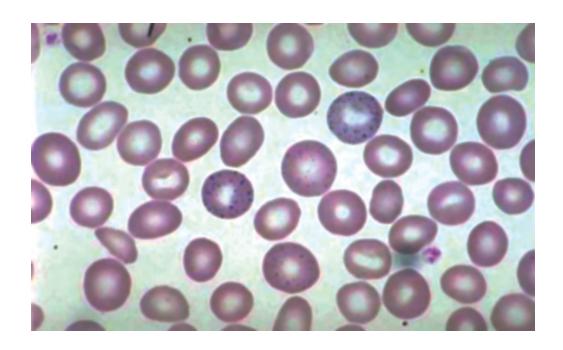
a. Identify the abnormality shown in the smear.
b. Give 2 differential diagnosis for this condition.
c. Describe Porter Index.
Answer
a. Basophilic stippling.
- b. Thalassemia
- – Lead poisoning.
- c. The desferal therapeutic index or porter index is defined as mean daily dose of desferrioxamine in mg/kg, divided by serum ferritin.
- – This is calculated every 6 months in patients receiving desferroxamine
- – Porterindex shouldnot exceed0.025 inordertominimize sensorineural hearing loss
VVK14-027
A 4-year-old male child is brought with a history of developmental delay, lethargy and constipation. He is found to have mild mental retardation and sensory neuropathy. He is from low socioeconomic group and his father is a laborer.
a. What is your most probable diagnosis?
b. What test in urine will confirm the diagnosis?
c. What treatment options are available for this condition?
d. What is the indication for treatment for this?
Answer
- a. Lead poisoning.
- b. Coproporphyrin in urine (CPU) > 150 mic/L. Aminolevulinic acid in urine (ALAU) > 5 mg/L.
- c. CaNa2 EDTA (calcium versanate) and BAL in symptomatic child.
- d. If lead levels > 45 µgm% (Normally < 10 µgm%).
VVK14-028
A 13-year-old, obese boy has been complaining of persistent knee pain and has developed a limp for several weeks. Physical examination of the knee is normal, but shows limited hip motion on the left. As the hip is flexed, the leg goes into external rotation and cannot be rotated internally.
a. What is the most likely diagnosis?
b. What characteristic sign is seen on X-ray of pelvis?
c. Mention two most serious complications of this condition.
Answer
- a. Slipped capital femoral epiphysis.
- b. 'Blanch sign of Steel' on AP view of pelvis (double density created from anteriorly displaced femoral neck overlying the femoral head).
- c. Osteonecrosis (avascular necrosis) and chondrolysis.
VVK14-029
Study the photo below and answer the questions.
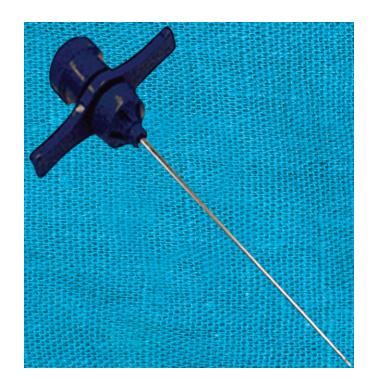
a. What is this instrument?
b. Name the procedure for which this instrument is used.
c. What is the minimum platelet count to be kept prior to this procedure?
Answer
- a. Jamshedi bone marrow biopsy needle.
- b. Bone marrow biopsy.
- c. No cut off for platelets needed prior to bone marrow study.
VVK14-030
You are working in the emergency department and a 4-year-old child is brought in with severe abdominal pain and back pain with vomiting. On examination, he has generalized tenderness over the abdomen with guarding. You learn he was recently diagnosed with acute lymphoblastic leukemia. His lab investigations showed serum Ca+2 10.8mEq/L, glucose 420 mg/dL and 3+ ketones in the urine. This child has received vincristine, L-asparaginase, and high dose prednisone.
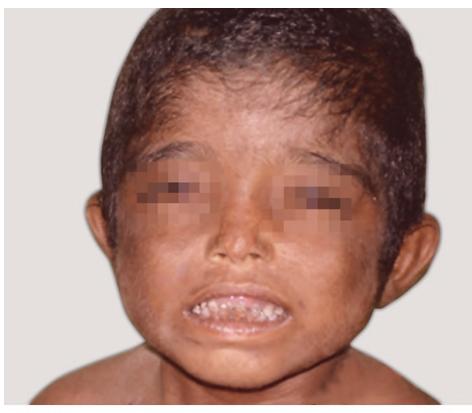
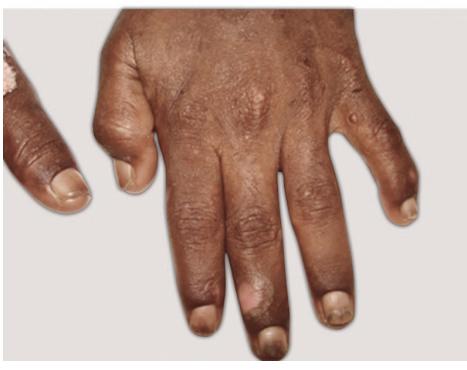
a. What is your differential diagnosis for the acute problem?
b. How would you manage this?
a. What is the most probable diagnosis?
b. What is the screening investigation that you will perform?
c. Name three other causes of generalized skin darkening other than excessive sun exposure.
d. Name three drugs that can cause an acute life-threatening crisis in this child.
Answer
- a. Acute pancreatitis with diabetic ketoacidosis.
- b. Pain relief, send lipase/amylase and USG abdomen to confirm, start treatment for DKA–IV fluids, insulin, etc. watch for shock. Stop offending drugs asparginase and prednisolone.
VVK14-031
A 10-year-old presents to pediatric OPD with these painful, hot lesions on both shins.
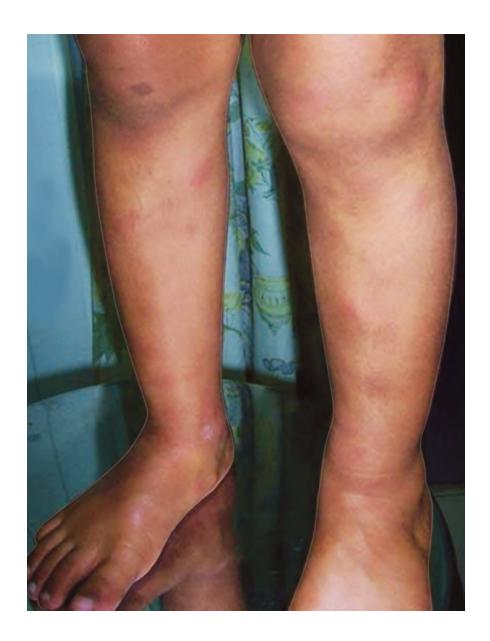
a. What is the diagnosis?
b. List 5 conditions which may be associated with this diagnosis.
Answer
- a. Erythema nodosum
- b. Infections:
Bacterial – Streptococcus, TB, Salmonella
Viral – EBV, HBV Fungal – Histoplasma
Inflammatory bowel disease – Crohns, ulcerative colitis Autoimmune – SLE, Behçet, sarcoidosis
Drugs – Sulphonamides.