VVK10-001
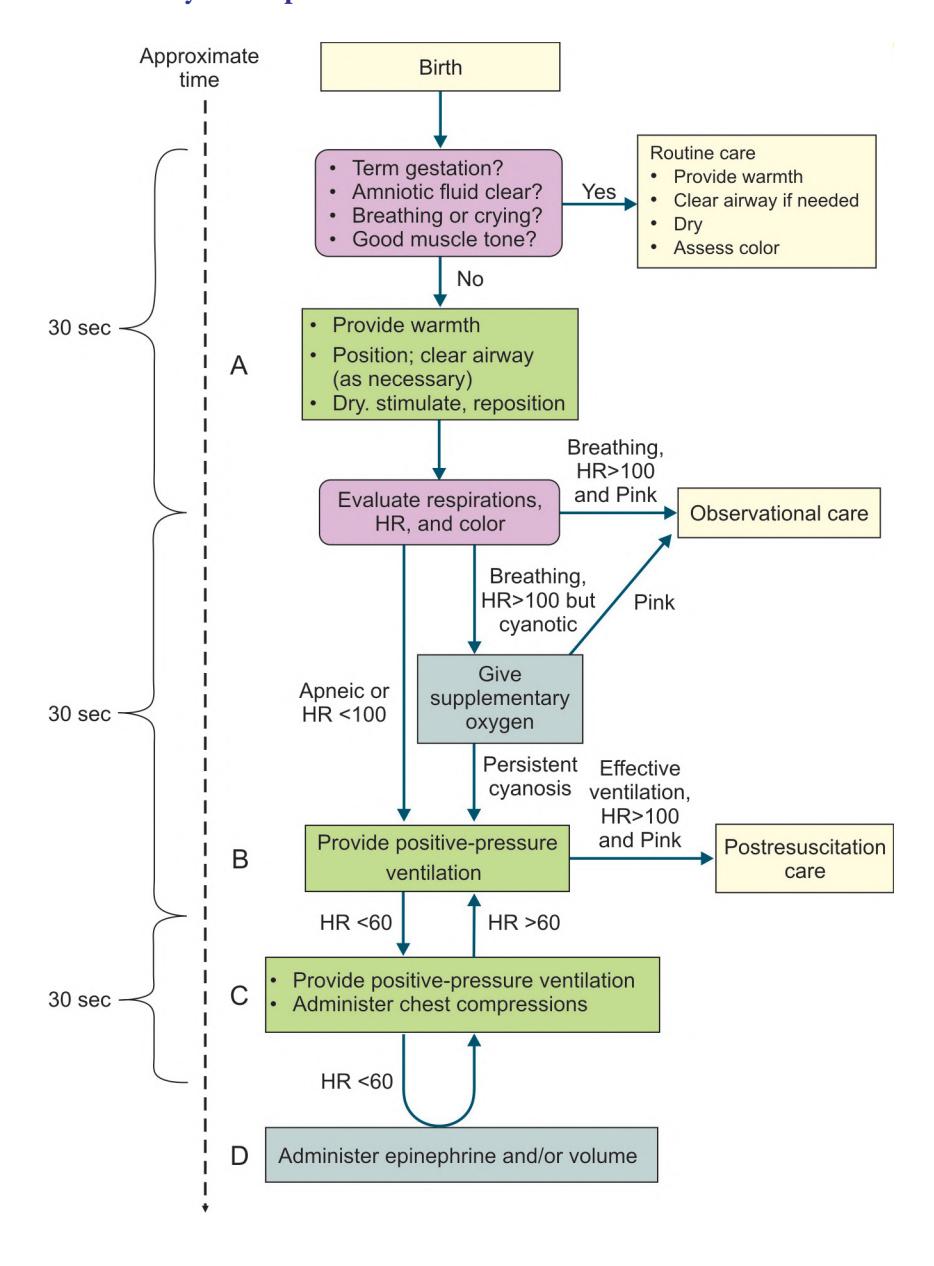
NRP Chart
• Enlists 5 points in routine care of newborn.
Answer
- • Dry baby on mother's abdomen
- • Provide warmth (skin to skin care)
- • Assure open airway if needed
- • Cut cord in 1–2 minutes
- • Ongoing evaluation of neonate.
VVK10-002
Positive pressure ventilation
a. Enlist 3 common problems encountered in PPV
b. Mention or demonstrate the techniques to improve PPV using bag and mask if above problems are encountered.
Answer
a. Inadequate seal Inappropriate position Blocked airway Inadequate pressure
b. Techniques to improve PPV using bag and mask.
| Inadequate seal |
Mask adjusted to ensure airtight seal |
|---|---|
| Inappropriate position |
Reposition the head in sniffing position |
| Blocked airway |
Suction the airway Open baby's mouth and ventilate |
| Inadequate pressure |
Increase Pressure by squeezing the bag with more pressure till a chest rise is visible |
| No improvement with above steps |
Alternate airway-Consider endotracheal intubation |
VVK10-003
Fill in the blanks
| Weight (g) | Gestational age (wks) |
ET Tube size (mm) (inside diameter) |
Suction Catheter Size(F) |
|---|---|---|---|
| Below 1000 |
Below 28 |
? | ? |
| 1000–2000 | 28–34 | ? | ? |
| 2000–3000 | 34–38 | ? | ? |
| Above 3000 |
Above 38 |
? | ? |
Answer
| Weight (g) | Gestational age (wks) |
ET Tube size (mm) (inside diameter) |
Suction Catheter Size(F) |
|---|---|---|---|
| Below 1000 |
Below 28 |
2.5 | 5F or 6F |
| 1000–2000 | 28–34 | 3.0 | 6F or 8F |
| 2000–3000 | 34–38 | 3.5 | 8F |
| Above 3000 |
Above 38 |
3.5–4.0 | 8F or 10F |
VVK10-004
a. What is the recommended dose of biphasic energy to be delivered by AED?
b. True false
i. Cuffed tracheal tube are unsafe and ineffective in pediatric population
c. Fill in the blanks
i. VF and VT contribute to______________% pediatric cardiac arrest
d. What is the ideal depth and rate of pediatric CPR?
Answer
a. First dose-2J/kg Subsequent dose-4J/kg
b.
- i. False
- ii. True
- iii. True
c.
- i. 5–15%
- ii. Asphyxia
- iii. International Liaison committee on resuscitation
- iv. CAB.
- d. 100/min
- 5 cm or 2 inches in child
- 4 cm or 1.5 inch in infants.
VVK10-005
A term baby is born by normal vaginal delivery. Amniotic fluid was not stained with meconium. The baby is born limp and is not crying. Resuscitate with the provided dummy and equipment. You are free to ask vital signs of the baby whenever appropriate.
Answer
- a. Mention your intention to handwash.
- b. Check the equipment: Radiant warmer, oxygen source, suction, ambu bag—if time is available. If not, mention your intention to have done so prior to baby's birth.
- c. Performallbasic stepswithin30 seconds incorrect order—Providewarmth, suction-clear airway, dry and stimulate, give O2 if required.
- d. Evaluate and ask for vitals—Examiner says HR <100/min.
- e. Bag and mask ventilation—Self-inflating resuscitation bag, look for correct assembling of parts, position the baby correctly, select proper size mask. Position mask and provide appropriate ventilation (rate and rise–40-60/ min). Say out loud: squeeze-two-three-squeeze-
- f. Evaluate vitals—Examiner says HR < 60/min.
- g. Mention your intention to have an assistant to provide bag and mask ventilation during chest compressions.
- h. Chest compression—two finger technique, depth 1/3 of AP diameter of the chestratio 1:3, check pulses. Say out loud: One-and two-and three-and squeeze-and
- i. Evaluate HR decide about medication.
- j. Epinephrine is indicated if HR <60 after 30 secconds of assisted ventilation and 30seconds of coordinated chest compression and ventilations.
VVK10-006
You are resuscitating a newborn at birth. The baby has gasping respiration at 30 seconds after birth. Demonstrate what steps you would take for the next 30 seconds.
Answer
- a. Check Ambu bag, mask, reservoir and oxygen source.
- b. Attach reservoir, and oxygen source.
- c. Correct technique of ambu bagging—good seal, look for chest rise.
- d. Correct frequency of ambu bagging—40–60 breaths per minute. Say out loud: squeeze-two-three-squeeze-two-three.
- e. Countheartrate at endof 30 seconds—by applying stethoscopeorpalpating base of umbilical cord for 6 seconds.
VVK10-007
You are resuscitating a newborn at birth. The baby is limp and blue, heart rate <100. You have done following steps: Warmed and positioned, suctioned, dried, stimulated, given bag and mask ventilation (40–60/min). Heart rate was <60/min and cardiac massage was given (120/min) along with bag and tube ventilation (due to inadequate bag and mask ventilation). There was no improvement. Demonstrate what steps you would take for the resuscitation of this newborn.
Answer
-
a. Place IV or umbilical line.
-
b. Asks if mother has received narcotics.
-
c. If no, then give epinephrine—0.1–0.3 mL/kg 1:10,000 IV or IT.
-
d. If no improvement soda bicarb 2 mEq/kg IV slowly.
-
e. If no improvement check that bag delivers 100% O2.
-
f. Check that head is not overflexed.
-
g. Check that ET tube is in trachea.
-
h. Adequate ventilation pressure is being provided.
-
i. Adequate cardiac massage is being given.
A 8:
- a. Check the equipment.
- b. Perform all basic steps within 30 seconds in correct order—Provide warmth, suction-clear airway, dry and stimulate, give O2 if required.
- c. Evaluates and ask for vitals: Examiner says HR < 100.
- d. Bag and mask ventilation self-inflating resuscitation bag.
- · Correct assembling of parts.
- · Position baby correctly.
- · Select proper sized mask.
- Provide ventilation.
- · Check chest rise.
- Rate of ventilation 40-60/min.
- Evaluate vitals (HR < 60, HR > 60/min).
A 9:
a. Uncuffed:
b. Uncuffed:
c. Depth of insertion:
A 10:
| Sl. No. | Drug | Intravenous | Intraosseous | Intratracheal |
|---|---|---|---|---|
| a. | Lignocaine | Yes | Yes | Yes |
| b. | Epinephrine | Yes | Yes | Yes |
| c. | Atropine | Yes | Yes | Yes |
| d. | Naloxone | Yes | Yes | Yes |
| e. | Sodium bicarbonate | Yes | Yes | No |
| f. | Adenosine | Yes | Yes | No |
| g. | Dopamine | Yes | Yes | No |
| ĥ. | Calcium gluconate | Yes | Yes | No |
VVK10-008
You have been called to attend a call from the operation theatre of a primi mother with a 35 weeks IUGR baby. Mother has PIH and now the fetus has developed fetal bradycardia and Doppler studies show absent flows in MCA. Half an hour ago there was meconium staining of the amniotic fluid. How will you proceed on reaching the operation theatre? What are the actions you will take in the first 60 seconds?
Answer
No model answer in source material.
VVK10-009
Calculate the size of cuffed and uncuffed tube required for a 4-yearsold child who requires intubation. Also calculate the depth of insertion of the tube. Give the formulae used.
Answer
No model answer in source material.
VVK10-010
Write the possible routes of administration of the following drugs (write "yes" or "no" in the appropriate box to signify that the drug can be given by that route).
| Sl. No. | Drugs | Intravenous | Intraosseous Intratracheal |
|
|---|---|---|---|---|
| a. | Lignocaine | |||
| b. | Epinephrine | |||
| c. | Atropine | |||
| d. | Naloxone | |||
| e. | Sodium | bicarbonate | ||
| f. | Adenosine | |||
| g. | Dopamine | |||
| h. | Calcium | gluconate |
Answer
No model answer in source material.
VVK10-011
A 9-year-old boy is brought to the emergency in a pulseless state. ECG shows electrical activity suggestive of ventricular tachycardia.
a. Name 8 etiologies that can precipitate pulseless electrical activity.
b. What is the dose at which defibrillation is initiated?
c. Name three drugs that can be used if defibrillation and adrenaline fail.
d. What is the ratio of cardiac compression to breathing prior to and after intubation and initiation of IPPR?
Answer
- a. Hypothermia, hypoxemia, hypovolemia, hypokalemia, hyperkalemia, metabolic disorders, cardiac tamponade, tension pneumothorax, toxins, thromboembolism.
- b. 2 J/kg.
- c. Amiodarone 5 mg/kg, lignocaine 1 mg/kg, magnesium sulfate 25–50mg/kg.
- d. Before intubationand initiationofIPPR: 15:2, afterintubationand initiation of IPPR: 5:1.
VVK10-012
The following are complications related to hypothermia except:
a. Ventricular fibrillation.
b. ARDS.
c. Hyperglycemia.
d. Thrombocytosis.
Answer
d. Thrombocytosis.
VVK10-013
A 14-month-old baby is brought with history of choking while playing with some beads. On arrival he has an inspiratory stridor, and suprasternal retractions. Chest rise and air entry are poor. Demonstrate five initial actions that you will perform.
Answer
- a. Lie the infant flat on his back.
- b. Open the airway by head-tilt, chin lift maneuver.
- c. Give five chest thrusts.
- d. Turn the baby over on your hand and give five back blows.
- e. Open the mouth and try to visualize the foreign body.