MNJ19-001
Match the following lysosomal storage disorders
1 Metachromatic leukodystrophy a β-galactocerebrosidase
Krabbe disease
Fabry disease
Ceramidase
4 Farber disease d Acid lipase
5 Wolman disease e Aryl sulfatase A
Answer
le 2a 3.b 4c 5.d
- . Mucopolysaccharidosis e .
- Hunter, Hurler, Scheie, Sanfilippo, Matoteaux Lamy, Morquio, Sly
- Urine electrophoresis
- Dermatan, keratan, heparan sulphate
- Liver, spleen, bone, heart, eyes (corneal clouding), hearing
- Dysostosis multiplex
- For Type 1, 2. and 6 mE Ge Se pects
- MPS, Zellweger syndrome
- T, 2 Ty ae, 4B. &27,. 6.7 Ans. 3.
- Mucopolysaccharidosis type II (iduronate 2-sulfatase deficiency), Hunter faces, X-ray show ovoid vertebra, bullet shape phalanges (dysostosis multiplex) Ans. 4
- Heparan and dermatan sulfate
- It is an X-linked recessive syndrome (all other MPS are AR)
- Homocystimuria (b) Ans. 5. ute Peo be
- Eye (ectopia lentis)
- Elevated plasma levels for homocystine
- Vitamin B, (200-1,000 mg/24 hour), folic acid 1-5 mg/24 hour Vit By (1-2 g/24 hours)
- Deficient activity of acid beta-galactosidase (b) Ans. 6.
- Type 1 GM1 gangliosidosis
- Angiokeratoma
- Tay-Sachs disease *(hyperacusis)*
- Classical galactosemia Ans. 7. Peo Ree Boe
- Galactose-1-phosphate uridyltransferase
- E. coli
- Cataract, vitreous hemorrhage
-
- Eliminating lactose and galactose from the diet
MNJ19-002
**
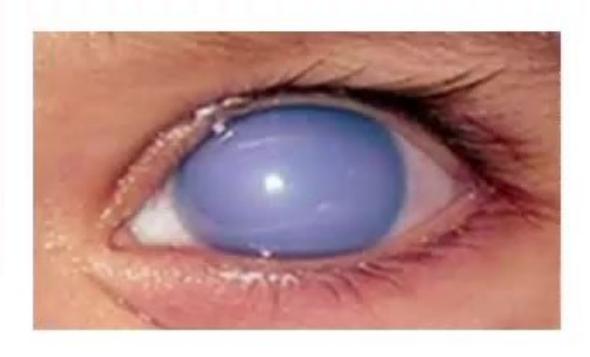
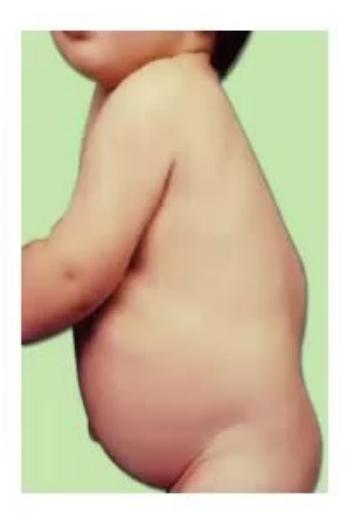
- Diagnose this eye problem and the disease
- Name five types of this condition.
- What is the urinary test for diagnosis?
- Name three metabolites seen in the urine
- Name the main organs involved.
- What are the X-ray findings called?
- For what types enzyme replacement available?
- Write down causes of corneal clouding.
Answer
No model answer in source material.
MNJ19-003
True statements regarding galactosemia include all of the following except:
- b Itis caused by a deficiency in the enzyme galactose-1-phosphate uridyltransferase
- ¢ Treatment 1s by eliminating galactose from diet
a. It is autosomal recessive
d. The majority of the hyperbilirubinemma is indirect
e. Hypoglycemia is frequent
f. E. coli sepsis is specific for this
Answer
No model answer in source material.
MNJ19-004
*
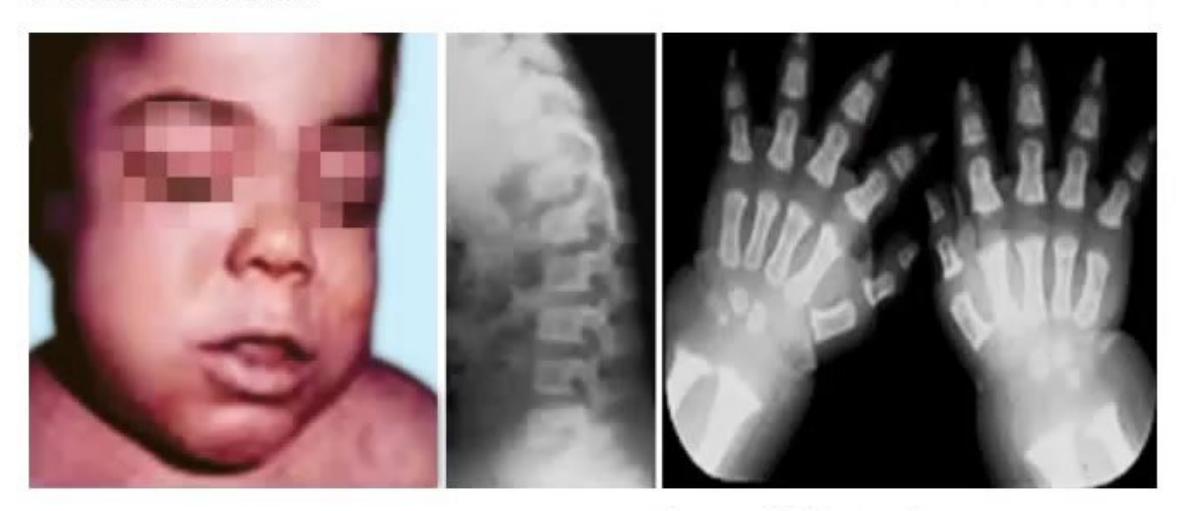
- Spot the diagnosis of facial character and X-ray finding and enzyme deficiency
- Tissues and urme contains.
- Mode of inheritance.
Answer
No model answer in source material.
MNJ19-005
** A 6-month-old child was noted to be normal at birth, but over the ensuing months you have been somewhat concerned about his slow weight gain and his mild delay in achieving developmental milestones.
The family calls you urgently at 7:00 AM. noting that their child seems unable to move the right side of his body:
- a. Phenylketonuria
- b. Homocystinuria
- c. Cystathioninuria
- d. Maple syrup urine disease
- Which of the following conditions might explain this child's condition?
a. Phenylketonuria
b. Homocystinuria
c. Cystathioninuria
d. Maple syrup urine disease - Which one other systemic examination would you like to do?
- What investigation would confirm the etiology?
- What treatment would you institute as a long-term measure?
Answer
No model answer in source material.
MNJ19-006
" At birth, an infant is noted to have an abnormal neurologic examination. Over the next 1-2 weeks he develops severe progressive central nervous system degeneration, an enlarged liver and spleen, macroglossia, coarse facial features, and a cherry-red spot in the eye:
-
a. Reduced serum hexosaminidase A activity
-
A defective gene on the X-chromosome
- The laboratory finding likely to explain this child's problem 1s:
a. Reduced serum hexosaminidase A activity
b. Deficient activity of acid beta-galactosidase
d. Complete lack of acid alpha-galactosidase activity
e. Deficient activity of galactosyl-3-sulfate-ceramide sulfatase - What is the diagnosis?
- What is specific skin finding?
- If this same child have hyperacusis and macrocephaly, then what is diagnosis?
Answer
No model answer in source material.
MNJ19-007
** An 8-day-old child presented with yellowish sclera, whitish stool and turmeric color urine and seizure, on 3rd day of septicemia who was on breastfeed:
- What could be diagnosis?
- What is enzyme deficient?
- What is commonest organism causing infection?
- What are ophthalmic manifestations?
- What is the treatment?
Answer
No model answer in source material.
MNJ19-008
** A six-week-old infant is referred for poor weight gain and seizure. On examination, he looks cachexic and is dysmorphic with low set ears and a very small lower jaw. He also has severe thrush affecting the oral cavity and perineum. Cardiac apex is displaced into the left sixth intercostal space in anterior axillary line and there is a palpable thrill. A loud pansystolic murmur and an apical mid-diastolic murmur can be heard. He is tachypneic but the lung fields are clear on auscultation. The liver is 3 cm below the costal margin in the midclavicular line.
Investigations: Na: 136; K: 4.9; Ca: 1.7; Albumin: 4.2; Urea: 7.8; Hb: 10.2; WBC: 3.8; Platelet: 2.45 L; Echo large VSD:
- What is the diagnosis?
- What is commonest presentation during newborn period?
- Most likely explanation for the low plasma calcium.
- What is the causes of immunodeficiency?
- What is the etiopathogensis of all these features?
Answer
This QO is given suddenly here to keep open your brain**—while domg OSCE always think as a whole Nelson. Not like only metabolic disease
- DiGeorge syndrome
- Hypocaleemic seizures
- Primary hypoparathyroidism
- Thymus gland aplasia leading to abnormal cell mediated immunity
- An embryological defect of the third and fourth pharyngeal pouches
- ITEM Ans. 9. BS Sa ao
- Organic acidemia (sweaty feet)
- Hydration, sodium bicarbonate, glycine and carnitine; ET / dialysis
- **In urea cycle defect there is hyperammonemia but never metabolic acidosis, it presents with respiratory alkalosis.
MNJ19-009
Baby of Neelu, a term newborn baby with birth weight of 2.6 kg, was admitted in NICU
on day 3 of life with poor feeding, lethargy and nonbilious forceful vomiting:
He was 2nd baby of 2nd degree consanguineous parents with normal antenatal, natal and immediate postnatal period. Elder sibling who expired on day 10 of life had similar complaints, but was not investigated.
Condition of baby worsened despite supportive care and she developed convulsions on next day she went to a comatose state. Baby was flaccid, dehydrated.
- Investigations showed: Hb: 12 g/dl, TC 3000, DC: P20 L80, ESR: 10, platelet count: 80,000, CRP· 2, blood, urine, CSF C and S. sterile, RBS 70 mg/dl, serum Ca: 6 mg/dl (N· 8–12 mg/dl), sodium: 140 mEq/L, potassium: 4 mEq/L, serum ammonia· 150 (N: 20–80 μg/dl), serum lactate: 6(N<3), ABG revealed a pH. 7.25, pO2: 80, pCO2: 30, HCO3: 15, anion gap: 20.
- Can you suggest a diagnosis?
- What abnormal odor may be seen in these cases?
- How will you tide over the acute crisis?
Answer
No model answer in source material.
MNJ19-010
**
- A 7-year-old boy is admitted with dehydration. He is the 3rd child whose 2 elder brothers died of similar illness. He gives history of worsening school performance and progressive defective vision.
- · Recently he is having some difficulty in walking
- · Exam: Wasted child, hyperpigmentation of lips and hands.
- Inv: Serum sodium: 112 mg/dl, potassium: 7 mg/dL, RBS: 60 mg/dl
-
- Identify this condition.
-
- What is the mode of inheritance?
-
- Which test is confirmatory?
-
- Discuss the management.
-
- Any drug tried in managing this disease.
-
- Identify this condition.
- What is the mode of inheritance?
- Which test is confirmatory?
- Discuss the management.
- Any drug tried in managing this disease.
Answer
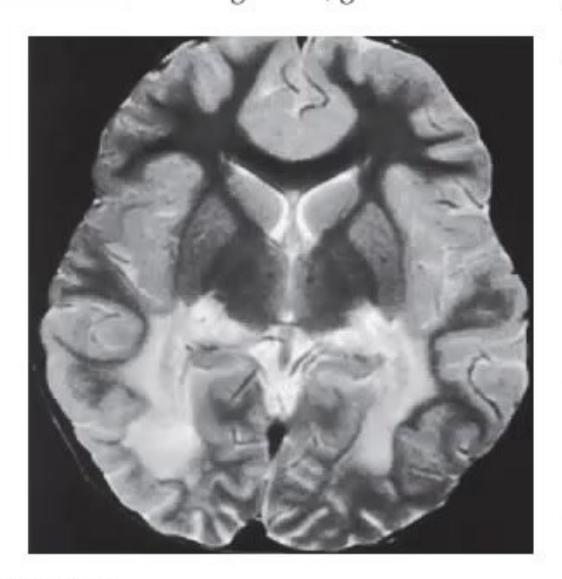
- Adrenoleukodystrophy
- X-linked recessive
- Plasma: Very long chain fatty acids
- oN Symptomatic
- Lorenzo's oul
- * *Keep in mind this MRI image also*, given in neuroimaging chapter
Ans. 11.1. Retinitis pigmentosa.
- . Mucopolysaccharidoses—Hunter, Hurler, Sanfilippo types.
- . Laurence-Moon-Beidl syndrome.
- . Kearns-Sayre syndrome
- Laurence-Moon-Biedl syndrome.
- . Mental retardation, hypogonadism.
- . Retinal dystrophy / retinitis pigmentosa
- Gaucher's disease
- Wrinkled paper cells in BM
- Intracytoplasmic substrate inclusion
- Erlenmeyer flask deformity 1n distal femur
- Enzyme replacement with f-glucosidase.
MNJ19-011
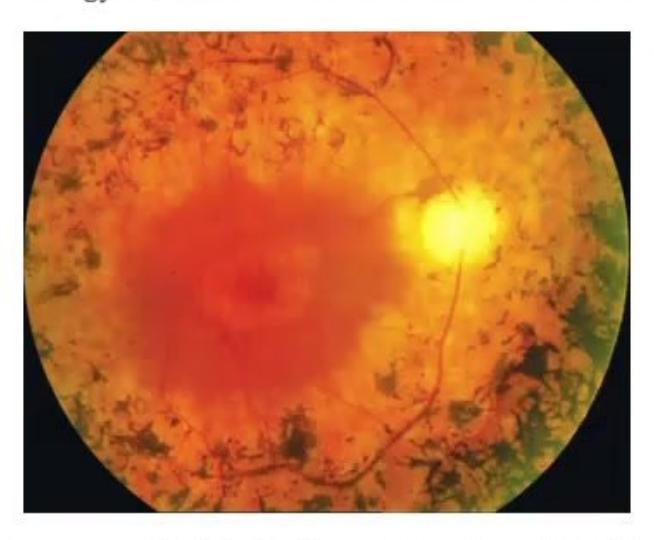
Identify the pathology. Give four conditions in which this could be a finding.
Answer
No model answer in source material.
MNJ19-012
A 6-year-old boy presented with obesity, polydactyly and diminished night vision.
- What is the likely diagnosis?
- What are the other abnormalities likely to be present in this child?
- What ophthalmologic finding will you get in this child?
Answer
No model answer in source material.
MNJ19-013
3-year-old child Monu with MR admitted for evaluation, on examination, he had anemia with organomegaly. Lab evaluation showed anemia with thrombocytopenia. BM done:
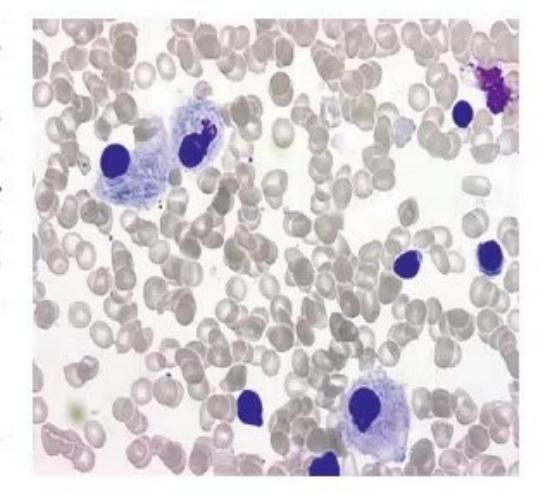
- What is the diagnosis?
- What are the marrow findings?
- What is the etiology for such findings?
- What are the typical radiological findings?
- What is the definitive treatment?
Answer
No model answer in source material.