MNJ04-001
EEG of a six-year-old child:
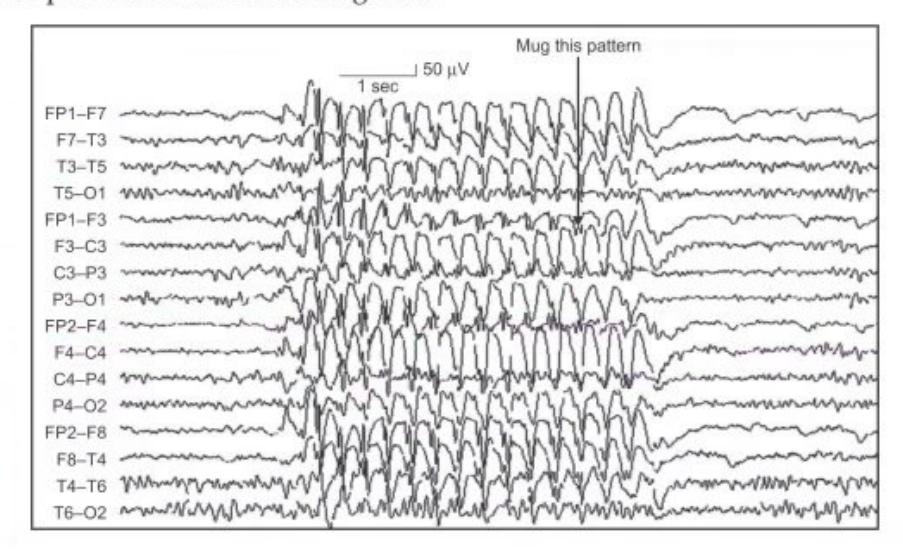
- What does this EEG show?
- What is the drug of choice (write two drugs)?
- Prognosis.
- One OPD procedure to confirm diagnosis
Answer
- 3 Hz spike and wave activity in absence seizure—Childhood/Juvenile
-
- Valproate, lamotrigine, ethosuxamide
-
- Good in childhood, slightly less for juvenile
-
- Hyperventilation
MNJ04-002
A 10-year-old child came with history of loss of school performance and abnormal body movement from last 3 months, the child now have loss of interest in surrounding. Past history suggests febrile illness with rash around 1 year age:
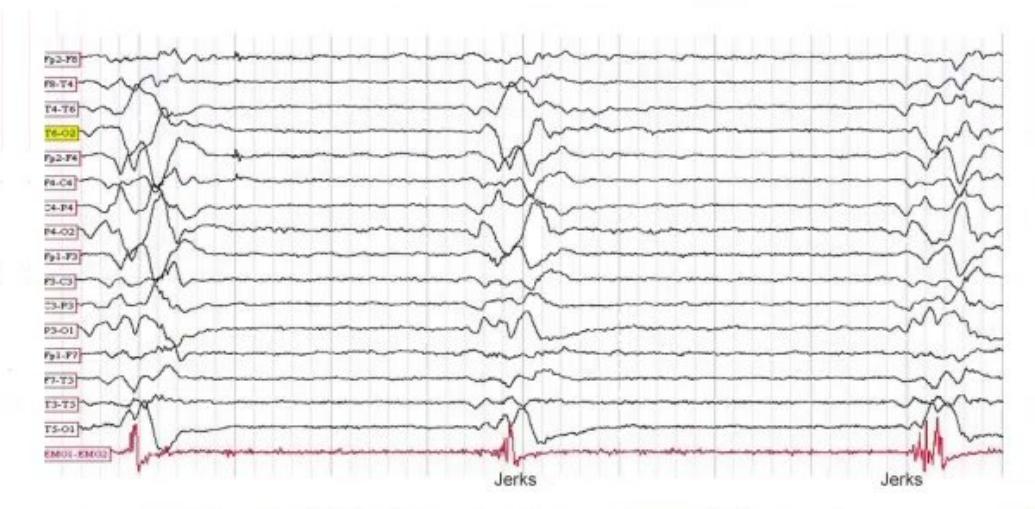
- Diagnosis of clinical condition and EEG pattern.
- Staging of disease.
- Diagnosis modality of disease.
- Treatment option with recent change in prevention strategy (2014 change).
Answer
- SSPE—burst suppression pattern (Subacute sclerosing panencephalitis)
-
- Three stages:
- i Behavioral, mental changes
- ii Myoclonic jerks, choreoathetosis, language problem
- iii No independent ambulation, no speech, blind
-
- CSF (Marked elevated gamma-globulin level), Typical EEG pattern
- Ribavarine, interferons, inosiplex, amantadine, in 2014 change of measles vaccine, replaced by MMR at 9 months.
MNJ04-003
* A 9-month-old male child admitted with complains of abnormal movement of head and hand, more than 100 time per day, baby do this when just awake from sleep. Baby now unable to sit without support as 2 months back, EEG was done:
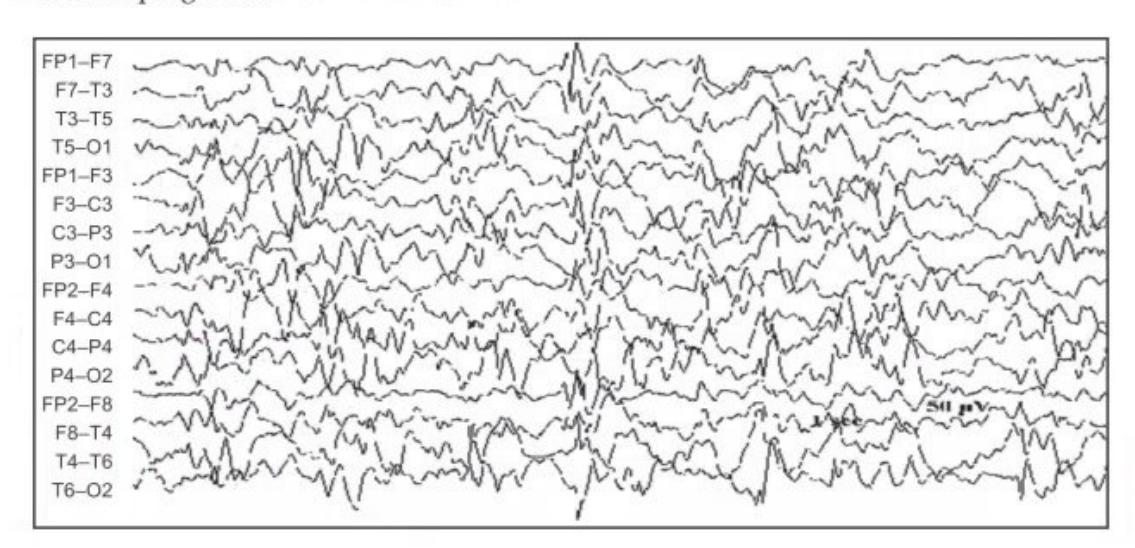
- What is diagnosis of EEG pattern?
- What are types of disease and causes?
- What is treatment options with name?
- What is prognosis?
Answer
- Infantile spasms with hypsarrhythmia—West syndrome EEG—chaotic, high amplitude, multifocal spikes and polyspikes, asynchronous, arrhythmic
-
- Two types: Cryptogenic and symptomatic
-
- Drugs of choice
- ACTH-75 u/kg/m2
- Vıgabatrin
- Steroids
-
- Poor
MNJ04-004
* A 3-year-old child admitted with complains of high grade fever with seizure, rash and loss of consciousness from last 2 days, EEG done:
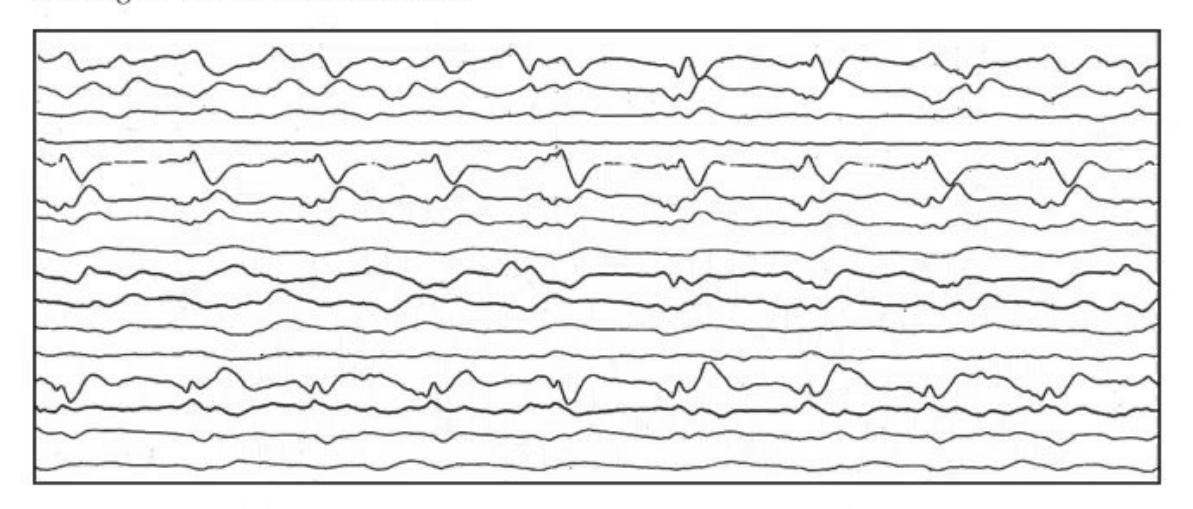
- Diagnosis of EEG pattern and diagnosis
- Site of lesion in MRI brain in this disease.
- Drug use in treatment with dose.
Answer
- Pleds (Periodic lateralization epileptiform discharge), herpes encephalitis
-
- Fronto-temporal area
- Acyclovir (10 mg/kg/dose, IV, TDS)
MNJ04-005
7-year-old boy presents with nocturnal seizure, jerky movements of the lips, eyes wide open, unable to sleep, hypersalivation, EEG done:
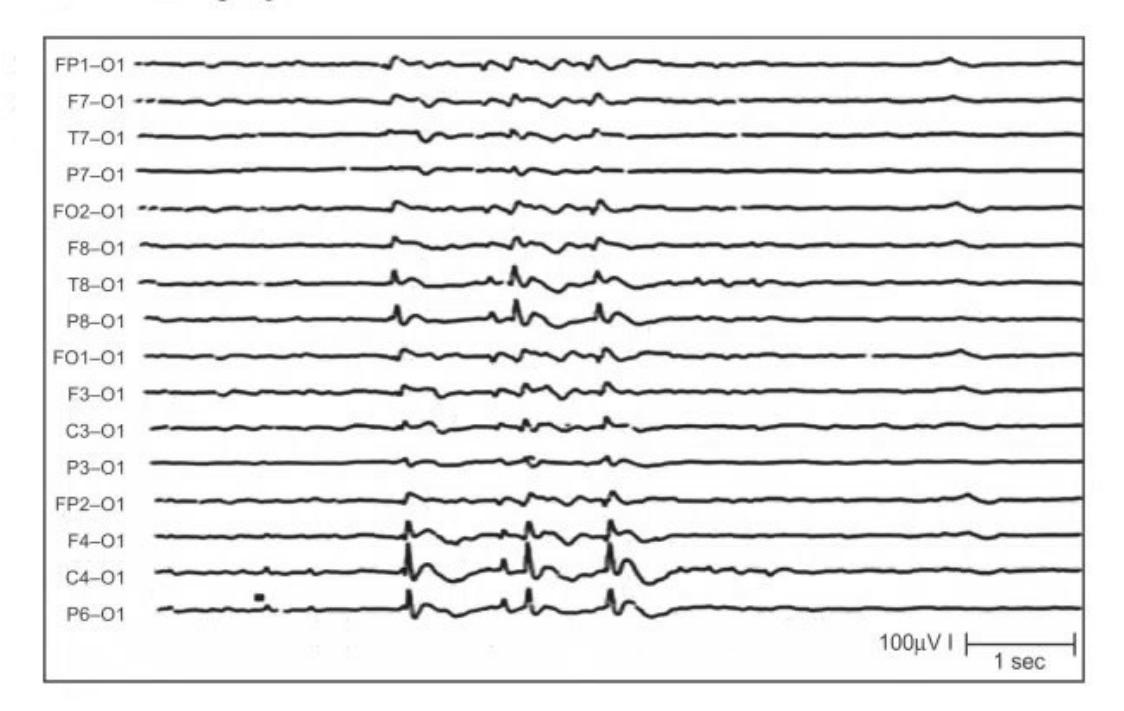
- Diagnosis of condition.
- Two important clinical features at face.
- Treatment and prognosis
Answer
- BECTS—benign childhood epilepsy with centro-temporal spikes (Rolandic epilepsy)
- Oneset 1–14 years, unilateral facial sensorimotor seizures, speech arrest, oropharyngeal manifestations, hypersalivation
- Prognosis—most remit in 2–4 years, treatment—nil, IF daytime seizure drugs: Carbamazepine
MNJ04-006
8-year-old boy, history of delayed milestones—walking 2 years, speech 3 years, multiple types of seizures several times a day-2 months, tonic seizures, atonic falls, myoclonic seizures, and regression of milestones:
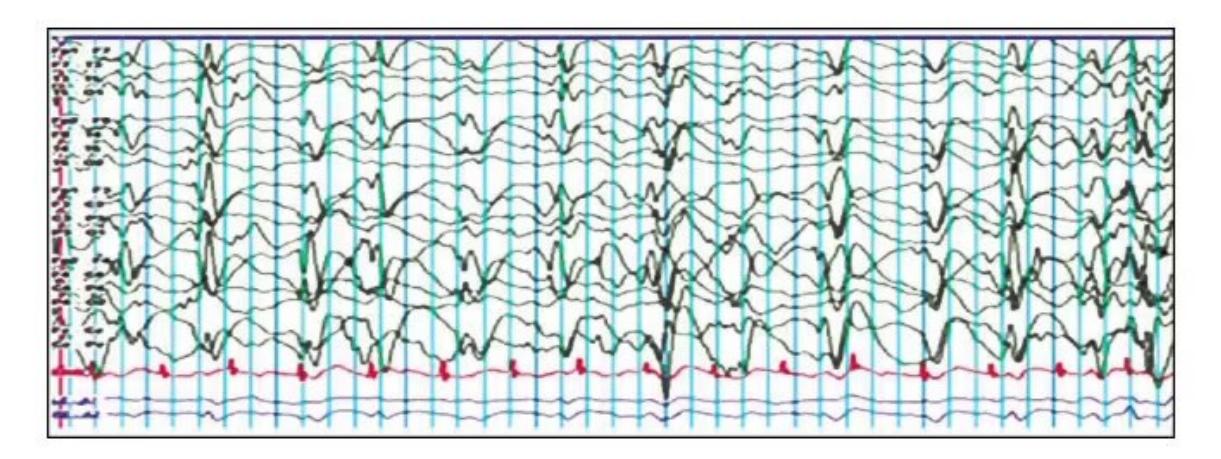
- What is EEG pattern and diagnosis of disease?
- Management options and name of surgery.
- What is test that is done before giving anesthesia in neurosurgery of a child with seizure?
Answer
- EEG of Lennox-Gastaut syndrome—background—slow and disorganised, slow generalized spike wave (<2.5 cps), multiple independent spike foci
- Multiple AET (anti-epileptic drugs), ketogenic diet, IVIG Surgery—corpus callosotomy
-
- Wada test
MNJ04-007
* 4-year-old girl presented with fever and recurrent focal seizures—2 days comes in status epilepticus. Seizures stop after lorazepam and phenytoin. Patient remains comatose >24 hours after all motor seizures have stopped:
ECG EXERCISES
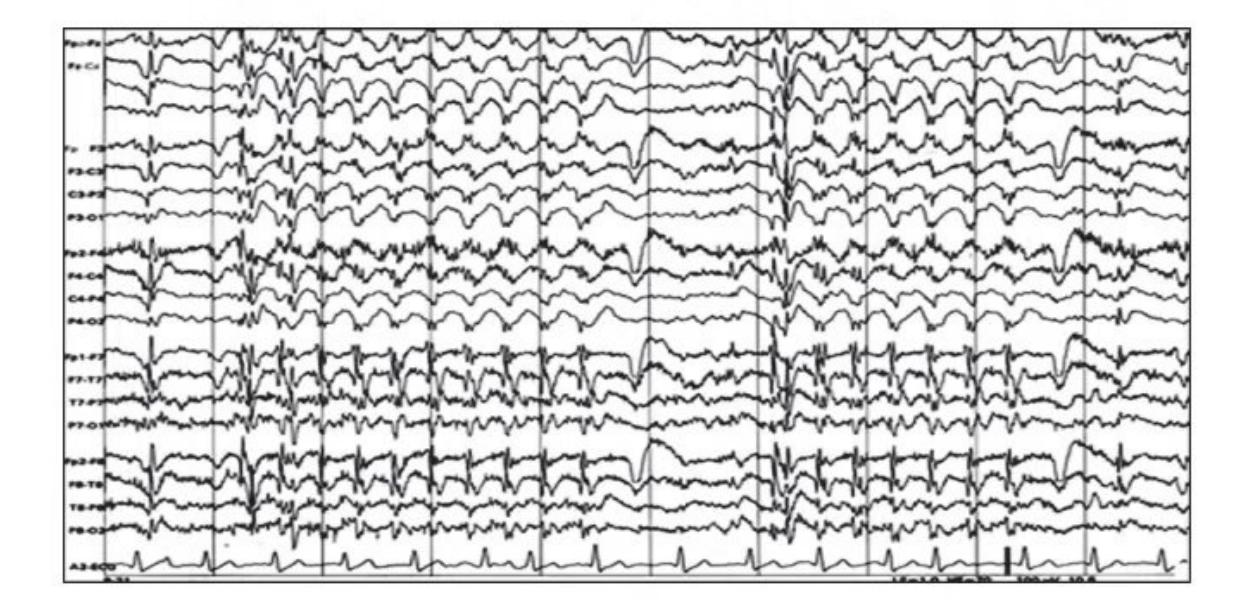

- Diagnose the EEG pattern.
- What is best way to diagnose this problem?
Answer
- EEG of NCSE (non-convulsive status epilepticus)
- · Spikes, waves, rhythmic activity
- · Focal or partial features, discrete or continuous
- Cyclic or recurrent patterns
- May correlate with changes in behaviour and responsiveness
- Significant improvement in discharges and sensorium on giving IV anti-epileptics, 24 hours EEG monitoring.

ANSWERS (ECG)
MNJ04-008
* A 2-month baby presents with hypotonia, X-ray and EEG was done:
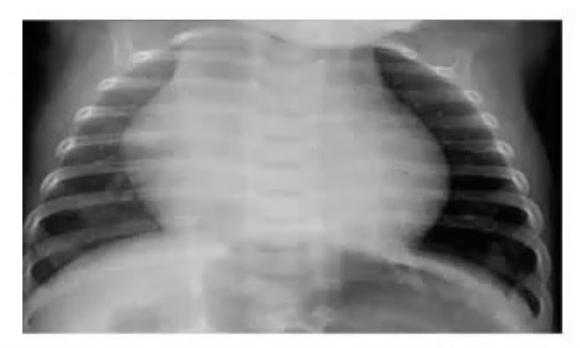
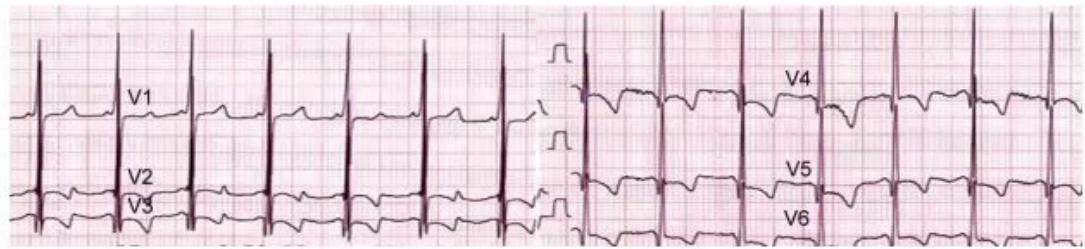
- What is finding in X-ray and EEG suggest the diagnosis?
- What are differential diagnosis?
- What is test for confirm diagnosis?
- Treatment
Answer
- Pompe's disease
- · CXR. Cardiomegaly with history of floppy infant
- · ECG has extremely tall QRS complexes
- · Needs to be taken at half calibration
- · Short PR interval
- Differential diagnosis SMA, hypotonic CP, Down syndrome, congenital muscular dystrophy
-
- Diagnosis Enzyme assay
- Treatment: Enzyme replacement (myozyme <8 years age), lumizyme (>8 years age), dose = 20 mg/kg
MNJ04-009
*
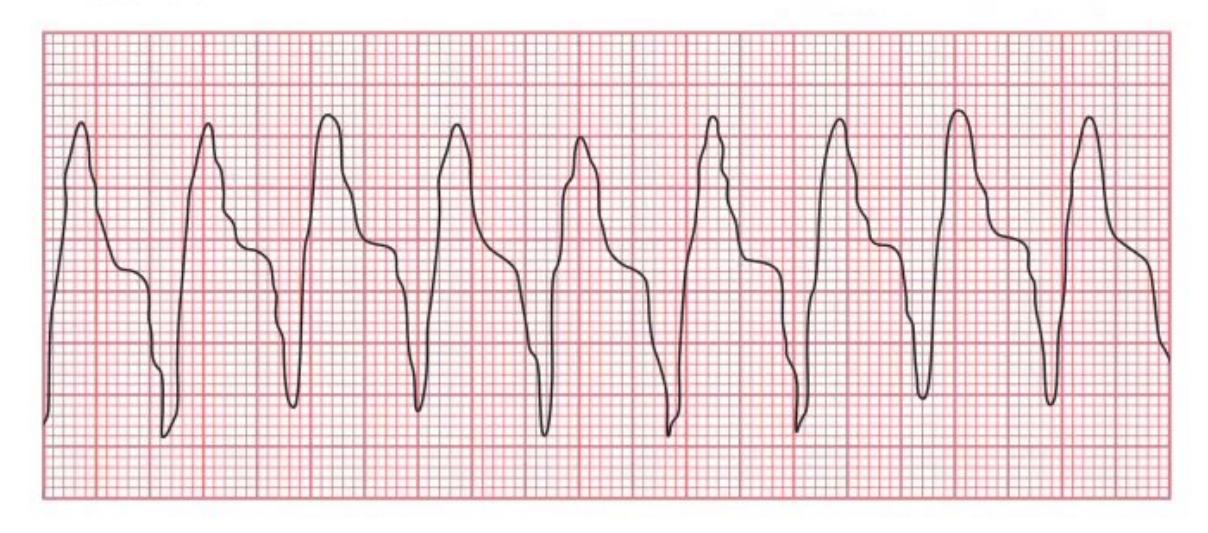
- What is the rate?
- Is the QRS wide or narrow?
- Causes
- Treatment
Answer
- Ventricular tachycardia Rate >120/min
-
- QRS >0.08 sec
-
- Causes: Myocarditis, LCAPA, tumour, long QT, drugs, surgery
-
- Treatment:
Stable—IV amiodarone, IV lignocaine, IV procainamide Unstable—DC shock
MNJ04-010
- Diagnose the condition shown in ECG.
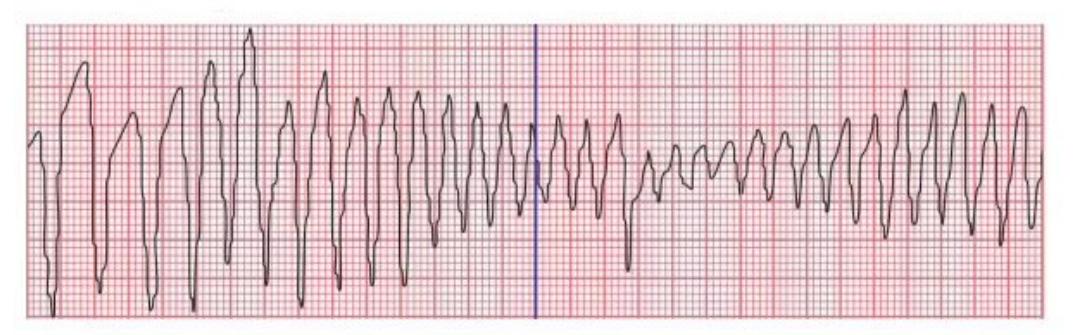
- Causes leads to this condition including 2 electrolytes
- Treatment of disease.
Answer
- Torsade de pointes Gradual change in amplitude of QRS-rate 150-250/min
-
- Prolonged QT interval, hypokalemia, hypomagnesemia
-
- IV magnesium sulphate
MNJ04-011
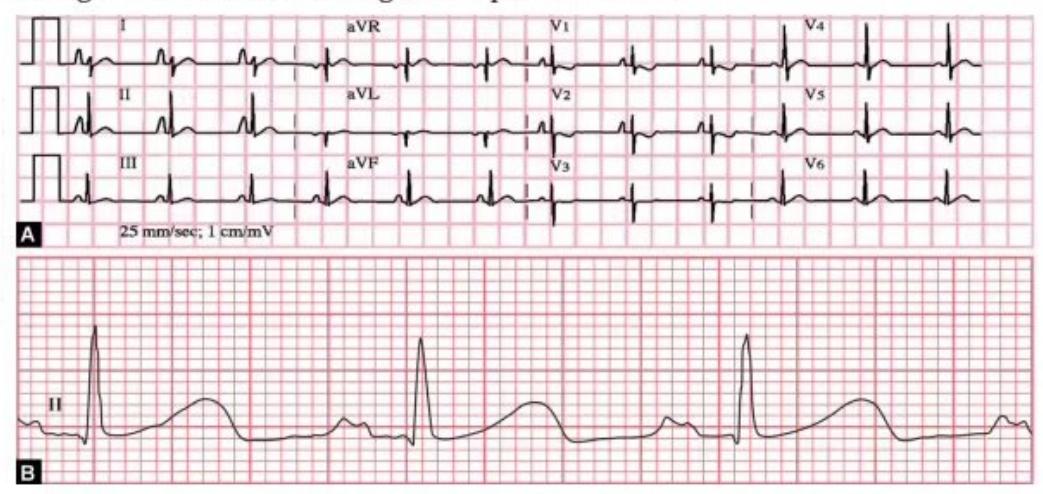
Diagnose these 2 ECGs and give one possible cause:
Answer
- P-pulmonale: P-wave >3 SD, right atrial enlargement
-
- P-mitrale: P-wave-notched and wider than 3 SD, left atrial enlargement-MS
MNJ04-012
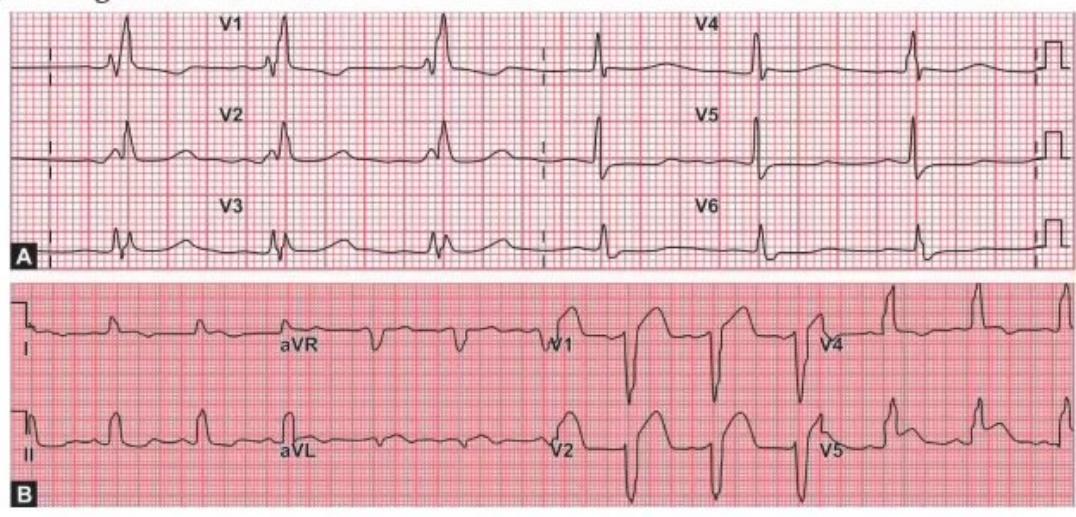
Diagnose these 2 ECG conditions:
Answer
- RBBB: Wide QRS >0.12s (3 small divisions), M morphology in V1, V3
- LBBB: Wide QRS >0.12s (>3 small divisions), M morphology in V5 and W in V1
MNJ04-013
* 20-day-old patient presents with fussiness and poor feeding. You are not sure about P-waves as quality is poor. BP: 80/50 mm Hg, CFT: <2 seconds:
-
Calculate HR on ECG and what should be the next step in management (other than supportive, paracetamol, comfort)?
-
Repeat ECG showed same pattern. Condition of the baby same Name one drug which is contraindicated in above situation and name simple non-pharmacological procedure which can be applied to this patient and also define how many attempts can be made if first time the procedure was unsuccessful (mention total number of attempts including the first attempt)
-
Prior to giving any medication patient becomes hypotensive mottled and cold. No IV cannulae in place. His heart rate is 300/min. Next therapeutic step would be.

- What is diagnosis and ECG features of this condition?
- After failure of the above attempt what procedure or drug would you like to give? Give dose for 4 kg baby and also assume weight of the child 70 kg Mention the name and dose. Also mention 2 precautions while giving above drug/procedure
Answer
- Supraventricular tachycardia. Narrow complex tachycardia
- HR 300/min 1500/5 (small squares between two r waves ), obtain ECG with 50 mm strip speed (with preferable non-crying baby).
-
- Verapamil. Ice pad placed over the face Causes vagal stimulation decreasing the AV conduction (total 2 attempts: 10–15 seconds each)
-
- Adenosine max 6 mg/rapid flush/choose proximal vein
-
- Airway/breathing/synchronized cardioversion/sedation and analgesia
MNJ04-014
* Diagnosis A, B, C, D. And give answer of questions ask below about D:
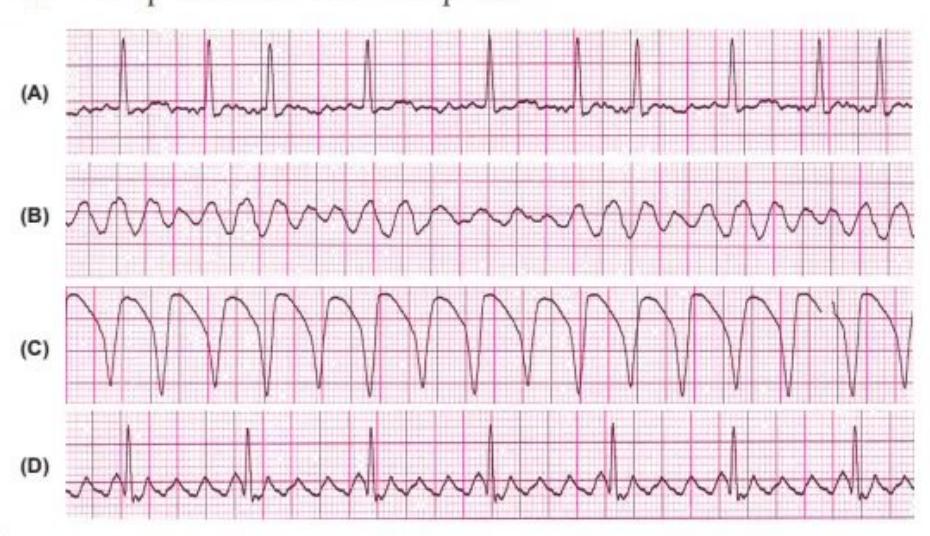
- List 4 underlying disorders causing this.
- What is the treatment of choice for pattern D.
- List 3 drugs useful in treatment for pattern D
- What CNS complication can occur after pattern D.
Answer
- A-Atrial fibrillation
- B—Ventricular fibrillation
- C—Ventricular tachycardia
- D-Atrial flutter
-
- Last question is asked about-atrial flutter
- Synchronised cardioversion
-
- Digoxin, β-blockers, or calcium channel blockers
-
- Thromboembolism and stroke
MNJ04-015
*

- What is the diagnosis of this ECG pattern? Give reason for diagnosis.
- List 3 indications for investigating further in this arrhythmia.
- What is the emergency medication for this arrhythmia?
Answer
- Premature ventricular contrachons (PVCs) mn a bigeminal rhythm.
- * 2 or more ventricular premature beats in a row,
- « Multiform PVCs, and
- * Increased ventricular ectopic activity with exercise
-
- Intravenous hdocaine as bolus
Ans. 16.* Frequently asked in exams:
-
- Deep Q-waves mI, aVL, ST elevation m V5/ V6, this suggests severe myocardial ischemia
-
- Diagnosis ALCAPA This condition mimic with intussusception, colic as ALCAPA present as cardiac ischemic pain
MNJ04-016
* 2-month-old baby with LV dysfunction, mitral regurgitation and cardiomegaly:
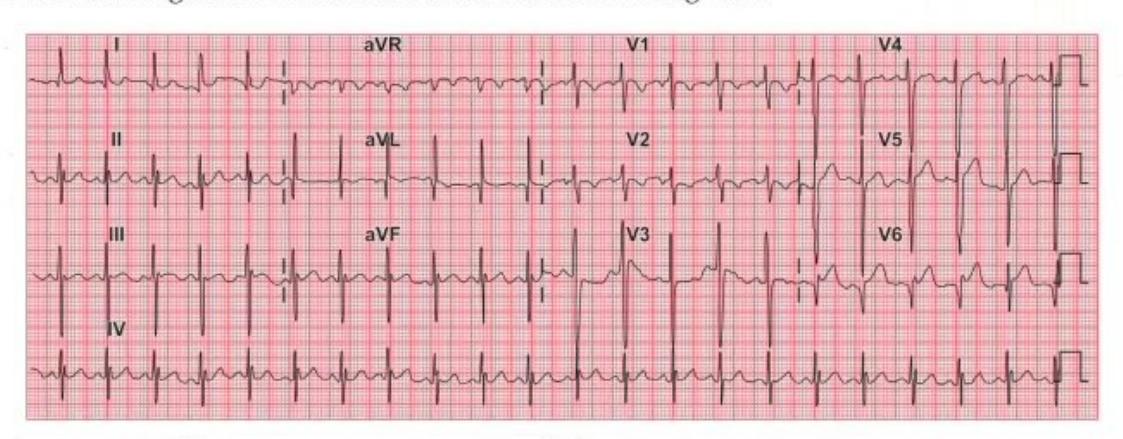
- Identify abnormality in this ECG.
- What is diagnosis of the condtions and differential diagnosis?
Answer
No model answer in source material.
MNJ04-017
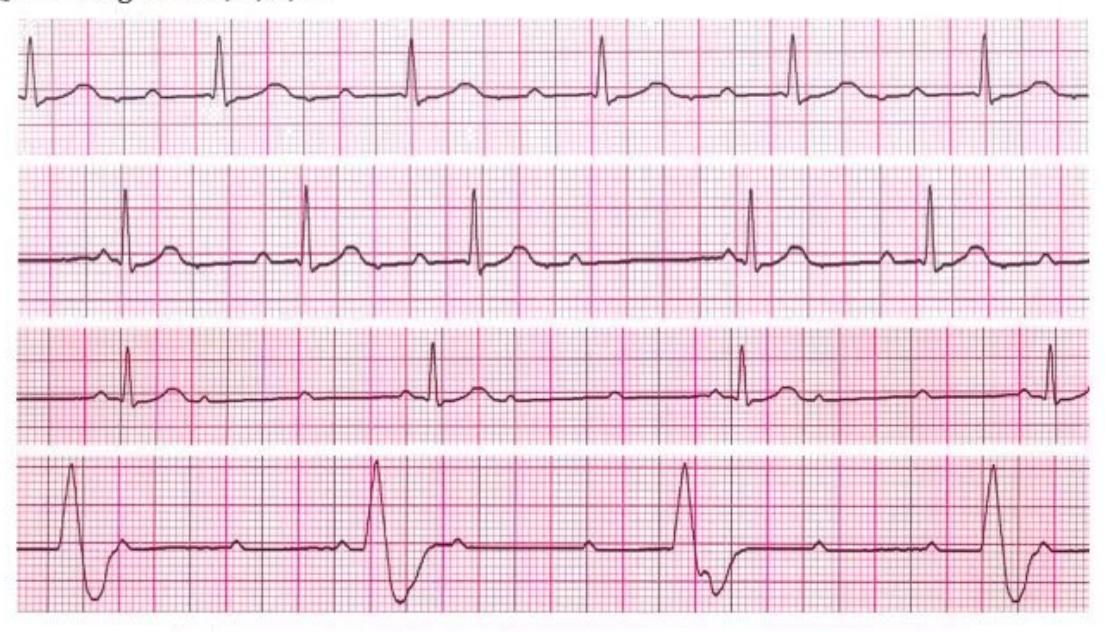
* Diagnosis A, B, C, D:
Answer
- Ist degree AV block
-
- 2nd degree AV block, type-I
-
- 2nd degree AV block, type-II
-
- 3rd degree AV block
MNJ04-018
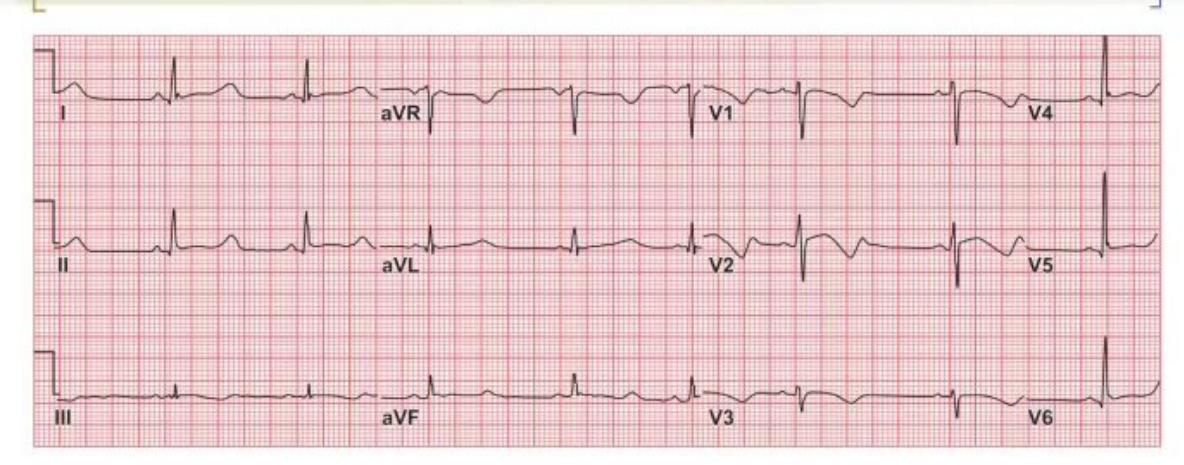
- Identify the abnormality in the ECG.
- What electrolyte abnormality can cause this?
- Why is it important to identify this rhythm disturbance?
Answer
- Prolonged OT interval
- 2 Hypocalcemia
-
- As it can degenerate into dangerous rhythm—V Tac/VF and cardiac arrest.
Ans. 19.1. ALCAPA
-
- Inverted T-wave, V;-V, deep Q-wave, ST elevation, inverted T-wave
-
- Cardiac catheterization
-
- Medical treatment for CCF, ischemma and surgical excision and ligation
ANSWERS (ABG)
Ans. 20.* VV important. See text written in beginning to understand the answers:
| AAG | 0 | +10 | +14 | +10 |
|---|---|---|---|---|
| AHCO, | 0 | ~10 | 4 | <8 |
| AAG/AHCO, | 1 | >1-2 (3.5) | <1 |
MNJ04-019
Two months old baby admitted with recurrent cough, cold, irritability, dyspnea and sweating. EKG done:
ABG EXERCISES
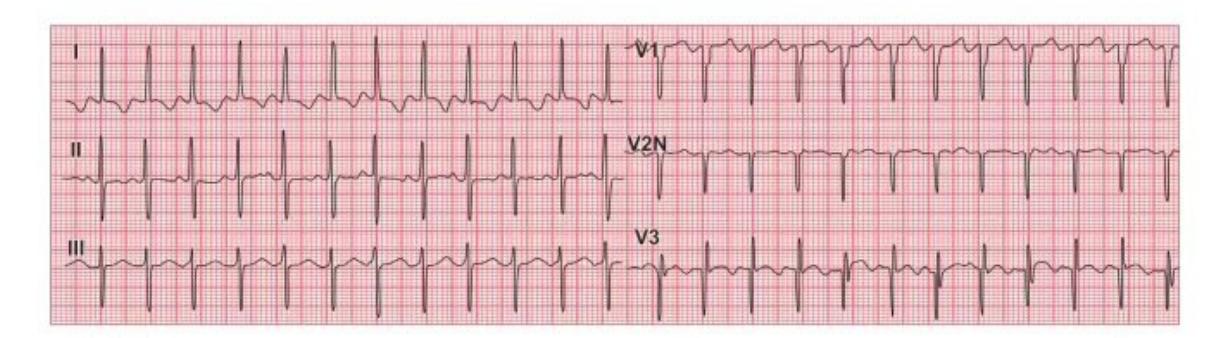
- What is the diagnosis?
- Name 4 EKG findings that helped you in diagnosis.
- What is the diagnostic test?
- Name treatment options of it.
Answer
No model answer in source material.
MNJ04-020
* Identify these acid-base disorder—A, B, C, D. And fill in the blank:
| ABG | A | В | С | D |
|---|---|---|---|---|
| pН | 7.40 | 7.29 | 7.38 | 7.10 |
| pCO 2 | 40 | 30 | 35 | 20 |
| HCO 3 | 24 | 14 | 20 | 6 |
| AG | 12 | 20 | 26 | 22 |
| ΔAG | ||||
| ∆HCO 3 | · · | |||
| ΔAG/ΔHCO 3 |
Answer
No model answer in source material.
MNJ04-021
* A child with short stature, come in OPD. ABG report is here. What is your interpretation in view of?
| FiO; | 100% | |
|---|---|---|
| paQ, | 477 | |
| paco, | 47 | |
| pH | 7.23 | |
| Hco, | 19 | |
| Hb | fges | |
| S. albumin | 2.0 | |
| Sr. Na | 131 | |
| rk | 3.4 | |
| ot Cl | 104 | |
| Ur. Na | 146 | |
| Ur. K | 27.6 | |
| Ur. Cl | 146 | |
| Ur. pH | 6.1 | |
- Diagnosis of ABG
- Amon gap (with this albumin level)
- AAG, AHCO,, delta ratio
- Urinary AG
- Diagnosis of the possible clinical cause
Answer
- Respiratory acidosis + metabolic acidosis (Mix acidosis)
-
- Expected anionic gap = 8 2.5 = 5.5* (see the effect of albumin in beginning)
-
- AAG =0 AHCO;=5 Delta ratio = 0 Therefore, metabolic acidosis with normal AG
-
- Urinary AG = 146 + 27.6 146 = 27 6 positive
-
- Therefore + RTA (Distal, because urine pH > 6)
Ans. 22.1. Hypoxemia
-
- Moderately severe
-
- Increase FiO;
Ans. 23.1. Hyperoxemia
* Expected paO, = 5 x 80 = 400

- * paQ,/ FiO, (old) = paO,/FiO, (new)-mug up this
- * paO, (new) = 220 x 21/80 = 57.8
- . Therefore, patient would be hypoxic on room air:
- . Not advisable to wean
- . Reduce FiO, to 36-40% to get paO, of 100
- pO; slightly increased but acceptable
pO, high, therefore, mcrease minute ventilation (RR x TV)
(old) =
12 x 60 = RR x 40
. RR = 18 (increase RR to 18)
Ans. 25. 1.
=
=
Oxygen gradient = pAQ, — paQ, = 650 - 50 = 600
- . Reversible respiratory failure Oxygen gradient >600 for 12 hr 94% mortality or >610 at 8 hr 79% mortality
MNJ04-022
* The ABG of a patient on room air given below (new pattern Q).
| FiO, | 0.21 |
|---|---|
| pO, | 48 |
| pco, | 40 |
| pH | 7.40 |
| HCO, | 24 |
- What 1s wrong?
- How severe 1s it?
- What will you do?
Answer
No model answer in source material.
MNJ04-023
* ABG of a patient on ventilator given below:
| FiO, | 0.80 |
|---|---|
| pO, | 220 |
| pco, | 34.6 |
| pH | 7.48 |
| HCO, | 26 |
- What 1s wrong?
- How are the lungs?
- Can the patient be weaned?
- What will you do?
Answer
No model answer in source material.
MNJ04-024
24.* ABG of a patient on ventilator with FiO,: 40%, TV: 500, RR: 12 is given below:
| FiO, | 0.40 |
|---|---|
| po, | 128 |
| pco, | 60 |
| pH | 7.21 |
| HCO, | 24 |
- What 1s wrong?
- What will you do?
Answer
No model answer in source material.
MNJ04-025
* A baby is admitted to the NICU with persistent pulmonary hypertension (PPHN). He is on ventilator with FiO, 100%, PIP 35 and PEEP 6 and SpO, 85% and he has following lab values:
ABG: pH: 7.22, pCO,: 50, pO,: 50, Na: 136, K: 4, Cl: 103
- Calculate alveolar-artenal oxygen gradient. Assume respiratory quotient (RQ) = 0.8
- What are the indications for extracorporeal membrane oxygenation (ECMO)?
Answer
No model answer in source material.
MNJ04-026
* A 5-month-old boy with development delay, ABG report below: pH: 6.64, pCO,: 25.8, pO,: 396.4, Na*: 140, K*: 4.3, Cl: 95, HCO,:5
- List the abnormalities in ABG.
- Calculate the anion gap.
- Two conditions with increased amon gap.
- Two conditions with decreased anion gap
Answer
- Mixed metabolic acidosis and hyperoxia
- . 40
- . Diabetic ketoacidosis, urerma, methanol, propylene glycol, IEM, lactic acidosis, ethylene glycol, salicylates
- . Hypoalbummemia, lithium toxicity
- 165.25
(Formula)
- . (a) Respiratory acidosis with metabolic compensation
- (b) 80-100 mm Hg . Uml0,/dl
Arterial oxygen content = (Hb x 1 34 x SpQ,) + (0.0031 x paQ,)
MNJ04-027
Interpret the following ABG reports:
- a. What is the ABG diagnosis?
- b. What 1s normal paO, level expected 1f a child is breathing at room air with normal lungs?
- pH7.6/paCO, 25/PaO, 160/HCO, 24 (FiO,-50%) Calculate AaDO, and write the formula
- pH 7.38/paCO, 65/paQ, 48 /HCO, 34 (FiO,-60%)
a. What is the ABG diagnosis?
b. What 1s normal paO, level expected 1f a child is breathing at room air with normal lungs? - pH 7.45/paCO, 40/paO, 120/HCO, 28.5/SpO, 99% /H¢ 8 2% Calculate oxygen content in given blood gas.
Answer
No model answer in source material.