THG25-001
Match the following:
i. Turns head to one side and then upward if sound is made above ear level | | | a. | 7 months |
v. Turns head in a curving arc toward the sound source | | | e. | 3 months |
Answer
Hearing milestones—age of appearance
i: c, ii: d, iii: e, iv: b, v: a
Normal hearing milestones:
| a. | 3 months: Turns head to the side of sound. |
| b. | 5 months: Turns head to one side and then downward if sound is made above ear level. |
| c. | 6 months: Turns head to one side and then upward if sound is made above ear level. |
| d. | 7 months: Turns head in a curving arc toward the sound source. |
| e. | 9 months: Turns head diagonally and directly toward the sound source. |
THG25-002
Q25.2
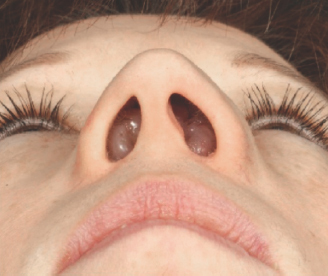
a. What is the diagnosis?
b. What is the most common cause?
c. What are the other causes/associations?
d. Explain common symptoms and signs.
e. Name symptomatic treatment.
f. What is the surgical modality of choice?
g. What are the indications for surgery?
Answer
| a. | Nasal polyp both nostrils |
| b. | Cystic fibrosis |
| c. | Allergic rhinitis, chronic sinusitis, familial (chronic rhinosinusitis with polyp), and low vitamin D levels |
| d. | Blockage of nasal passages resulting in hyponasal speech, mouth breathing, profuse unilateral mucoid, or mucopurulent rhinorrhea |
| e. | Nasal/systemic decongestants, intranasal steroid sprays, and doxycycline |
| f. | Functional endoscopic sinus surgery (FESS) |
| g. | Complete obstruction, uncontrolled rhinorrhea, and deformity of the nose appears |
THG25-003
Q25.3
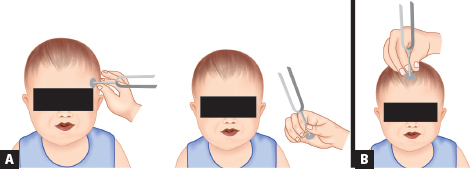
a. Name of two tests given in images A and B.
b. Name the frequency of tuning fork used.
c. What is the purpose of test?
d. What is the interpretation if test A is positive or negative?
e. What is the interpretation if test B is central or lateral?
Answer
| a. | Rinne test and Weber test |
| b. | 256 or 512 Hz tuning fork |
| c. | To assess and compare air conduction and bone conduction |
| d. | Rinne positive = Air conduction is better than bone conduction; Rinne negative = Bone conduction is better than air conduction. |
| e. | Weber central = Sound is equally heard in both the ears. |
| In conducting hearing loss, sound is better heard in the involved ear = Lateralized to the worse ear. In sensorineural hearing loss, sound is heard best in the normal ear = Lateralized to the normal side. |
THG25-004
Q25.4
a. Rinne positive | Rinne positive | Weber central |
b. Rinne negative | Rinne positive | Weber right |
c. Rinne positive | Rinne positive | Weber left |
d. Rinne negative | Rinne negative | Weber central |
Answer
| To determine whether the hearing loss is sensorineural or conductive | ||||
| 0 | Right | Left | 0 | |
| a. | Rinne positive | Rinne positive | Weber central | Normal or bilateral sensorineural |
| b. | Rinne negative | Rinne positive | Weber right | Right conductive |
| c. | Rinne positive | Rinne positive | Weber left | Right sensorineural |
| d. | Rinne negative | Rinne negative | Weber central | Bilateral conductive |
THG25-005
An adolescent presented with history of fever, sore throat, trismus, and dysphagia.
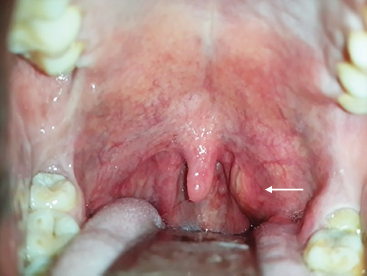
a. What do you see? What is the diagnosis?
b. What is the etiology?
c. Name the most common pathogens.
d. What are the complications?
e. What is the management?
Answer
| a. | Unilateral/asymmetric tonsillar bulge and acute peritonsillar abscess |
| b. | Oropharyngeal and dental infections |
| c. | Group A streptococci and mixed oropharyngeal anaerobes |
| d. | Parapharyngeal abscess and retropharyngeal abscess |
| e. | Surgical drainage (needle aspiration) and antibiotic therapy |
THG25-006
A 7-month-old infant with history of excessive crying, irritability, fever, tugging of left ear—otoscopic examination reveals in given image.
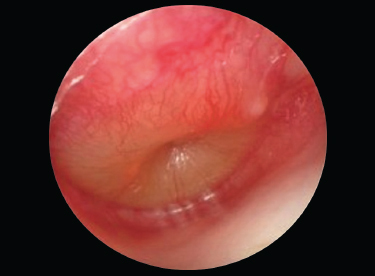
a. What are the otoscopic findings?
b. What is the diagnosis?
c. Describe the prevention strategies (any four).
d. Name the most common pathogens.
e. Mention antibiotics recommended for first-line treatment and duration.
f. What are the complications (at least eight)?
Answer
| a. | Bulging of tympanic membrane and erythema of tympanic membrane |
| b. | Acute otitis media |
| c. | Avoidance of contact with individuals having respiratory infection; ensuring vaccination against pneumococci and Haemophilus influenzae; avoiding exposure to tobacco smoke; breastfeeding; avoidance of pacifier; avoidance of bottle feeding especially in recumbent position |
| d. | Streptococcus pneumoniae, nontypable H. influenzae, and Moraxella catarrhalis |
| e. | Amoxicillin or co-amoxiclav; 10 days |
f. • Infratemporal complications: Dermatitis, tympanic membrane perforation, chronic suppurative otitis media (CSOM), mastoiditis, hearing loss, facial nerve paralysis, cholesteatoma formation, and labyrinthitis.
| • | Intracranial complications: Meningitis, epidural abscess, subdural abscess, focal encephalitis, brain abscess, sigmoid sinus thrombosis, and otitic hydrocephalus. |
THG25-007
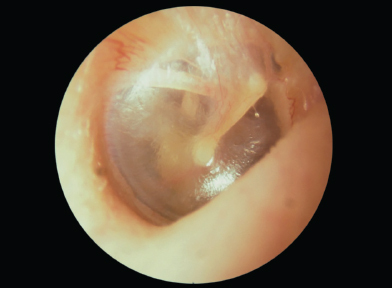
Identify this image
Source: https://commons.wikimedia.org/wiki/
Answer
Normal tympanic membrane
Tympanic membrane, otoscope view: A healthy tympanic membrane (ear drum) shows a circular, translucent membrane with the handle of the hammer (malleus), protruding on the upper left. Malleus is the first of the three ossicles connecting the membrane to the inner ear. Adjacent to the handle of the malleus, the second bone, the incus (anvil) can be seen where it attaches with the stirrup (stapes). Across the incus, a thick white line is seen. It is the chorda tympani nerve.
THG25-008
A 7-year-old boy developed severe ear pain 1 day after swimming in a community pool. Pain is accentuated on manipulation of pinna, there is tenderness over tragus and pinna. On examination, there is erythema, edema of ear canal, and otorrhea.
a. What is the diagnosis?
b. Name the most common causative organisms (any three).
c. What are the otoscopic findings?
d. What is the mainstay of treatment?
e. If the same boy develops facial paralysis, vertigo, sensorineural hearing loss, lateral displacement of pinna what will you suspect?
Answer
| a. | Otitis externa |
| b. | Pseudomonas aeruginosa, Staphylococcus aureus, Enterobacter species, Proteus, Klebsiella, streptococci, fungi—Candida, Aspergillus, and Diphtheroids. The most common is P. aeruginosa |
| c. | Tympanic membrane is normal or opaque; tympanic membrane mobility is normal or reduced if it is thickened. |
| d. | Topical otic preparations containing acetic acid with or without hydrocortisone or neomycin |
| e. | Necrotizing (malignant) otitis externa |
THG25-009
A 6-year-old boy presents with audiogram as given in below image. A history of recurrent upper respiratory tract infections treated with recurrent courses of antibiotics. His speech is limited, but he has no other medical problems. His father and grandfather who are with him are smokers.
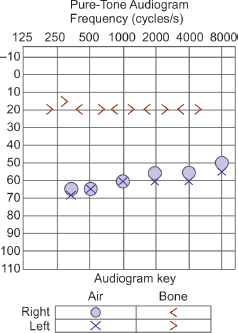
a. What does the audiogram show?
b. At what age is pure tone audiometry possible?
c. What is the most likely cause for the speech defect?
d. Give three steps to help him with his hearing and speech defect.
Answer
| a. | Bilateral conductive hearing loss |
| b. | 5 years |
| c. | Bilateral otitis media |
| d. | Grommet insertion; Advise the child to sit at the front in his class; reduce cigarette smoking exposure; speech therapy. |
THG25-010
Parents of a 6-year-old boy reports that he has restless sleep, loud, frequent, and disruptive snoring, breathing pauses, choking arousals, and nocturnal diaphoresis. During daytime, he has mouth breathing and dry mouth, chronic rhinorrhea, drowsiness, hyponasal speech, and poor appetite.
a. What is your diagnosis?
b. Enumerate anatomical factors (at least six) that predispose to this condition.
c. What is the gold standard test for diagnosing this condition?
d. Name most commonly used parameter in this test for evaluation.
e. If gold standard test is not available what alternate tests you can perform?
f. ________ is the first-line treatment advocated in a child with ________?
Answer
| a. | Obstructive sleep apnea |
| b. | Deviated nasal septum, seasonal/perennial allergic rhinitis, adenotonsillar hypertrophy, macroglossia, micrognathia/retrognathia, and achondroplasia |
| c. | In-laboratory overnight polysomnogram |
| d. | Apnea-hypopnea index (AHI) |
e. Nocturnal video recording, nocturnal oximetry, daytime nap polysomnography, or ambulatory polysomnography
| f. | Adenotonsillectomy in significant adenotonsillar hypertrophy |
THG25-011
A 28-day-old well thriving term infant is brought to outpatient department with complaints of persistent stridor, noticed since birth. This is associated with increased work of breathing as in inspiratory obstruction like suprasternal and subcostal retractions. He is able to feed well and is growing well but frequently regurgitates.
a. What is most likely diagnosis?
b. How you will confirm your diagnosis?
c. What is the treatment?
Answer
| a. | Laryngomalacia. |
| b. | Explanation: Laryngomalacia is common condition, characterized by noisy breathing that exacerbates during viral upper respiratory tract infections or when lying in the supine position. |
| c. | Flexible laryngoscopy and expectant observation |
THG25-012
A 2.5-month-old infant has been experiencing worsening biphasic stridor. Her parents give history of two brief episodes of croup. There is a 1-cm-diameter hemangioma on the infants’ right thigh.
a. What is the most likely diagnosis?
b. What will be radiographic finding?
c. How will you manage?
Answer
| a. | Congenital subglottic hemangioma |
| b. | Asymmetric subglottic narrowing |
| c. | Medical management: Prednisolone 2–4 mg/kg for 4–6 weeks; interferon-α-2a in life-threatening steroid-resistant cases. |
THG25-013
A 3-month-old infant developed biphasic stridor and barking cough during an episode of upper respiratory tract infection; Past history of recurrent such episodes once/twice a month. Bronchoscopy was done.
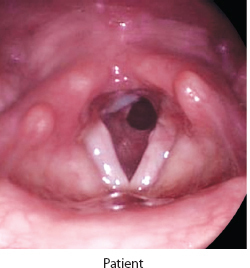
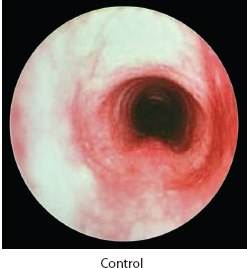
a. What is your diagnosis?
b. How will you grade the severity of this condition?
c. How will you treat this child?
Answer
| a. | Congenital subglottic stenosis |
| b. | Grade 1: <50% obstruction; Grade 2: 51–70% obstruction; Grade 3: 71–99% obstruction; Grade 4: No detectable lumen. |
| c. | Expectant observation |
| Note: Majority of congenital subglottic stenosis cases resolve spontaneously as the child grows. However in cases with significant airway compromise, endotracheal intubation and tracheotomy may be required. Children who require tracheotomy can be decannulated by 3–4 years of age as the subglottic space widens. |
Figure Sources
Figures of Q25.2, Q25.5, Q25.6, Q25.7 and Q25.9 are from open source.
Figure of Q25.3 are redrawn by artist.
Figure of Q25.13 are from author’s personal collection.