MNJ31-001
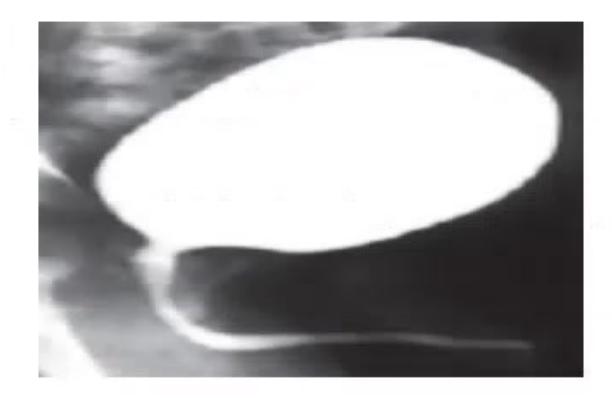
- Name the investigation.
- What 1s the diagnosis?
- What are the further inveshigatons this child need?
Answer
- MCU (Micturating cystourethrogram)
-
- Posterior urethral valves
-
- DTPA (diethylenetriamine penta-acetic acid) function
- DMSA (dimercaptosuccinic acid)—scarring
MNJ31-002
See the image and answer the following questions.
Tar |
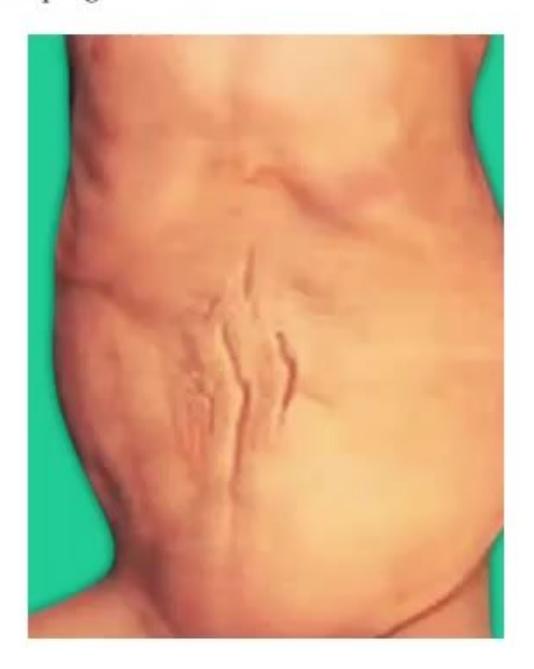
- Give the diagnosis of this condition
- Give four important components
- State the most important prognostic factors.
Answer
- Prune-belly syndrome
-
- Important components
- a. Abnormal abdominal musculature
- b. Abdominal cryptorchidism
- c Renal and ureteric anomalies with VUR
- d. Pulmonary hypoplasia
Long-term complication
- a. ESRD (End stage renal disease)
-
- Prognostic factors
- a. Degree of renal dysplasia
- b. Pulmonary hypoplasia
MNJ31-003
- *® Growth hormone 1s a mode of treatment for short stature due to CKD.
- * Anema in CKD 1s caused primarily due to loss of ferritin in urine
- * The most common form of renal osteodystrophy seen with CKD 1s high turnover bone disease
- How do you determine GFR using serum creatinine with Schwartz formula?
- Whats stage II chromic kidney disease (CKD) in terms of GFR?
- State True / False
Answer
- GFR (ml/min/1.73 m2)
where K is
- · 0.33 for low-birth weight infants younger than 1 year,
- · 0.45 for term AGA infants younger than 1 year,
- · 0.55 for children and adolescent females, and
- · 0.70 for adolescent males
- Stage 2 CKD: GFR 60–89 ml/kg/1.73 m2
-
- True
- False
- True
| Table 31.1: Genet Standardized terminology for stage of chronic kidney disease | ||
|---|---|---|
| Stage | Description | GFR (ml/min/1.73 m) |
| Stage 1 | Kidney damage with normal or increased GFR | >90 |
| Stage 2 | Kidney damage with mid decrease in GFR | 60-89 |
| Stage 3 | Moderate decrease in GFR | 30-59 |
| Stage 4 | Severe decrease in GFR | 5-29 |
| Stage 5 | Kidney failure GFR | <15 or on dialysis |
MNJ31-004
A 6-year-old boy Rajeev presented with periorbital puffiness, red color urine. He had history of URTI 12 days back and now on examination he had tachycardia, tachypnea and his BP 142/80 mm Hg:
- Whats the most likely diagnosis of this clinical scerurio?
- What investigations will you do to confirm the diagnosis?
- What 1s the drug of choice for hypertension?
Answer
- Acute glomerulonephritis
-
- ASLO titre and C3 level
-
- Loop diuretics
MNJ31-005
A 12-year-old boy Vivek presents with 2 episodes of gross hematuria. He also has hearing impairment. All other clinical examination is normal:
- Whats the likely diagnosis?
- Which are the other extra renal manifestations present in this condition?
- What are the patterns of inheritance?
Answer
- Alport syndrome
-
- Bilateral sensormeural hearing loss
- Ocular abnormalities—anterior lenticonus
- · Macular flecks, corneal erosions
- · Leiomyomatosis of the esophagus
Nephrology 439
-
- X-linked disease: 85%
- AR: 10%
- AD: 5%
MNJ31-006
A 14-year-old male child Bhanu presented with complaints of severe failure to thrive, history of recurrent vomiting, polyuria. On examination he is moderately dehydrated with
Nephrology 433 |

- What 1s the most likely diagnosis?
- What are the various types of this disorder?
- Give three secondary causes of this condition.
- How will you manage this child?
Answer
- Distal RTA
-
- Distal RTA (Type I), proximal (Type II), hyperkalemic (Type IV)
- Interstitial nephritis, obstructive uropathy, vesicoureteral reflux, pyelonephritis, sickle cell nephropathy, Ehlers-Danlos syndrome, lupus nephritis: Toxins/ medications
- Bicarbonate replacement—4 mEq/kg/day in TID doses Potassium supplementation
MNJ31-007
A6-year-old girl Megha is referred with an abdominal mass found by her mother as she was undressing her. She has had no significant problems in the past. On examination, you note a mass arising from the right renal angle extending medially almost to the midline and inferiorly 10 cm. Her BP is noted to be 160/110. Investigations of plasma urea, creatinine, and electrolytes are normal, urine microscopy—haematuria +++, culture—no growth:
- What are the 2 most likely diagnosis?
- Explain why the BP 1s raised in these 2 condibons.
- For each diagnosis give one site where further lesions might be commonly found.
Answer
- Wilms' and neuroblastoma
- Wilms'—renal ischemia
Neuroblastoma-increased catecholamine secretion
- Wilms'-lung
Neuroblastoma-long bones
MNJ31-008
A 4-day-old newborn male baby of Anita with history of oligohydramnios in the antenatal period in the mother underwent MCU (Micturating cystourethrogram):
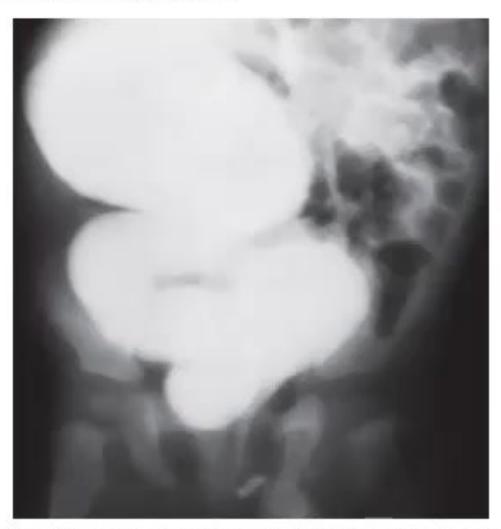
- Describe the MCU image.
- What 1s the absolute indication for MCU in newborn?
- What antenatal intervention would have helped this child?
- What are the chances of CKD in adolescence in this child?
- What are the surgical procedures possible?
Answer
- MCU showing narrow anterior urethral stream, dilated posterior urethra, dilated and trabeculated bladder with diverticulae and secondary VUR
-
- Suspected PUV (Posterior urethral valve)
-
- Vesicoamniotic shunting
-
- 20-30%
-
- Primary fulguration, vesicostomy and high ureterostomy/ureterostomies
MNJ31-009
2-year-old male Rahul with acute gastroenteritis develops anuria. His Hb is 8.5, platelet count: 80,000 and PT: 24/20, PTT: 28/30:
- Describe PS (Peripheral smear of blood film) of this child.
- . Mention two most common differential diagnoses for 1t Oe Ne
- Which single test will help differentiate your D/D?
- This baby's renal functions deteriorated after 2 units of FFP What would be the possibility?
- What are indicathons of steroids in this case scenario?
- oe Which other conditions here similar PS findings?
Answer
- Microangiopathy—hemolytic anemia with helmet cells, burn cells, He—RBCs
-
- HUS, RVT
-
- Doppler USG
-
- HUS due to Streptococcus pneumoniae
- Seizures
-
- Malignant hypertension, SLE
MNJ31-010
An 8-year-old boy Bhushan brought from his native place with history of fever and hematuria for last three days. He was apparently alright 3 months back. He had epistaxis from right and then from both nostrils. Also noted to have red eyes without discharge. 1 month back developed cough and had hemoptysis. He was noted to have breathlessness since 1 week. His voice has changed significantly as per his mother:
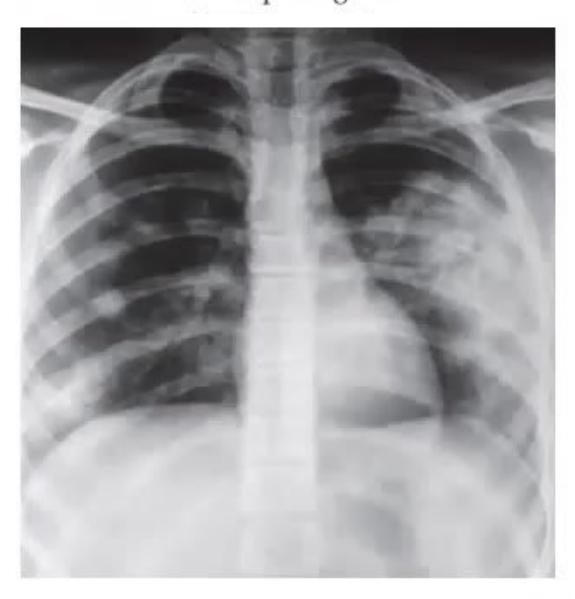
- Clinical diagnosis.
- Name the confirmatory lab test for this disease.
- Write (any 2) treatment options.
- Name (any 2) other diseases with similar pathogenesis
Answer
- Granulomatosis with polyangiitis (GPA)—Wegener
-
- PR4 ANCA of C-ANCA
-
- Rituximab
- Cyclophosphamide
- Plasmapheresis
-
- Churg-Strauss syndrome
- Henoch-Schonlein purpura (IgA vasculitis)
- · Microscopic polyangiitis
MNJ31-011
An infant born to diabetic mother presented with hematuria/anuria with bi-enlarged kidneys on USG and CBC showed Hb: 22.5, HCT: 72%, TLC: 9100, platelet: 70,000:
- Clinical diagnosis of this condition.
- Differential diagnosis of this condition.
- Diagnostic modality for this condition.
- Treatment principles.
- Long-term complications.
Answer
- Renal vein thrombosis
-
- HUS, DIC, sepsis
-
- USG Doppler-kidneys
-
- Treatment of predisposing condition and systemic heparinization
-
- Atrophy of affected kidney, systemic hypertension
MNJ31-012
A child Monu presents with muscle cramps since last 7 days. The serum magnesium is 1.2 mg/dL, K is 1.6 mg/dl and HCO3 is 42 mg/dl. There is no sign of dehydration:
- What electrolyte in urine will you estimate?
- Why?
- The level of the urinary electrolyte estimated is high—BP is normal. List 3 possible diagnosis.
- There is no history of drug ingestion or failure to thrive, hypertension. What is the diagnosis?
- 3 drugs for treatment
- What will be level of renin and aldosterone in serum?
- What will be the urinary calcium level?
Answer
- Calcium
-
- To distinguish low and high urine calcium levels
-
- Barter, Gitelman and base administration
-
- Gitelman's syndrome
-
- Na, Mg and indomethacin
-
- Normal
-
- Low
MNJ31-013
With regard to the renal radioimaging, identify the following images and mention the name of the imaging:
Nephrology 435 |
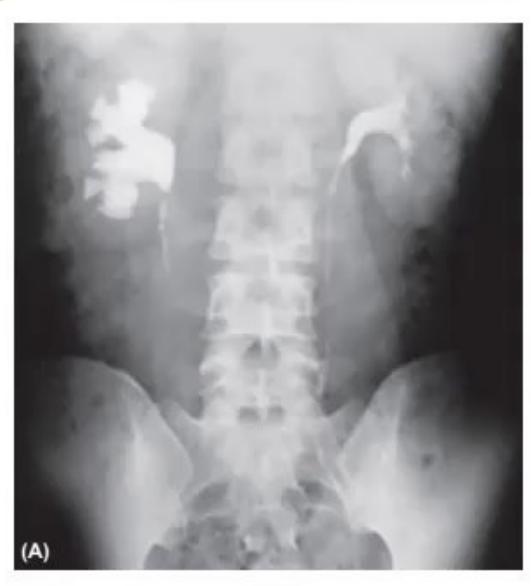
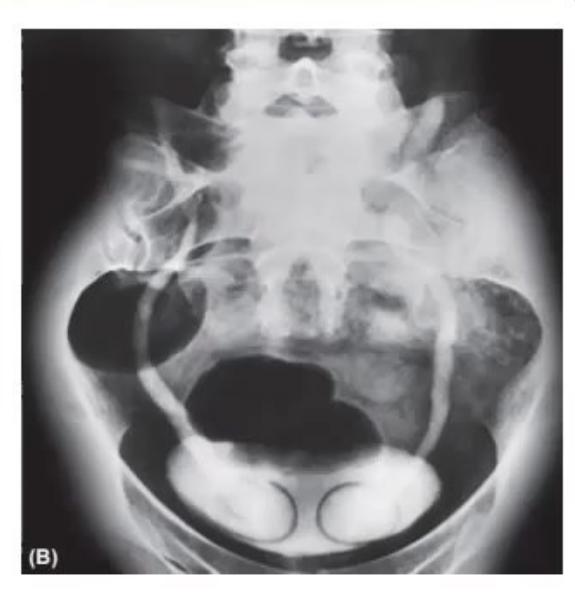
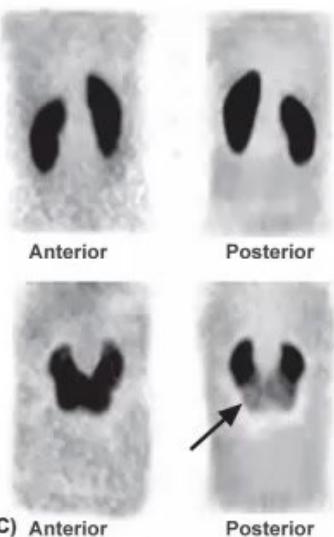
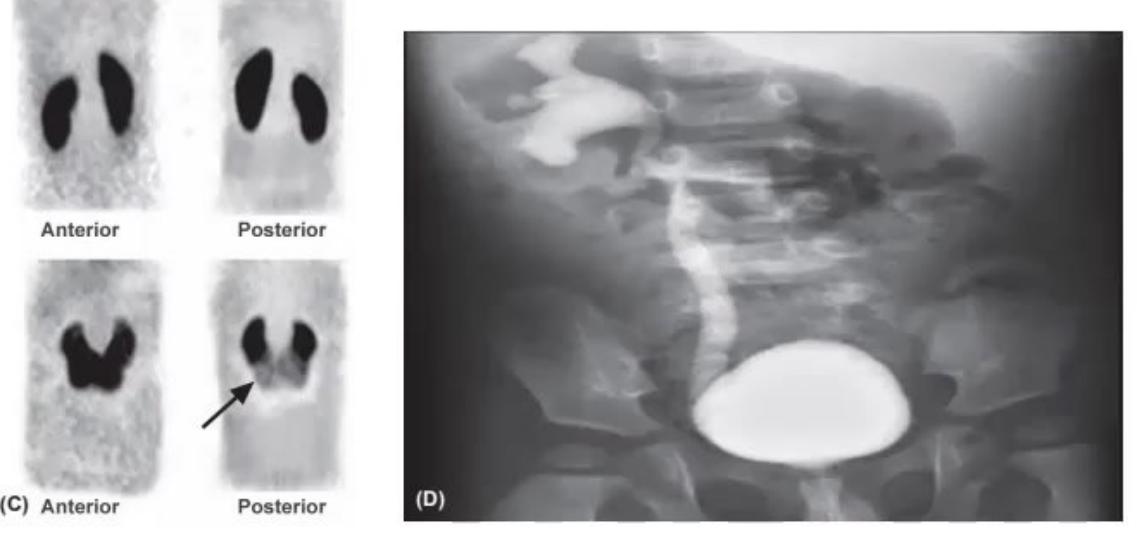
Answer
A. PUJ obstruction—excretory urogram
- B. Ureterocele-excretory urogram
- C. Horseshoe kıdney—DMSA scan
- D. Grade IV VUR-VCUG/MCU
MNJ31-014
A 13-year-old girl Radha, history of recurrent muscle cramps, ABG-pH: 7.65, pO,: 98, HCO,: 37, pCO,: 46, SaQ,: 98:
- Interpret the ABG.
- Is it compensated? What is the formula for compensation?
- What is the probable diagnosis?
- Whats the basic defect?
- Mention 3 associated metabolic abnormalities in this condition.
Answer
- Metabolic alkalosis.
-
- Compensated. pCO2 increases by 7 for every 10 mm increase in HCC
-
- Gitelman's syndrome.
-
- Defect in sodium chloride co-transporter in DCT
-
- Hypokalemia, hypomagnesemia and hypocalciuria.
MNJ31-015
A 7-month-old male child Sanju admitted with complaints of tubercular meningitis. He is unimmunized till date. His serum sodium 124, S.K: 4.1:
- What cause of this low sodium you will suspect in this case?
- How will you correct this hyponatremia?
- What investigation you advise to confirm you the diagnosis of this low sodium?
Answer
- Cereberal self wasting
-
- 3% NaCl
-
- S uric acid, vasopressin acid
MNJ31-016
Match the investigation of choice with given renal conditions: Each option may be use once, more than once or not at all.
- Abdominal X-ray in. Pylonephritis
- IVU (intravenous urography) v. VUR
- DMSA i Horse shoe kidney
- MCUG 11. Detection of obstructive renal disease
- USG iv. Diagnosis of renal artery stenosis
- MAG 3 scan vi. Calcium stone in ureter
Answer
- E, 2. A, 3. F, 4 F, 5. C, 6. B
**Calcium stone are radio opaque so we can see them in X-ray but oxalate, uric acid and xanthine stones are radiolucent so visible only on USG. For any anatomical defect like horse shoe kidney, duplication of renal system IVU is good investigation. Hydronephrosis because of obstruction or without obstruction is best diagnosed by MAG-3 scan. Vascular pathology like renal artery and venous stenosis are best diagnosed by MAG-3 scan. For scarring due to reflux or pylonephritis DMSA scan is best. MCUG is best investigation for reflux.
MNJ31-017
A 9-month-old child came to you as a follow up case of UTI. Renal USG showed unilateral dilated pelvis. Your consultant order an important investigation. You called to give Inj Lasix given at 20 min of procedure.
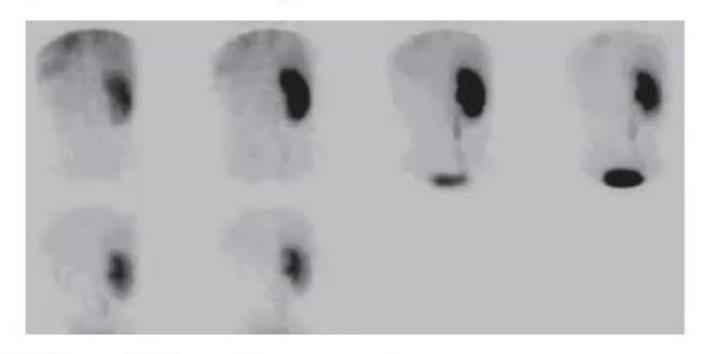
- Whats this investigation?
- What are its uses?
- What are its phases?
- What abnormality 1s this scan showing 1n this child?
Answer
- This is T99 -mercapto-acetyl triglycine (MAG3) scan. This is also called dynamic renogram.
- Hydronephrosis because of obstruction or without obstruction is best diagnosed by MAG-3 scan
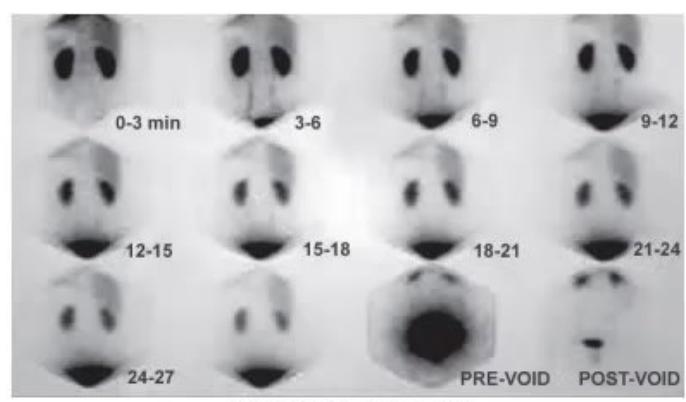
Normal MAG-3 scan
Nephrology 444 ]
- . This scan has three phases, first phase-rapid rise due to uptake of radio isotope, Second phase-gradually nsing slop as normal kidney excrete radio isotope, Third phase is slow down slop.
-
- This child has normal right kidney and obstruction at left pelvic-ureteric junction.
Ans. 18. 1.1,2.iv,3 un
MNJ31-018
Choose right diagnosis from given scenarios
-
- Testicular torsion
- ii. Epididymo-orchitits
- ii. Torsion of appendix testis
- iv. HSP
- A6 years old boy with history of UTI present with a few hours history of severe scrotal pain. His urine R/M 1s normal and no history of fever is present. You examine the child and found swollen and tender left testis.
- A3 years old boy came in emergency for rash and painful right scrotal swelling. His urine examination showed presence of blood and he 1s also afebrile.
- A 13 years old boy Rajan admitted with complaints of 2 days history of scrotal pam. His urine R/M showed positive for leucocyte and protein. On examination, his ght tests is tender on posterolateral surface. He has straddle injury a few days back.
- Testicular torsion
v. Testicular trauma.
Answer
No model answer in source material.
MNJ31-019
Nephrology 437
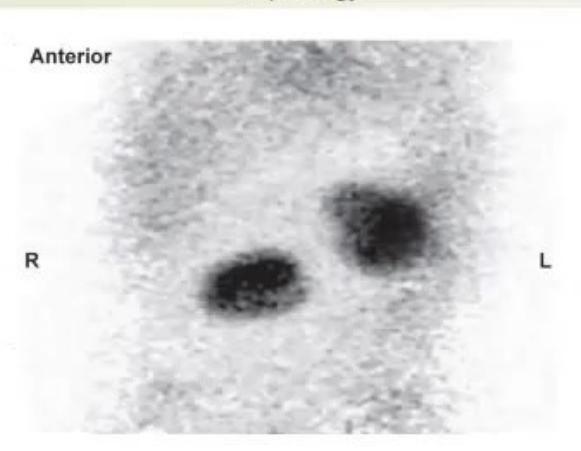
- Identify the following test.
- Whats possible diagnosis according to this film
- How much Time needed between injection and imaging?
- Write down Four indications of this investigation.
Answer
- Identify-Technetium99m DMSA (Di mercapto succinic acid) scan
-
- Diagnosis Ectopic Rt Kidney
- a Time needed between injection and imaging: 3 hours
- 4, Four indications:
- * Assessment of Renal Scarring
- * Unnary Tract Infection
- * Pyelonephritis
- * Renal mfarct
- * Horseshoe kidney
- * Ectopic kidney
MNJ31-020
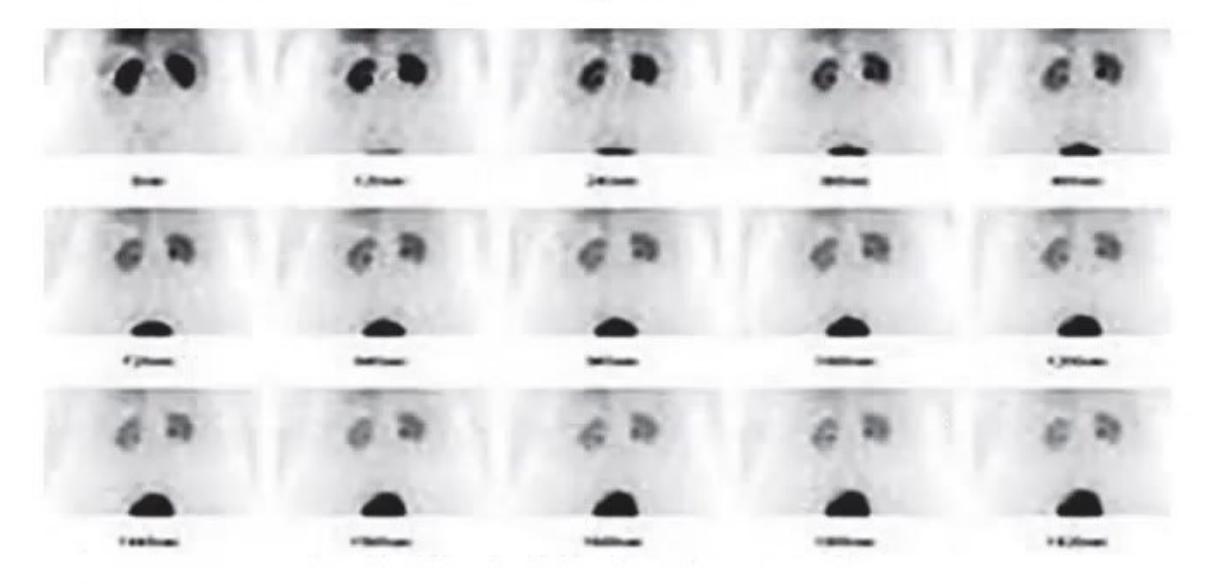
- Identify the following test.
- What information we get with this investigation?
- How much time needed between injection and imaging?
- Write down four indications of this investigation.
Answer
- DTPA (99 mTc-diethylene triamine pentaacetic acid) scan
- . What information do we get
- * Renal blood flow,
- * GFR,
- * Tubular function
- « Urinary excrehon.
- . Immediate images of the kidneys are taken as the myection enters the body
- . Four indications:
- * Assessment of GFR. Differential renal function
- * Acute renal failure: Chronic renal failure
- Acute and chronic rejection: Screening of patients with suspected renal HTN
- * Obstruction Hydronephrosis