MNJ10-001
%—chest compression
Answer
Pulseless electrical activity
-
- Write down according to Flowchart 10.5
MNJ10-002
%—chest compression with adrenaline.
Equipment Checklist
| Warm | Preheated warmer @ Warm towels or blankets ss 2£# «£ @# 8 Temperature sensor and sensor cover for prolonged resuscitation Hat Plastic bag or plastic wrap (<32 weeks' gestation) Thermal mattress (<32 weeks' gestation) |
|---|---|
| Clear airway | Bulb syringe 10F or 12F suction catheter attached to wall suction, set at 80-100 mm Hg * Tracheal aspirator |
| Auscultate | Stethoscope |
| Ventilate | Flowmeter set to 10 L/min © Oxygen blender set to 21% (21-30% if <35 weeks' gestation) 8 Positive-pressure ventilation (PPV) device @ Term and preterm-sized masks # 8F orogastric tube and 20 ml syringe # Laryngeal mask (size 1) and 5 ml syringe (if needed for inflation) ts # 5F or 6F orogastric tube if insertion port is present on laryngeal mask Cardiac monitor and leads * |
| Oxygenate | Equipment to give free-flow oxygen Pulse oximeter with sensor and cover Target oxygen saturation table |
| Intubate | Laryngoscope with size O and size 1 straight blades (size 00, optional) 8 8 8 Stylet (optional) Endotracheal tubes (sizes 2.5, 3.0, 3.5) s Carbon dioxide (CO,) detector #@ 8# Measuring tape and/or endotracheal tube insertion depth table s Waterproof tape or tube-securing device Scissors |
Medicate Access to
- * Epinephrine (0.1 mg/ml = 1 mg/1 O ml)
- * Normal saline (100 ml or 250 ml bag, or prefilled syringes)
- ® Supplies for placing emergency umbilical venous catheter and administering medications
- * Table of pre-calcuated emergency medication dosages for babies weighing 0.5-4kg
| view of NRP 8th Edition Practice Changes Table 10.1: Ov |
||||||
|---|---|---|---|---|---|---|
| Change | NRP 7th edition | NRP 8th edition | ||||
| Umbilical cord management plan added to 4 pre-birth questions replacing "How may babies?" |
The 4 pre-birth questions: 1. Gestational age? 2. Amniotic fluid clear? 3. How many babies? 4. Additional risk factors? |
The 4 pre-birth questions: 1. Gestational age? 2. Amniotic fluid clear? 3. Additional risk factors? 4. Umbilical cord management plan? |
||||
| Initial steps recorded to better reflect common practice |
Initial steps: Warm and maintain normal temperature, position airway, clear secretions if needed, dry, stimulate |
Initial steps: Warm, dry stimulate, position airway, suction if needed. |
||||
| An electronic cardiac monitor is recommended earlier in the algorithm |
Anelectronic cardiac monitor is the preferred method for assessing heart rate during cardiac compressions |
When an alternative airway becomes necessary, a cardiac monitor is recommended for the most acourate assessment of the baby's heart rate |
||||
| Epinephrine intravenous intraosseous (IV /IO) flush volume increased |
FlushTV, lO epinephrine with 0.5 to 1 ml normal saline |
Flush IV/1O epinephrine with 3 ml normal saline (applies to all weights and gestational ages) |
||||
| Epinephrine IV /1O and endotracheal doses have been 0.01-0.03 mg/kg simplified for educational efficiency. The dosage range is unchanged. The simplified doses (IV /IO and ET) do not represent an endorsement of any particular dose within the recommended dosing range. Additional research is needed. |
Range for IV or IO dose = (equal to 0.1-0.3 ml/kg) Range for endotracheal dose = 0.05-0.1 mg/kg (equal to 0.5-1 ml/kg) |
The suggested initial IV or 10 dose = 0.02 mg/kg (equal to 0.2 ml/kg) The suggested endotracheal dose (while establishing vascular access) =0.1 mg/kg (equal to 1 mg/kg) |
||||
| Expanded timeframe for cessation of resuscitative efforts |
If there is a confirmed absence of heart rate after 10 minutes of resuscitation, it is reasonable to stop resuscitative efforts; however, the decision to continue or discontinue should be individualized |
If confirmed absence of HR after all appropriate steps performed, consider cessation of resuscitation efforts around 20 minutes after birth (decision individualized on patient and contextual factors) |
IV Intravenous; [O- Intraosseous, ET: Endotracheal, HR: Heart rate.
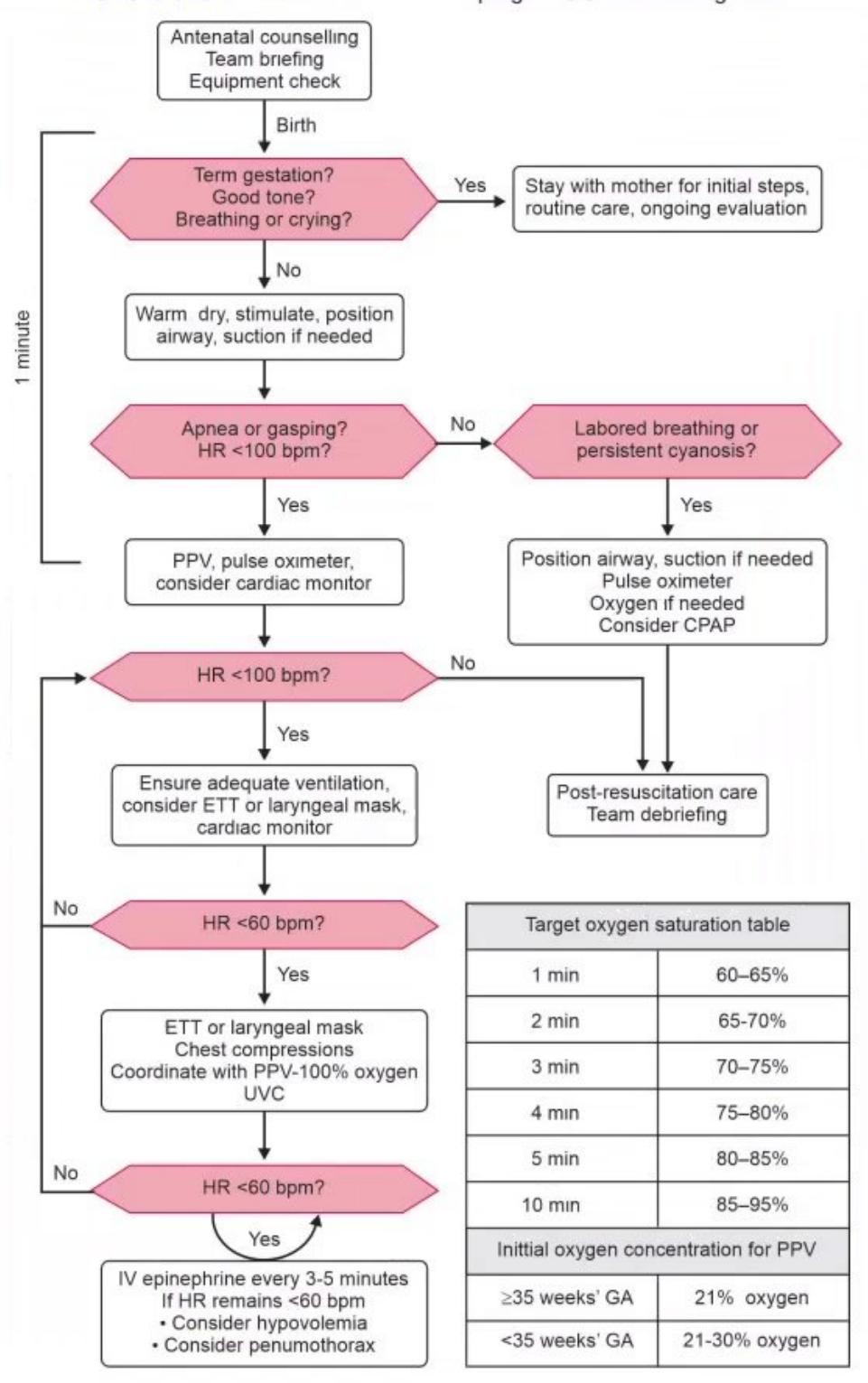
Flowchart 10.1: Neonatal resuscitation program® 8th Edition Algorithm
NRP CASE SCENARIOS
-
A. What are the three questions?
-
Ans. Term? Tone? Cry?
- B. What next?
-
Ans. Routine care-Stay with mother?? maintain warmth with skin to skin contact, position airway, clear secretions if needed, ongoing evaluation.
-
A. What are the 4 pre-birth questions that need to be asked to the obstetrician? (Latest NRP 8th edition)
- * Gestational age
- * Amniotic fluid clear?
- * Additional risk factors
- * Umbilical cord management
-
B. How would you proceed to resuscitate the baby?
| Ans. | 1. Switch on the warmer | (44 mark) |
|---|
- ® Food grade plastic bag and thermal mattress (34)
- * T-piece resuscitator/Self inflating bag with reservoir functioning (44)
- * Endotracheal tubes, Laryngoscope (34) * Oxygen and suction (34)
- C. Baby did not cry at birth, what are your initial steps? (2)
Ans. Initial steps (Newer order as per latest NRP 8th edition)
- ® Warmth
- * Dry
- * Simulate
- * Position airway
- * Sucton if needed.
- D. Baby is gasping after initial steps. How will you proceed?
Ans. * PPV with FiO, 21-30% (14)
* SpO; monitoring (44)
- * Consider cardiac monitor (ECG)-> mandatory only when alternate airway needed
- E. After 15 seconds of PPV, no chest rise, HR <100 bpm, how will you proceed?
Ans. Ventilation corrective steps
MRSOPA (2 marks) M: Mask adjustment (44) R: Reposition of head and neck S: Suction mouth followed by nose (44)
| Advanced Life Support | 133 | |
|---|---|---|
| QO: Opens the mouth P: Increase pressure A: Alternate airway |
(44) (44) |
|
| After 30 seconds of effective PPV, baby has cried, HR >100 but now has laboured breathing. Next step? |
||
| Ans. | Position and clearing airway Oxygen if needed ° Consider CPAP |
(1) (1) |
| You came to attend a delivery, 40-week term baby with meconium-stained liquor, how will you proceed? |
||
| 1. Switch on the warmer 2. Wash hands 3. Equipment check * Self inflating bag with reservoir functioning * Endotracheal tube and laryngoscope Suction catheters 10 or 12 F and meconium aspirator/Bulb syringe Pulse oximeter and oxygen. |
(4 mark) (44 mark) (2 marks) |
|
| Ans. | Baby did not cry at birth how will you proceed? Initial steps Warmth Dry > Shmulate Position airway Suction if needed. |
(2 marks) |
| After initial steps HR is 46 per min, how will you proceed? PPV with FiO, 21% * SpO; monitoring |
(44 mark) (4 mark) |
|
After 30 seconds of effective PPV HR is 52 per min, how will you proceed. Intubate if not already done 100% oxygen ECG monitor * Chest compression coordinated with PPV Place UVC * |
(44 mark) (44 mark) (4% mark) (4 mark) |
|
| When will you check heart rate after starting chest compression? After 60 seconds of effective chest compression coordinated with PPV * |
(14) | |
| HR is 58 per min after 1 min of chest compression how will you proceed? IV Epinephrine 0.2 ml/kg, 1 10000 IV or 1 ml/kg intratracheal dose Epmephrine followed by 3 ml saline bolus irrespective of weight or gestation when given through UVC |
(14) | |
| No response to IV epinephrine, what will you consider? Hypovoemia * |
(42) |
* Pneumothorax. (44)
However, the decision to continue or discontinue should be individualized.
EXERCISES
- A baby born at 38 weeks gestation delivered by normal vaginal delivery. Cried immediately after birth with normal tone.
a. What are the three questions?
b. What next? - A baby born to primi mother delivered at 30 weeks of gestation, with birth weight of 1100 grams is delivered by emergency LSCS for PPROM. Mother did not receive antenatal corticosteroids.
a. What are the 4 pre-birth questions that need to be asked to the obstetrician? (Latest NRP 8th edition)
b. How would you proceed to resuscitate the baby? - Wash hands (44)
- Check equipment (2)
c. Baby did not cry at birth, what are your initial steps? (2)
d. Baby is gasping after initial steps. How will you proceed?
e. After 15 seconds of PPV, no chest rise, HR <100 bpm, how will you proceed?
Answer
No model answer in source material.
MNJ10-003
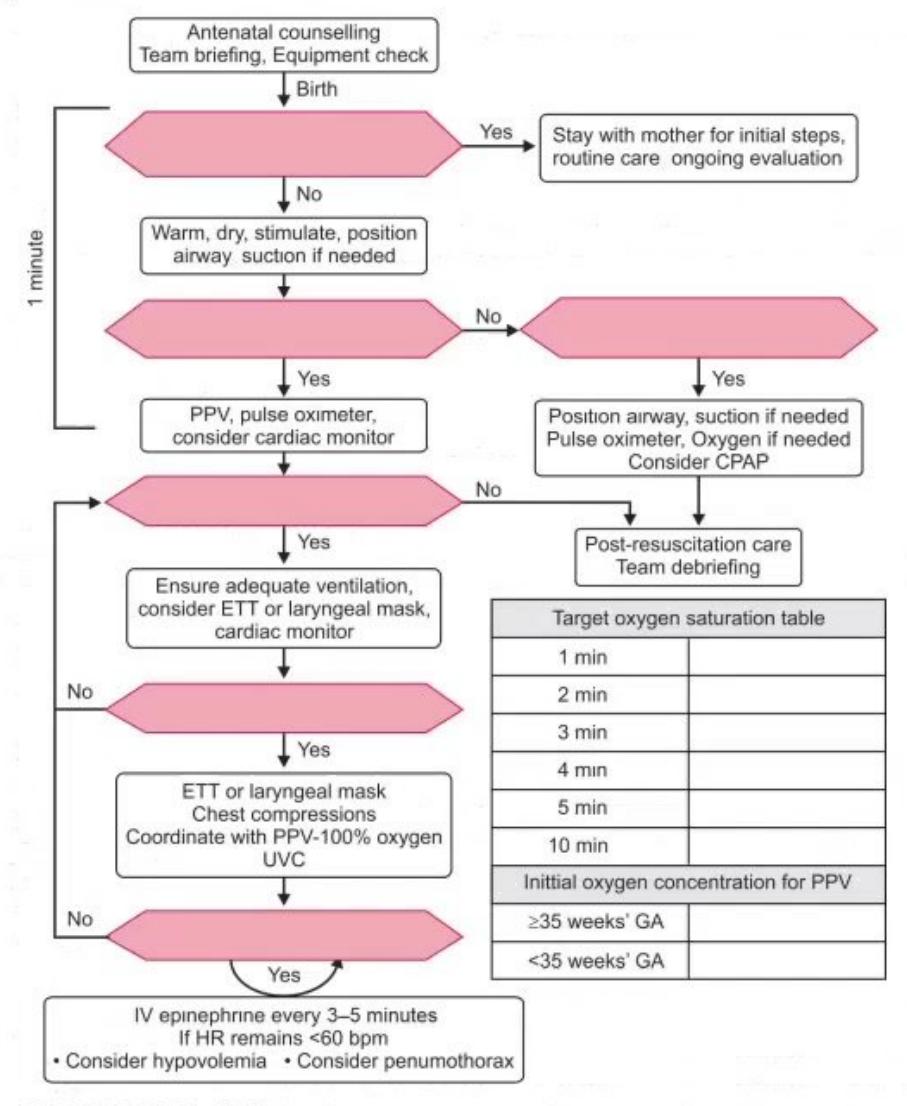
* May 2013. Fill in the blanks:
Answer
No model answer in source material.
MNJ10-004
* May 2014 (15-20 Marks)
- You are called to attend a delivery in labour room that in view of baby need resuscitation. You are now in labour room 30 minutes before the delivery so please check/call all things you may need in newborn care
- A 28 weeks preterm baby delivered, you called to handle the baby, baby is just delivered, commentary when you need to ask about the newborn condition/vitals?
Answer
No model answer in source material.
MNJ10-005
* Nov 2014 (15-20 Marks):
A 28 weeks preterm baby is delivered and shifted to NICU, you attend the baby and put CPAP and give instruction for care of baby on CPAP to NICU nurse (nurse provided).
1 A new nurse join the NICU, you are posted doctor, please instruct this new nurse about the care of baby on warmer, different mode of warmer and monitoring of baby on warmer. Q.4.* You are called to attend the delivery of a baby who is term by gestation but gynecologist told you that NST suggest acute fetal distress.
Now baby is delivered and handed over to you. Ask the needful question or condition of baby when you need and perform advance resuscitation if baby need. Wrong step considered for negative marking.
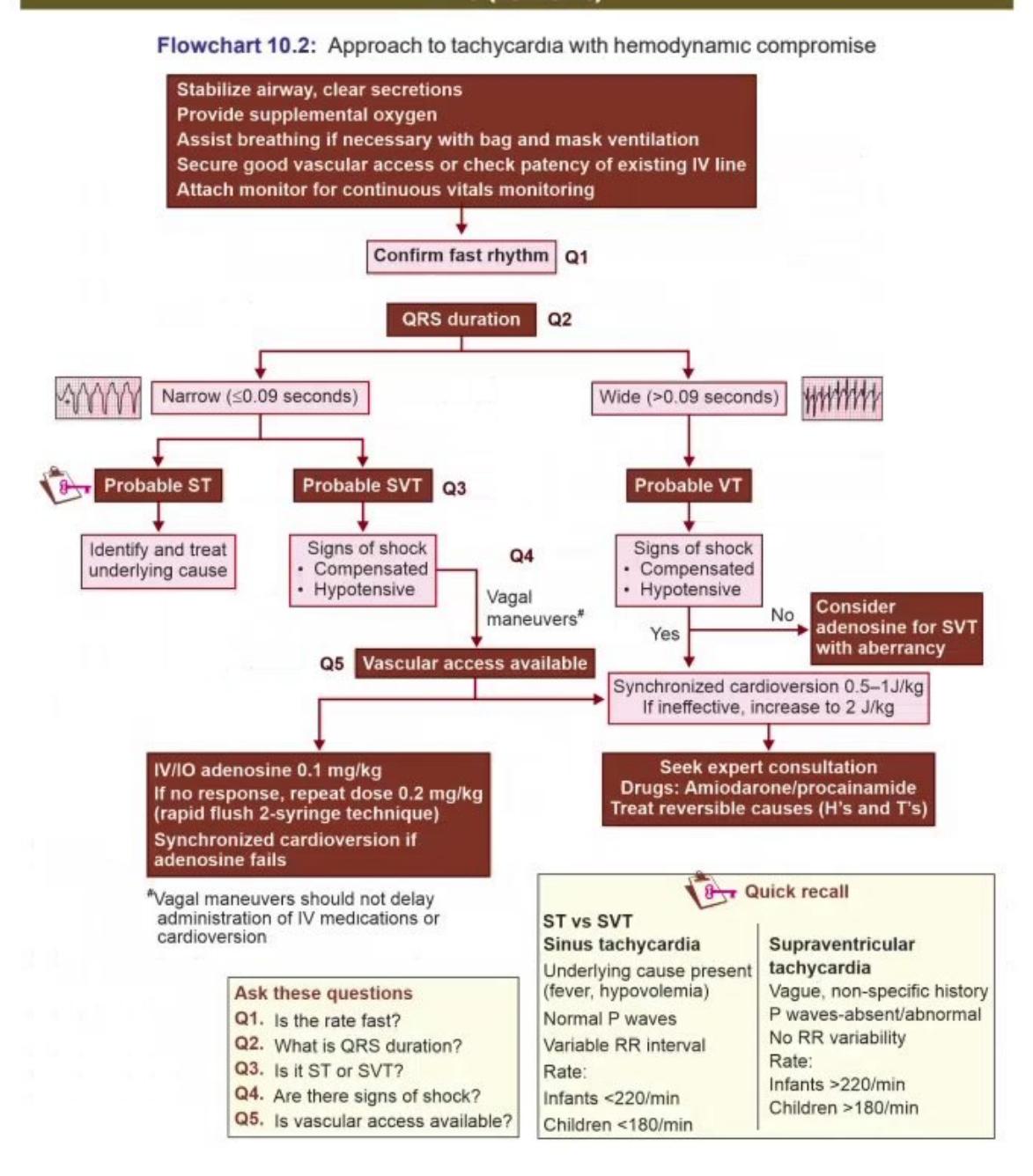
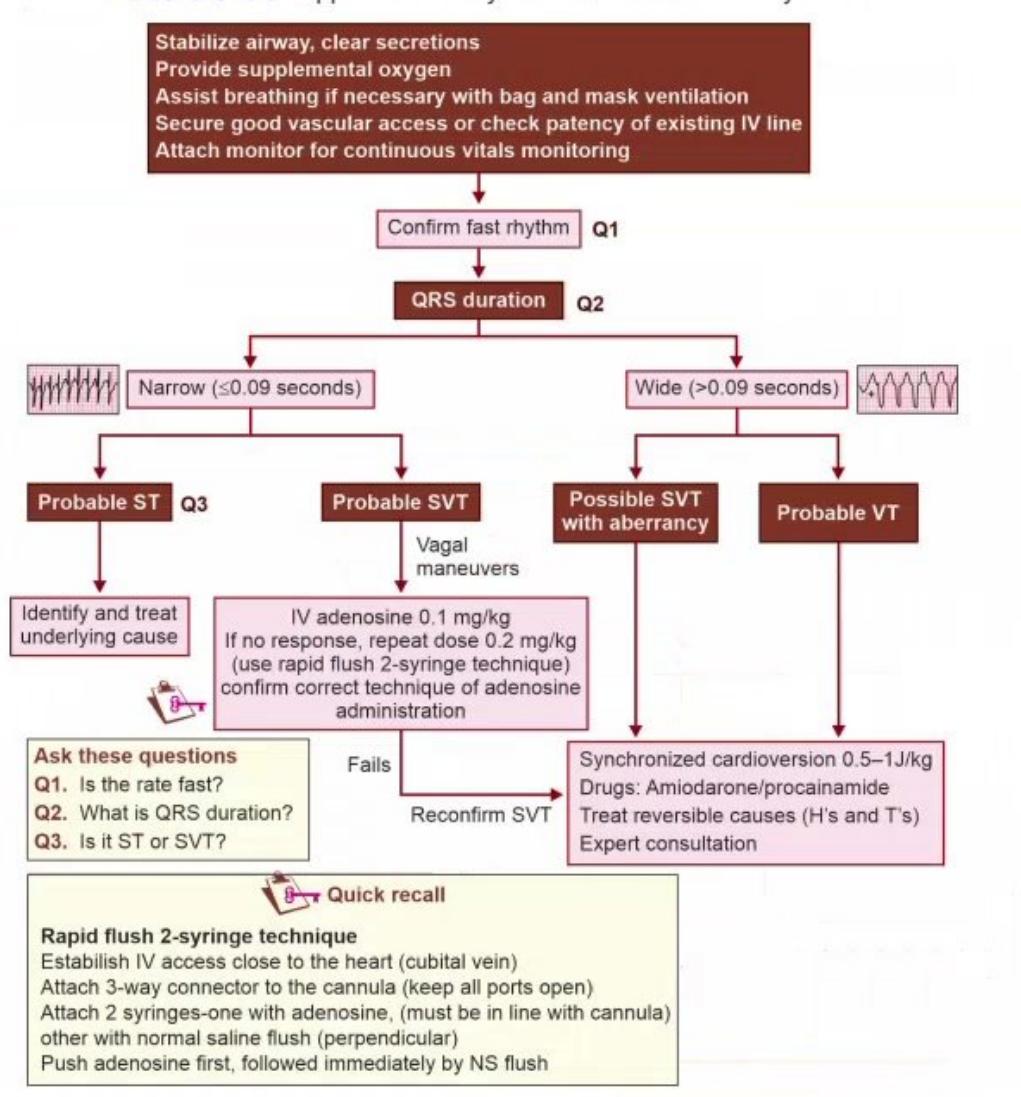
PALS (10 Marks)
Flowchart 10.3: Approach to tachycardia with normal hemodynamic
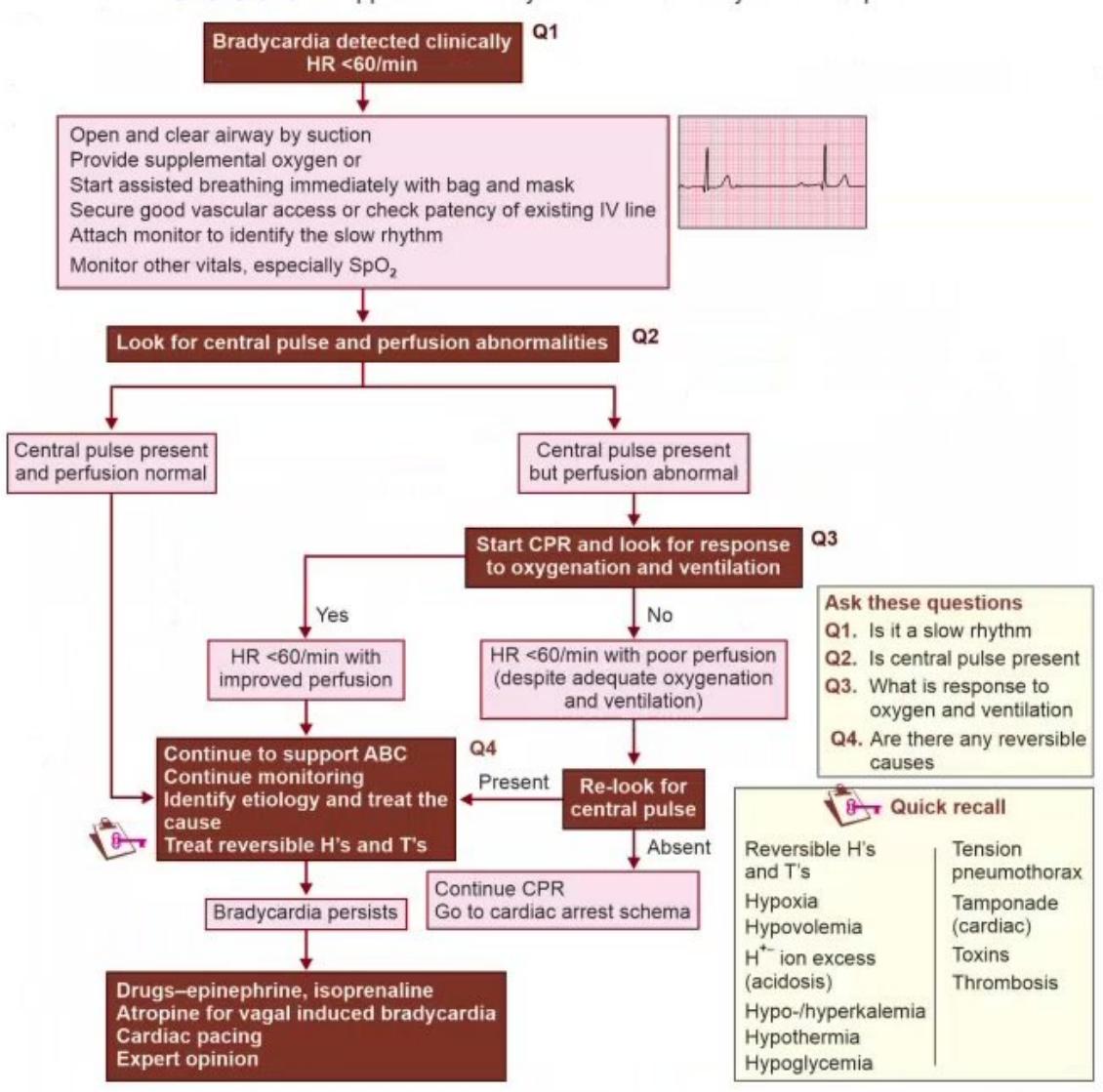
Flowchart 10.4: Approach to bradycardia with hemodynamic compromise
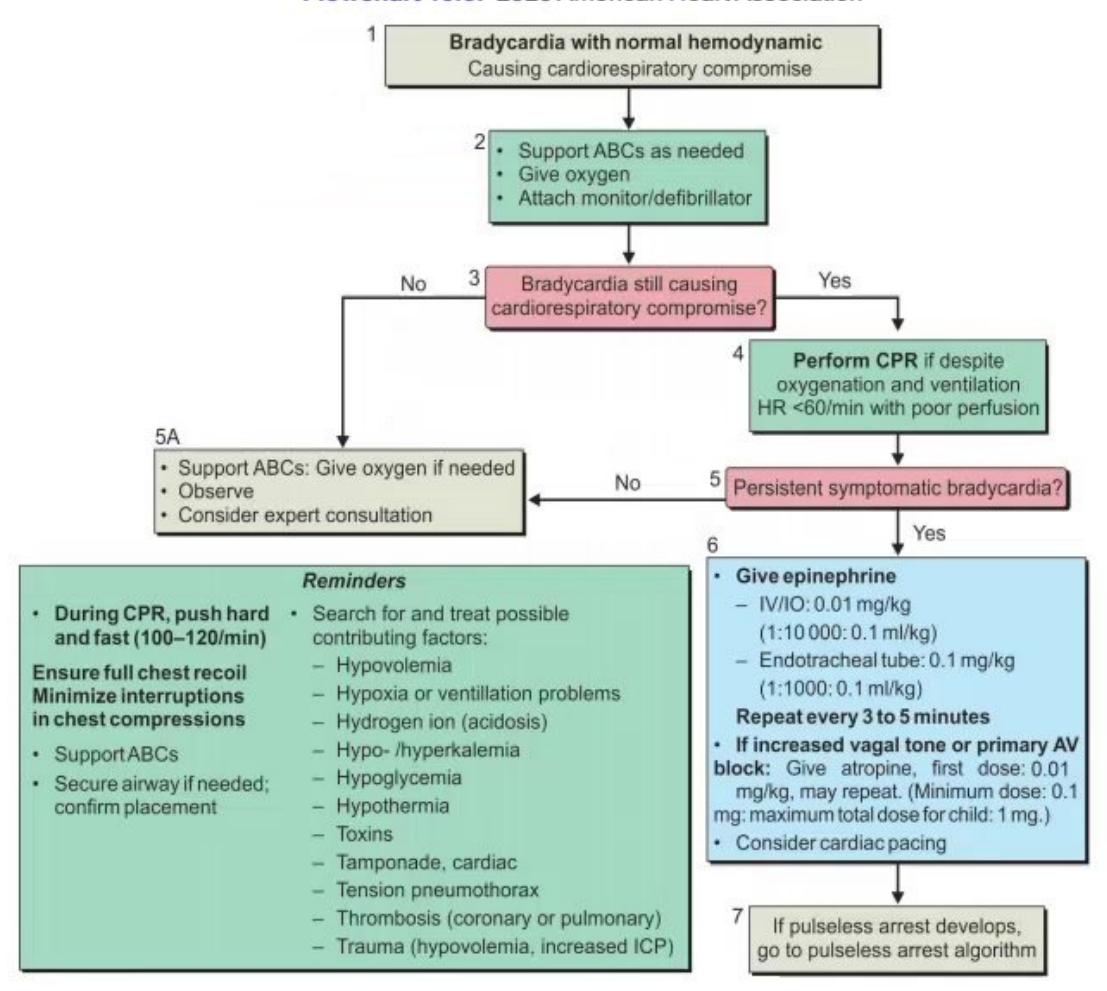
Flowchart 10.6: 2020 American Heart Association

Answer
No model answer in source material.
MNJ10-006
A 2-year-old child was struck by an automobile respiratory rate = 0, central pulse = absent, ECG given below:

- What is this diagnosis after reading ECG and clinical condition.
- After initial assessment you found that rhythm is shockable. Write down all steps in view of continue shockable rhythm.
Answer
Pulseless electrical activity
-
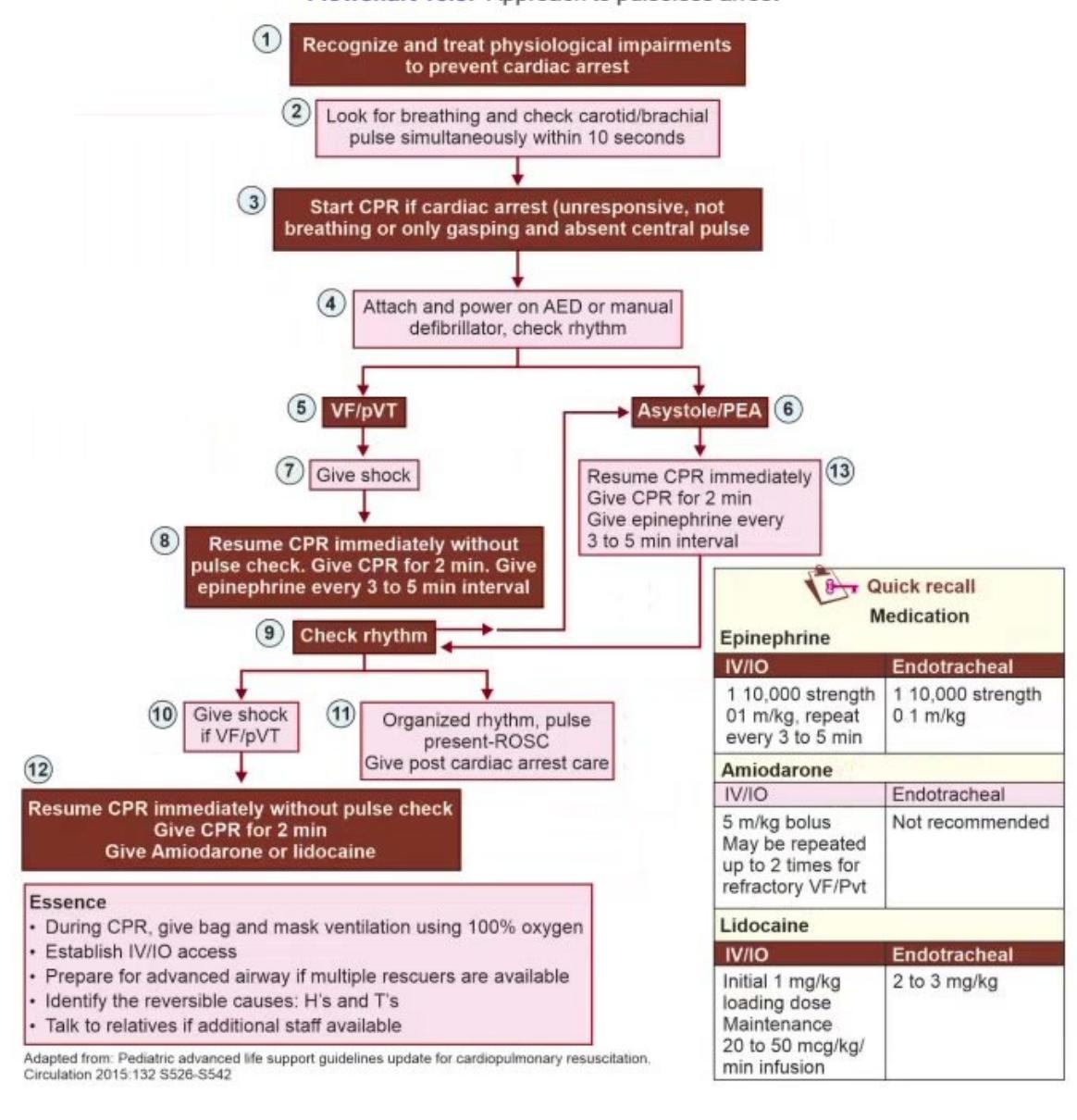
- Write down according to Flowchart 10.5
MNJ10-007
* A 5-year-old child was struck by an automobile respiratory rate = 0, central pulse = absent, ECG given below:
- What is this diagnosis after reading ECG and clinical condition?
After initial assessment you found that rhythm is non-shockable. Write down all steps in view of continue non-shockable rhythm.

Answer
- Asystole
- Zz Write down according to Flowchart 10.5
MNJ10-008
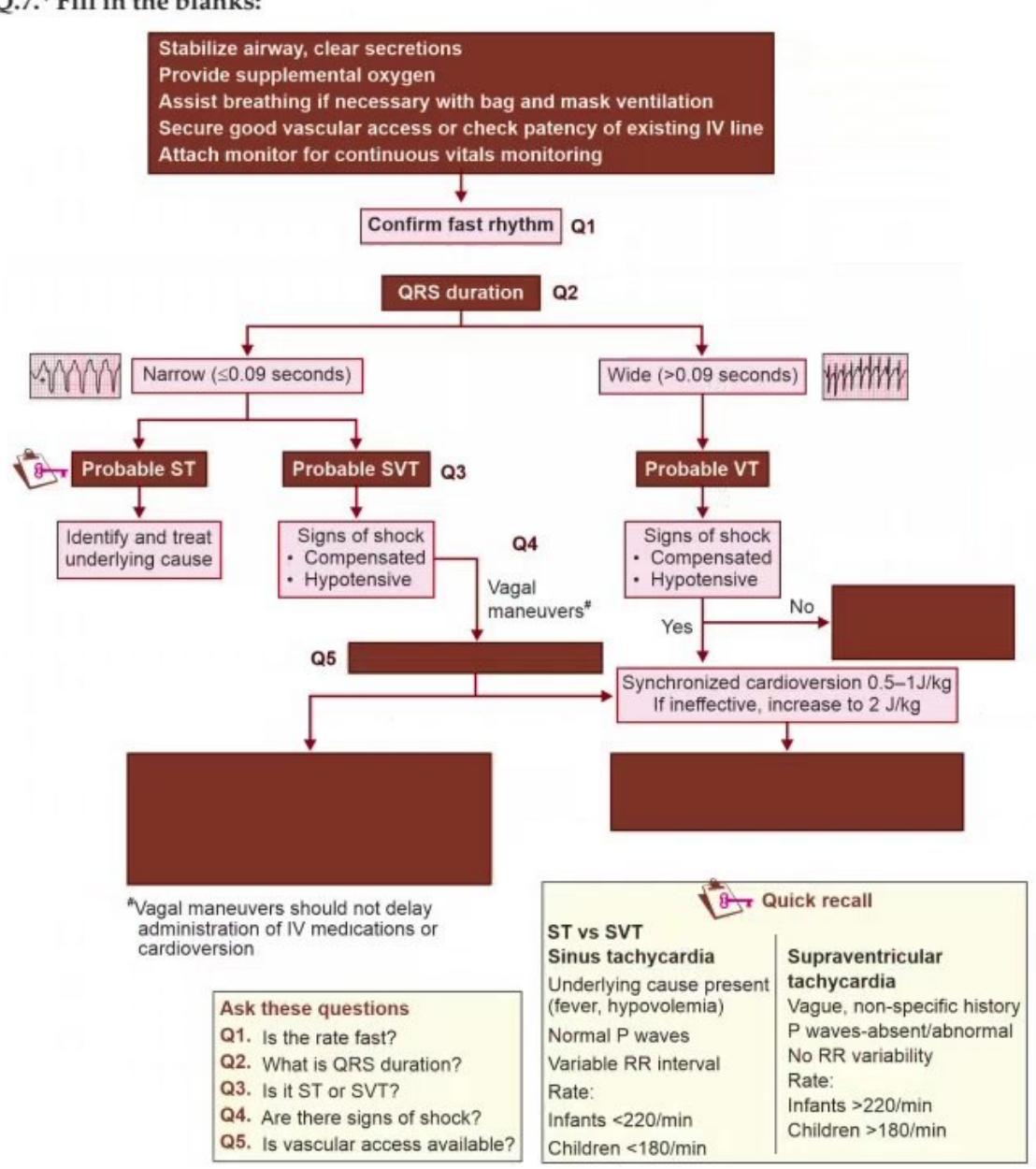
* Fill in the blanks:
Answer
See the Flowchat 10.2.

Ans. 8. Absent pulse. Differential diagnosis of arrhythmias
- Asystole * Ventricular fibrillation
- Pulseless ventricular tachycardia
- Pulseless electrical activity /electromechanical dissociation
MNJ10-009
* An §-year-old submersion victim with apnea and no palpable pulse.
What arrhythmias could be present?
Answer
No model answer in source material.
MNJ10-010
* A4-month-old male baby present irritability, sweating and poor feeding, got admitted in PICU, doctor diagnose the problem and give the drug with ECG below:
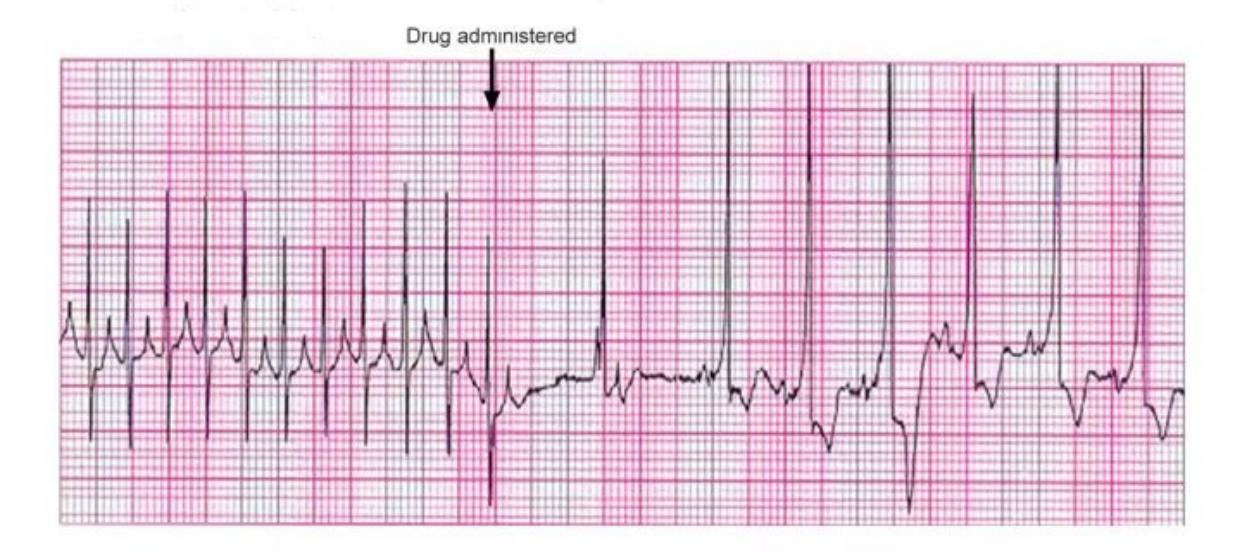
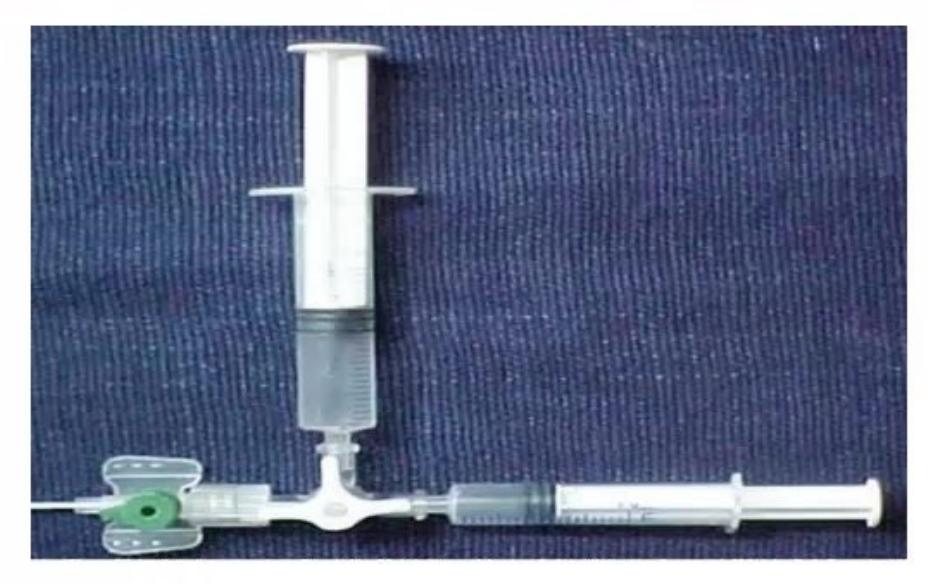
- What 1s ECG diagnosis and what drug is given?
- Whats dose of drug with max dose and maximum attempt?
Answer
Moe 8 PSVT and adenosine
- Ist dose 0.1 mg/kg (max 6 mg), IInd dose. 2 mg/kg (max dose 12 mg)
MNJ10-011
*
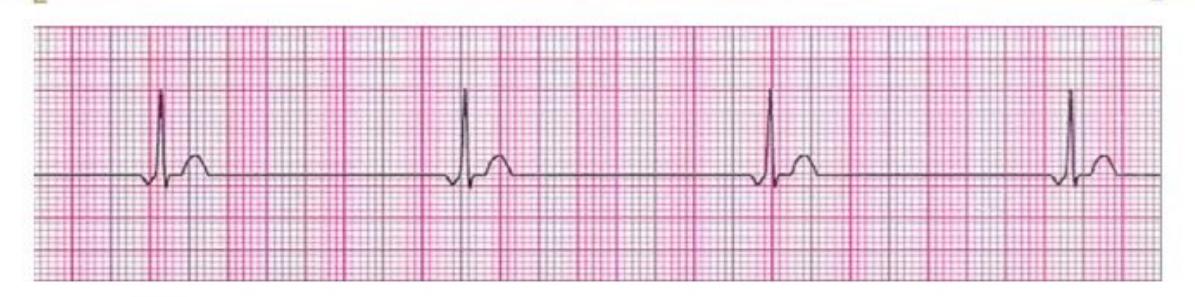
- What 1s the rhythm?
- What are the possible contributing factors?
- What interventions should you consider?
Answer
- Bradycardia
-
- Contributing factors—hypomia, hyper-/hypokalemia, hypothermia, hypovolemia, toxin, tamponade ...... see Flowchart 10.3,
-
- Management
- * Oxygenation (FiO, = 1.00) and ventlahon
- * Chest compressions
- * Epmephrine
- * Atropine
Ans. 11. For all O of FB follow these steps according to age and condition of child.
-
- Hygiene steps.
-
- Inspect the mouth for visible FB. If visible remove out with finger sweep clearance 1f not visible do not sweep your finger blindly (blind sweep, or blind suctioning 1s contraindicated)
- See the child 1s conscious or unconscious.
- . A conscious child allows to cough until cough 1s no longer effechve or develop respiratory distress or became unconscious.
- . LEchild is unconscious or became unconscious put the child on safe place in supine positon with head tilt/chin lift position.
- Start mouth to mouth ventilation with close the nose of child and make a good seal at mouth to mouth.
- . If ventilation is unsuccessful reposifioning the airway and attempt again mouth to mouth respiration.
- . Ifbaby <1 year put the child on your thigh prone and give 5 back thrust, then supine the baby and give 5 chest thrust (ike CPR of neonate—two-finger technique).
- . If child >1 year age (conscious) ... give 5 abdomunal thrust by placmg your fist between xiphisternum and umbilical but 1f >1-year-old child who is unconscious put the child supine and give 5 thrust.
-
- After step 9 or 10 see the mouth again if any FB clear it.
-
- If no FB in mouth, then again follow steps 7-9/10
Ans. 12. 1. Laryngeal mask airway
-
- Indications
- * Routine airway in operating room, and
- * In cases with difficult bag-mask ventilation
-
. Contraindicahon: Severe airway obstruchon
-
Two limitations
- * Dislodgement during transport, and
- * Minimizes but cannot prevent aspiration
-
Comphcation Regurgitation and aspiration
-
. Jaw thrust without head tlt.
- . Yes, scrwora (spinal cord injury without radiographic bone abnormalities) MRI spine.
- High dose methylpredmisolone (30 mg/kg) within 8 hours of injury
-
. Death within 24 hours of an immersion event a
- . Any survival from an immersion event b
- . a, Sezures b, Long OT syndrome c. Poisoning with drugs
- . Hypernatremia, hyperkalemia, hypercalcemua, hypermagnesemia a
- . Hemolysis b
-
- Pulmonary edema
MNJ10-012
**
1 An 8-month-old male child with his mother came in emergency department with history of sudden onset cough than chocking. Mother gave history of pea ingestion.
Or
2 A 4-year-old child with sudden onset cough and chocking. Perform the step for given condition (dummy given)—ask the question regarding the condition of child, when you proceed.
Answer
No model answer in source material.
MNJ10-013
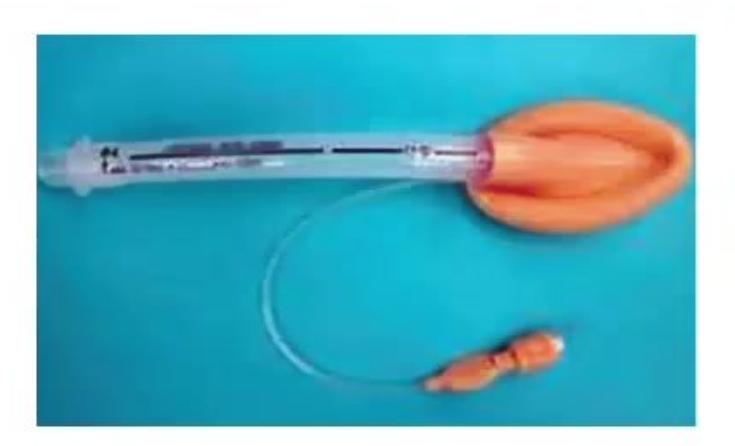
- What is this device?
- Indication
- Contraindication
- Limitation
- Complication
Answer
No model answer in source material.
MNJ10-014
* A 12-year-old girl Ritu has sustained injury to the neck due to a road traffic accident. He is breathing but cannot move or feel her arms or legs:
- X-ray of the cervical spine shows no bony injury. Is it still possible for the boy to have a spinal cord injury? Name the condition and its mode of diagnosis.
- What maneuver you will use to opening the airway in neck injuries?
- What is the emergency drug treatment that can be offered to this boy?
Answer
No model answer in source material.
MNJ10-015
*
-
List three predisposing factors for drowning.
-
4, What is commonest radiological finding in X-ray chest?
- Define: a. Drowning b. Near drowning
- List 2 electrolytic and one hematological disturbance in near drowning.
Answer
No model answer in source material.
MNJ10-016
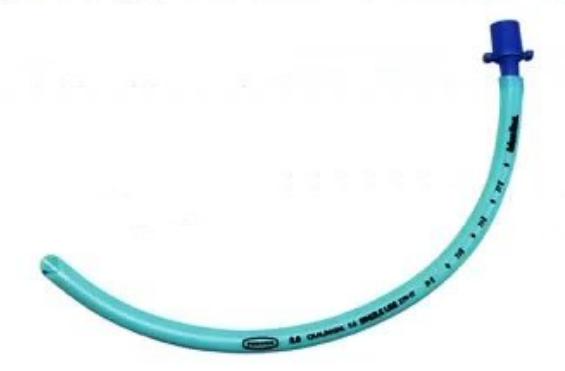
- Identify the instrument
- Name its parts
- What size would you use in a 6-year-old child?
- Mention 5 physiological changes, which occur when it is used in children.
Answer
- Endotracheal tube uncuffed
-
- Adaptor, markings on tube for nasal/ oral fixing, vocal cord guide, Murphy's eye, radiological marker
-
- 5.5 cm uncuffed (tubes 0.5 cm less and greater in size to be kept ready)
-
- icp T
- « Laryngospasm
- * Hypoxia
- * Tachycardia and hypertension in older children
- * Bradycardia and hypotension in infants
MNJ10-017
- a. Nasal prongs b. Simple face mask c Non-breathing mask
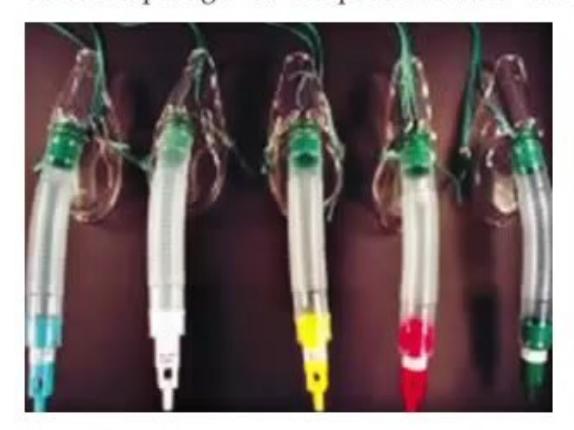
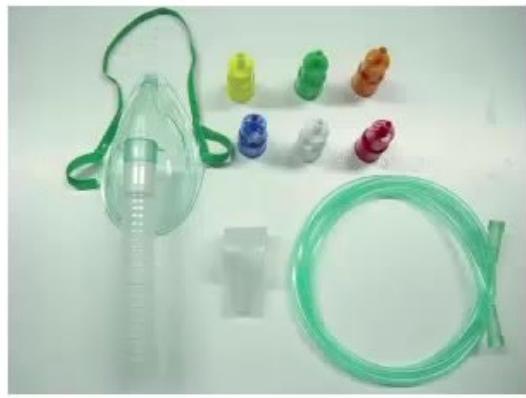
- Name of the device shown.
- What does the colour of the mask's aperture and adaptors reflects?
- Menton the FiO, achneved with various colours
- Percentage of oxygen delivered by the following devices:
a. Nasal prongs b. Simple face mask c Non-breathing mask
Answer
, 1. Venturi mask (oxygen)
-
- The colour of the mask's aperture reflects the FiO, achieved
- a (24%: blue; 28%: white; 35%: yellow; 40%: red; 60%: green)
-
- Percentage of oxygen delivered by the following devices:
- a. Nasal prongs (flow of 2-4 L/min) 24-28%
- b. Simple face mask (flow of 6-10 L/min) 35-60
- ¢ Nonrebreathing mask or reservoir 90-95%
Ans. 17. Bnet history and assessment
- Assemble equipment, medications, etc.
- Preoxygenate patient
- Premedicate with lidocame atropine
- Sedation and analgesia induced
- Pretreat with nondepolarizing paralytic agent
- Administer muscle relaxants
- Sellick maneuver
- Endotracheal intubabon
- Secure tube, verify position with roentgenogram
- Begin mecharucal ventilation
Drugs: Thiopental, diazepam, ketamine, fentanyl, morphine, succinylcholine, vecuronium or pancuronium or rocuronium
MNJ10-018
You are asked to perform rapid sequence intubation. Write the steps sequentially. Mention the names of drugs wherever necessary.
Answer
No model answer in source material.
MNJ10-019
A 3-year-old child broughtin ER at 10:30 AM with 12 kg and 45% burn while playing at 5:30 AM, as a attending pediatrician.

- Calculate his fluid requirement in next 48 hr (as per Parkland formula)
- His 24 hr correction will be complete by which time?
- What 1s the desired 5. albumin level in this child?
- In this patient how much 0.5% albumin you will infuse?
Answer
- 1st 24 hours RL 4 ml x 12 ( weight) x 45 (% of burn)
- * 14in first 8 hours and 4 in over 16 hours (2160 ml)
- * 2nd 24 hours RL with 5 % D (4 of Ist day fluid)
- . Next day 8:30 AM
- ae) . 2¢/dLh
- . 30-50% burn, 0.3 ml of 5% albumin/kg/% of burn over 24 hours (0.3 x 12 x 45 = 162 ml).