THG16-001
Fill in the blanks.
a. Vaccination at birth means within ________ of birth or at least not later than ________.
b. Mention the recommended interval between two live vaccines ___________.
c. The distance separating two injection sites should be ________.
d. Mention the angles at which intramuscular and subcutaneous injections should be delivered.
Answer
| a. | Vaccination at birth means within 24–72 hours of birth or at least not later than 7 days. |
| b. | The recommended interval is 4 weeks apart and not <5 days prior to 28 days. |
| c. | The distance separating two injection sites should be 1 inch (2.5 cm). |
| d. | Intramuscular injections should be given at 90° and subcutaneous injection at 45° angle with the skin. |
THG16-002
Vitamin A Prophylaxis.
a. What is the total number of doses of vitamin A to be given and at what age will be the last dose given?
b. Mention the recommended storage guideline for vitamin A.
c. A 9-month-old infant is suffering from measles, give the schedule and dose for vitamin A supplementation in this infant.
Answer
| a. | Total nine doses of vitamin A starting at 9 months, given every 6 months till 5 years of age. |
| b. | Keep it away from sunlight. Unopened bottles can be used till expiry date. |
| c. | Vitamin A 1 lakh international units on day 1 and day 2. |
THG16-003
Heat/Freeze sensitive vaccines.
a. Arrange the following vaccines according to heat sensitivity and freeze sensitivity
b. What is the catch-up vaccination for a 10-year-old adolescent girl?
Answer
| a. | Heat sensitivity: |
| BCG after reconstitution > OPV > MMR > DPT > BCG before reconstitution > Td > hepatitis B > JE | |
| Freeze sensitivity: | |
| Hepatitis B > DPT > Td > TT > MMR > BCG |
b. • Tdap at 10 years followed by Td every 10 years.
| • | MMR two doses at 4–8 weeks interval |
| • | Typhoid conjugate vaccine single dose |
| • | Hepatitis A two doses |
| • | Varicella two doses |
| • | HPV two doses |
THG16-004
A 3-year-old male child was treated for culture positive enteric fever. He has received one dose of typhoid polysaccharide vaccine.
a. What advise will you give the parents regarding typhoid vaccines?
b. Mention the types of typhoid vaccines.
c. Mention age of administration and dose.
d. What is the conjugate used in typhoid vaccine?
Answer
| a. | One dose of typhoid conjugate vaccine to be given 4 weeks after recovery. |
| b. | Vi polysaccharide vaccine, capsular conjugate vaccine, and oral live attenuated Ty21a vaccine. |
| c. | Polysaccharide vaccine—above 2 years of age, repeat every 3 years |
| Typhoid conjugate vaccine—above 6 months of age, single dose | |
| d. | TT and CRM197 |
THG16-005
Q16.5
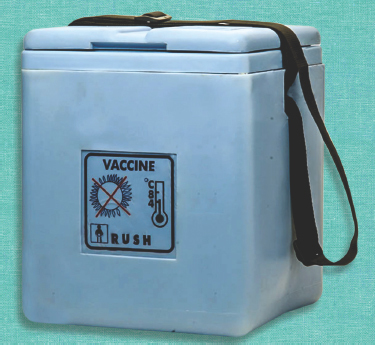
a. Identify the image shown above.
b. Number of ice conditioned packs used in the above container?
c. At what temperature should it be stored?
d. How many hours can vaccine be stored in this container?
e. How many vials can be carried in this?
f. Name the process used to make the ice packs ready to use?
Answer
| a. | Vaccine carrier |
| b. | 4 |
| c. | +2 to +8°C |
| d. | Up to 12 hours |
| e. | 16–20 vials |
| f. | Sweating |
THG16-006
In which compartment of the fridge, the following items should be kept?
| ■ | Water bottle |
| ■ | Dial thermometer |
| ■ | Ice pack |
| ■ | OPV |
| ■ | BCG |
| ■ | Hepatitis B |
| ■ | DPT/TT |
| ■ | Diluents |
| ■ | Measles vaccine |
| ■ | Varicella |
| ■ | Typhoid |
| ■ | Hepatitis A |
Answer
| Water bottle | Vegetable tray |
| Dial thermometer | First shelf in main compartment |
| Ice pack | Freezer |
| OPV | Freezer |
| BCG | First shelf in main compartment |
| Hepatitis B | Second and third shelf in main compartment |
| DPT/TT | Second and third shelf in main compartment |
| Diluents | First shelf in main compartment |
| Measles vaccine | First shelf in main compartment |
| Varicella | First shelf in main compartment |
| Typhoid | Second and third shelf in main compartment |
| Hepatitis A | Second and third shelf in main compartment |
| Compartment | Items to be kept in this compartment |
|---|---|
| Freezer | Ice packs and OPV |
| First shelf in main compartment | Dial thermometer, BCG, measles, varicella |
| Second and third shelf in main compartment | Hepatitis B, DPT/TT, typhoid, hepatitis A |
| Vegetable tray | Water bottles |
| Door | Nil |
THG16-007
A 5-year-old child has been admitted for hepatitis A infection in view of vomiting and poor oral intake.
a. What advice regarding vaccination will you give for the contact siblings at home?
b. What is the type of vaccine and mention its schedule?
c. Who are the high-risk groups to be vaccinated?
Answer
| a. | Single dose of live hepatitis A/first dose of killed hepatitis A should be given within 2 weeks of exposure to those between 1 and 40 years of age. |
| b. | Single dose of live hepatitis A vaccine can be given intramuscularly above 1 year of age or inactivated vaccine two doses starting above 1 year of age, given at an interval of 6 months intramuscularly. |
| c. | High-risk group: |
| • | Patients with chronic liver disease |
| • | Carriers of hepatitis B and hepatitis C |
| • | Congenital or acquired immunodeficiency |
| • | Transplant recipients |
| • | Travelers to endemic areas |
THG16-008
A 5-year-old male child was adopted by a couple no medical records available and BCG scar not seen.
a. What will you advise?
b. Mention the catch-up vaccination of DPT for above 7 years.
c. Until what age catch-up vaccination advised?
Answer
a. • BCG—catch-up till 5 years
| • | Hepatitis B—three doses 0, 1, and 6 months |
| • | DTaP/IPV—one dose |
| • | Hepatitis A—two doses, typhoid conjugate vaccine—one dose, varicella two doses |
| b. | Tdap as first dose followed by Td vaccine |
| c. | Till the age of 18 years |
THG16-009
A 12-week-old female infant who is on expressed breast milk (EBM) was brought by mother with complaint of diarrhea. History taking revealed the baby has not received rotavirus vaccine.
a. What is the minimum and maximum age of first dose of rotavirus vaccine to be given as per Indian Academy of Pediatrics (IAP)?
b. What is the maximum age for the final dose of rotavirus vaccine?
c. What are the different types of rotavirus vaccines available?
d. Mention contraindication for rotavirus vaccines.
e. Mention the recommended schedule for rotavirus vaccine.
f. What is the age limit of rotavirus vaccine first dose as per the Universal Immunization Programme (UIP)?
Answer
| a. | Minimum age: 6 weeks and maximum age: 14 weeks 6 days |
| b. | 8 months 0 days |
| c. | Human monovalent live vaccine (RV1), human bovine pentavalent live vaccine (RV5), Indian neonatal rotavirus live vaccine (116E), and bovine rotavirus pentavalent vaccine |
d. • History of severe allergic reactions/anaphylaxis
| • | History of intussusception in the past |
| • | Severe combined immunodeficiency (SCID) |
| • | Children with severe allergy to latex should not receive RV1 vaccine |
| e. | RV1—two doses at 4 weeks interval and other RV vaccine—three doses at 4 weeks interval |
| f. | The first dose is to be administered at 6 weeks, with the first dose of the pentavalent vaccine anytime up to 1 year of age. |
THG16-010
Hepatitis B vaccine usage.
a. When do we advise serologic testing for antibody response following a hepatitis B vaccine?
d. What are the recommendations for postexposure prophylaxis in healthcare professionals?
Answer
| a. | Only in specific population: |
| • | Patients receiving hemodialysis |
| • | HIV infected individuals |
| • | Immunosuppressed individuals |
| • | Infants born to hepatitis B positive mothers |
| • | Occupational hazards |
b. i. Nonresponders are vaccine recipients who does not have antibody titers >10 mIU/mL after two series of hepatitis B vaccine.
| ii. | Two doses of HBIG 1 month apart after every single exposure. |
c. i. HBIG along with hepatitis B vaccine should be given within 12 hours of life at different sites with different syringes at the same time.
| ii. | Hepatitis B immunoglobulin can be given up to 7 days of birth |
| iii. | Ideally done after 9 months. |
d.
| Exposed Person | Source | |
|---|---|---|
| HBsAg positive | HBsAg negative | |
| Unvaccinated | HBIG and vaccine series | Vaccine series |
| Vaccinated and responder | No treatment | No treatment |
THG16-011
MMR/Varicella vaccine.
a. Name the strains used in measles/mumps vaccine.
b. What is the dose of MMR vaccine as per IAP?
c. Mention dosage and schedule of varicella vaccine.
d. How do we treat a high-risk child who is exposed to varicella contact?
Answer
a.
| 0 | Measles strains | Mumps strains |
|---|---|---|
| 1. | Edmonston-Zagreb | L-Zagreb |
| 2. | Schwarz | RIT 4385 |
| 3. | Rubella strain is RA 27/3 |
| b. | 0.5 mL subcutaneously |
| Dose 1—9 months completion | |
| Dose 2—15–18 months | |
| Dose 3—4–5 years of age | |
| c. | Varicella vaccine: |
| Two doses of 0.5 mL S/C each | |
| First dose after 15 months of age | |
| Second dose after 3–6 months of first dose |
d. • VZIG as soon as after exposure up to 10 days. Dose IV 0.20 mL/kg diluted in NS over 1 hour
| • | If VZIG unavailable—IVIG 400 mg/kg single dose |
| • | If both unavailable—oral acyclovir 7–10 days 20 mg/kg/dose 6th hourly |
THG16-012
Immunization in special situations
a. What are the vaccines advised prior to transplant?
b. What is the vaccination timing for live/killed vaccines for the above child?
c. Post-transplant when can we start vaccines?
Answer
a. • Should receive all vaccines as per schedule of IAP appropriate for age.
| • | Should receive one dose of PPSV23 (above 2 years) |
| • | One dose of HIB vaccine after age 5 years regardless of prior HIB vaccination |
| • | MCV if risk present |
b. • Inactivated vaccines should be completed at least 2 weeks before transplant.
| • | Live vaccines should be completed at least 4 weeks prior to transplant. |
| c. | Inactivated vaccines—after 6 months and live vaccines—after 1 year. |
THG16-013
Vaccines for travelers.
a. What are the specific vaccines advised for travelers apart from routine vaccines?
b. Mention contraindication for yellow fever vaccine.
c. Mention dose and route of yellow fever vaccine.
d. What is the dosage schedule of meningococcal vaccine (MCV) in children?
Answer
a. • Yellow fever
| • | Meningococcal conjugate vaccine |
| • | OPV |
b. • Infants aged <9 months
| • | Child with acquired immunodeficiency syndrome (AIDS) |
| • | History of hypersensitivity |
| c. | Single subcutaneous or intramuscular injection of live attenuated vaccine should be administered 10 days before travel. |
d. • 9–23 months—two doses at 3 months interval
| • | Above 2 years—single dose |
THG16-014
Recommended duration for which vaccines can be kept after reconstitution?
a. Varicella
b. BCG
c. Measles/MMR
d. Yellow fever
e. MCV
f. DTap/Haemophilus influenzae type b (Hib)
Answer
| a. | Varicella—30 minutes |
| b. | BCG—4 hours |
| c. | Measles/MMR—4–6 hours |
| d. | Yellow fever—1 hour |
| e. | MCV—30 minutes |
| f. | DTap/Hib—30 minutes |
THG16-015
Answer the following regarding BCG vaccination.
a. Mention the type, dose, route, and schedule of this vaccine.
b. Mention the diluent used.
c. List the special precaution during vaccination.
d. Mention the sequence of reaction after vaccination.
e. What is the maximum age at which catch-up vaccination can be given?
Answer
| a. | Live attenuated, 0.1 mL, intradermally, over the left shoulder near the insertion of deltoid, given soon after birth. |
| b. | Diluent is normal saline |
c. • Protect from sunlight
| • | Use within 4 hours of reconstitution |
| d. | Papule develops after 2–3 weeks, increases to size 4–8 mm by 5–6 weeks, heals with ulceration and scar formation by 6–12 weeks. |
| e. | Catch-up vaccination up to 5 years |
THG16-016
Enumerate the disposal of the following.
a. Needles
b. Plastic part of syringes
c. Wrapper of syringes
d. Empty unbroken vials
e. Broken vials and ampoules
f. Needle caps
Answer
| a. | Needles—hub cutter, 1% hypochlorite solution |
| b. | Plastic part of syringes—red bag |
| c. | Wrapper of syringes—black bag |
| d. | Empty unbroken vials—red bag |
| e. | Broken vials and ampoules—hub cutter or white translucent puncture proof container |
| f. | Needle caps—black bag |
THG16-017
Seasonal Flu vaccine.
a. How many strains are used in flu vaccine?
b. What are the types of vaccine available?
c. Who are the high-risk groups for flu vaccine?
d. Mention contraindication for live flu vaccines.
Answer
| a. | Two strains of influenza A and two strains of influenza B |
b. • Quadrivalent inactivated vaccine
| • | Live attenuated vaccine |
| c. | High-risk groups: |
| • | Chronic illness |
| • | Primary or acquired immunodeficiency |
| • | Children on long term-salicylate therapy |
| • | Laboratory personnel and healthcare workers |
| d. | Contraindications: |
| • | Children <2 years |
| • | High-risk individuals |
THG16-018
COVID vaccine.
a. Name the different types of coronavirus disease (COVID) vaccines.
b. What is the dosage schedule and route of administration?
c. Mention complication of messenger ribonucleic acid (mRNA) vaccine.
d. Which COVID vaccines are approved in India?
Answer
a. • Whole-virion inactivated vaccine
| • | Protein subunit vaccine |
| • | Recombinant nanoparticle vaccine |
| • | Deoxyribonucleic acid (DNA)-based vaccine and mRNA vaccine |
b. • mRNA—above 6 months, intramuscular
| • | Other vaccines—two dose schedule at 0 and 28 days, intramuscular, above 12 years |
| c. | Myocarditis/pericarditis |
| d. | Covaxin, Corbevax, and Covovax |
THG16-019
Vaccine programs.
a. What is Mission Indradhanush?
b. When was it launched and by whom?
c. What is Intensified Mission Indradhanush (IMI)?
d. What is the special focus of IMI 5.0?
e. What are eVIN, CoWIN, and U-WIN?
Answer
| a. | Mission Indradhanush is a special catch-up campaign under UIP to vaccinate all the children and pregnant women who have been left out or dropped out from routine schedule, especially in areas of low immunization coverage. |
| b. | Launched on 25th December 2014 by Ministry of Health and Family Welfare (MoHFW). |
| c. | IMI is a special catch-up vaccine drive for children under 2 years in select districts and cities to ensure full immunization to >90% by December 2019. |
| d. | IMI 5.0 special focus is on the improvement of measles and rubella vaccination coverage (with the aim or measles and rubella elimination by 2023) and use of U-WIN digital platform for routine immunization in pilot mode across all districts in the country. |
e.
| eVIN (Electronic Vaccine Intelligence Network) | Smart vaccine supply chain management system for monitoring of vaccine stocks and temperatures across the country |
| CoWIN (COVID Vaccine Intelligence Network) | Digital platform for registration and monitoring of COVID-19 vaccination coverage |
| U-WIN (UIP-Vaccine Intelligence Network) | Online portal for digitizing routine immunization services under UIP in the country which will send reminders to patients, allow patients to book vaccination slots online, maintain vaccine certificates and download vaccination certificates |
THG16-020
Vaccine storage.
a. What are freeze indicators with example?
b. In a domestic refrigerator, name the vaccines stored in top shelf, middle shelf, and bottom shelf.
c. Name the vaccines which are light sensitive.
d. Fill in the gaps about vaccine storage equipment (A–D).
e. What is conditioning of ice pack?
Answer
| a. | Freeze indicators: Devices to monitor the exposure of vaccines to freezing and are used with freeze sensitive vaccines (such a DPT containing vaccines, hepatitis B, and TT), e.g., Freeze tag, 3M Freeze Watch |
| b. | Top shelf: MR, MMR, BCG, OPV, Yellow fever, JE (SA-14-142), meningococcal A conjugate, Rotavac, and any other vaccine not damaged by freezing |
| Middle shelf: DTP, DT, Td, TT, hepatitis B, DTP/hepatitis B, DTP/hepatitis B/Hib, DTP/Hepatitis B/HiB/IPV Hib, PCV, HPV, influenza, and any other freeze sensitive vaccines | |
| Lower shelf: Diluents, HPV, and rabies vaccines | |
| c. | Light sensitive vaccines: BCG, MMR, varicella, DTaP, HPV, and rotavirus |
d.
| Equipment | Level of storage | Optimum temperature | Purpose |
|---|---|---|---|
| Walk-in Freezers (WIFs) | State level | -18° to -20°C | Bulk storage of OPV and preparation and storage of frozen ice packs |
| Walk-in Coolers (WICs) | State level and regional stores | +2° to +8°C | Bulk storage of vaccines (for 3 months of requirement of vaccines and 25% buffer stock) |
| Deep freezers | District level | -15° to -25°C | For storage of OPV and freezing ice packs |
| Ice-lined refrigerator | District level | +2° to +8°C | For storage of heat sensitive vaccines |
| e. | Conditioning of ice pack: Before using for lining the cold box or vaccine carriers, the ice packs should be thawed and have to undergo sweating done by shaking it every few minutes till the ice is noted to move around in the ice pack. |
THG16-021
Adverse event following immunization (AEFI).
a. Mix and match the following examples with the type of adverse event following immunization (AEFI)
b. What is the adverse reaction seen with contamination of BCG vial?
c. What are serious AEFI, severe AEFI, and minor AEFI?
d. Which AEFIs should be reported—mention at least two?
e. What is causality assessment and within how many days of reporting should it be done?
Answer
a.
| 1. | Extensive limb swelling after DTwP vaccination | D. | Vaccine product related reaction | ||
| 2. | Paralytic polio as a result of poor inactivation of IPV | C. | Vaccine quality defect related reaction | ||
| 3. | Transmission of infection by contaminated multidose vial | B. | Immunization error related event | ||
| 4. | Syncope (vasovagal) after MR vaccine at school | E. | Immunization anxiety related reaction | ||
| 5. | Fever 1 day after vaccination and testing positive for Dengue | A. | Coincidental event | ||
| b. | Toxic shock syndrome |
c. • Serious AEFI: If it results in death, hospitalization, significant disability, occurs in clusters, causes parental/community concern or results in congenital anomaly or birth defect or where the vaccine quality is suspicious.
| • | Severe AEFI: These are minor AEFI with increased intensity or severity, e.g., high-grade fever following pentavalent vaccine. |
| • | Minor AEFI: Occur within few hours and resolves after a short period of time. These can local or systemic reactions but resolve in 2–3 days. |
d. • All serious AEFI
| • | Events associated with a newly introduced vaccine |
| • | AEFI due to immunization error |
| • | Significant events of unexplained cause occurring within 30 days after vaccination |
| • | Any event causing significant concern from the parent/community |
| e. | Causality assessment is the systemic evaluation of the information about an AEFI to determine the likelihood of an event having been caused by the vaccines received. It is done within 100 days of reporting at state/national levels. |
THG16-022
OPV vaccine.

a. What is open vial policy? Give examples of vaccine for which this is applicable to and not applicable (at least one for each).
b. What is Ro number?
c. Identify the status of the vaccine vial monitor appropriately and recommend which vaccine can used and which should be discarded.
d. Fill in the gap: Vaccination at birth means as early as possible within __________ of birth or at least not later than ___________ after birth.
e. Changing needles between drawing vaccine from a vial and injecting it to a recipient is necessary—True/False?
Answer
| a. | Open vial policy is a vial of the vaccine which has been opened during a session can be reused again for multiple immunization sessions within a period of 28 days provided. |
| • | The expiry date has not passed |
| • | The vaccines are stored properly under cold chain conditions during transport and in storage point |
| • | Vaccine vial septum has not been submerged in water or contaminated in any way |
| • | Aseptic precautions used during withdrawal of vaccine |
| • | Vaccine vial monitor has not crossed the discard point. |
| Open vial policy applicable—DPT, Td, TT, hepatitis B, OPV, PCV, Hib and containing vaccines, and IPV | |
| Open vial policy not applicable—measles, BCG, and JE vaccines | |
| b. | Ro: Basic reproductive number which measures the average number of secondary cases generated by one primary case in susceptible population |
| c. | A—inner square lighter than outer circle, within expiry date—can use the vaccine |
| B—inner square lighter than outer circle but slight discoloration, within expiry date—can use the vaccine | |
| C—inner square matches the outer circle—discard point, do not use the vaccine | |
| D—inner square darker than the outer circle—beyond discard point, do not use the vaccine | |
| d. | Vaccination at birth means as early as possible within 24–72 hours of birth or at least not later than 7 days after birth |
| e. | False |
THG16-023
Rabies vaccine.
a. A 5-year-old 15 kg child presents to your clinic with category III dog bite over leg with the laceration measuring 3 × 2 cm, write the treatment plan for this child in a setup with rabies monoclonal antibody (mAb) available.
b. What are the two available mAbs for rabies along with their appropriate dose?
c. If a child who has received two doses of preexposure prophylaxis on day 0 and day 7, but gets bitten by a dog within 14 days, what is the next step of management and why?
d. If a child has been previously immunized with rabies, what is the next line of management
i. If the child presents within 3 months with another dog bite
e. If child has bite at unusual sites such as eye, eyelids, glans penis, or lips, how is rabies immunoglobulin (RIG) or mAb administered locally?
Answer
a. • Clean the wound with soap and running tap water.
| • | Rabies vaccine (IM schedule) on day 0, day 3, day 7, day 14, day 28 (5 vials/5 visits) (as per the WHO 4 doses/4 vials day 0, day 3, day 7, 4th dose between day 14 and day 28) |
| • | mAb to be infiltrated around the wound on day 0 or within 7 days. For this child, dose of Rabishield is 3.33 IU/kg body weight which is 1.2 mL (1 mL contains 40 IU). |
| • | If wound large and bleeding, loose sutures can be considered. |
| • | Antibiotics prophylaxis with amoxicillin |
| b. | 1. Rabishield (rabies mAb rDNA) available as 2.5 mL/100 IU—dose is 3.33 IU/kg body weight |
| 2. | TwinRab (docaravimab and miromavimab) available as 2.5 mL/1,500 IU—dose is 40 IU/kg body weight. |
| c. | Should receive rabies immunoglobulin or mAb as antibody levels after rabies vaccine are expected to rise only after 14 days after vaccination. |
d. i. <3 months—only wound washing
| ii. | >3 months—two doses of rabies vaccine on day 0 and day 3. |
| No role of RIG/RmAb if previously immunized fully. | |
| e. | Eye (conjunctiva)—RIG or RmAb can diluted with NS 1:1 dilution and can be administered as eye drops |
| Eyelids, glans penis, inside part of lip—instill and inject small amount into these sites with preferably insulin syringe/26G needle |
THG16-024
Human papillomavirus vaccine (HPV).
a. What is gender neutral vaccination (GNV) in HPV vaccine and name at least two advantages?
b. Which HPV vaccines are approved for both boys and girls in India and what is the schedule?
c. The three-dose schedule is applicable for whom and what is the minimal interval between the doses?
d. What is the minimum age recommended for HPV vaccine?
e. What is the maximum age for catch-up of HPV vaccine?
Answer
| a. | HPV vaccine has been approved for both females and males as per 2013 ACVIP recommendations. Advantages are: |
| • | Cost-effective intervention |
| • | Will help reduce transmission |
| • | Imparts herd immunity |
| • | Helps in eradication of HPV (girls only program does not lead to eradication) |
| • | Protects boys from infection |
| b. | 9vHPV vaccines and new 4vHPV (Cervavac) are approved for use in both boys and girls. |
| 0 | 9vHPV vaccine | | | New 4vHPV SII vaccine (Cervavac) | | |
| Girls | | | | | | |
| • | 9-14 years: Two doses with an interval of 6-12 months | | • | 9-14 years: Two doses at 0 and 6 months | |
| • | 15-26 years: Three doses at 0, 2, 6 months | | • | 15-26 years: Three doses at 0, 2, 6 months | |
| | | | | | |
| Boys | 9-14 years: Two doses with an interval of 6-12 months | | | | | |
| • | 9-14 years: Two doses at 0 and 6 months | |
| • | 15-26 years: Three doses at 0, 2, 6 months | |
| | | |
| c. | Three-dose schedule is recommended for girls >15–16 years of age and for all immunocompromised for any age. The minimal interval between the first and second dose be at least 1 month and the third dose should be administered at least 3 months after the second dose. |
| d. | 9 years |
| e. | 45 years only for females (4vHPV—Gardasil) |
THG16-025
Japanese encephalitis (JE) vaccine.
a. Who are recommended to receive Japanese encephalitis (JE) vaccine routinely?
b. What is the minimum age for JE vaccine as per universal immunization program (UIP) versus Indian academy of pediatrics (IAP)?
c. Fill in the blanks (A–D) with respect to the schedule of the following JE vaccines.
d. What is the maximum age for catch-up of JE vaccine?
e. What is the component present in JE vaccine which is known to cause hypersensitivity reactions in some individuals?
Answer
a. • Not recommended for routine vaccination except for individuals living in endemic areas.
| • | Recommended for travelers to JE endemic areas provided they are expected to stay there for a minimum of 4 weeks. |
| b. | UIP—8 months, IAP—12 months |
c.
| Vaccine | First dose | Second dose |
|---|---|---|
| SA-14-14-2 (live attenuated, cell culture derived, in UIP) | At 9 months | At 16–18 months |
| SA-14-14-2 (inactivated cell culture derived, JEEV) | 12 months (Dose in <3 years 3 μg/0.5 mL, >3 years to adults it is 6 μg/0.5 mL) | After 28 days |
| Inactivated Vero cell culture-derived Kolar strain (JENVAC) | 12 months | After 4 weeks |
| d. | 15 years |
| e. | Protamine sulfate |
THG16-026
Pneumococcal vaccine.
a. What is the routine schedule of pneumococcal vaccine as per UIP versus IAP?
b. What are the common side effects after receiving pneumococcal conjugate vaccine (PCV) and could it be administered if child is having fever?
c. As per IAP, what is the minimum interval between two doses for children vaccinated at age <12 months and for those vaccinated >12 months of age?
d. What is the minimum age for pneumococcal polysaccharide vaccine (PPSV23) and for whom is it recommended?
e. What is the schedule for a 5-year-old child undergoing splenectomy who has not received even one dose of pneumococcal vaccine earlier?
f. When should pneumococcal vaccination be completed prior to elective splenectomy/cochlear implant?
Answer
| a. | UIP—two doses at 6 weeks and 14 weeks followed by booster at 9 months. |
| IAP—three doses at 6 weeks–10 weeks–14 weeks followed by booster between 12 and 18 months. | |
| b. | Irritability, crying, swelling and tenderness at injection site, and transient fever >39°C (102°F). PCV may be administered in mild respiratory illness and low-grade fever but not in severe illness. |
| c. | <12 months—minimum interval is 4 weeks between two doses |
| >12 months—minimum interval is 8 weeks between two doses | |
| d. | Minimum age—2 years, recommended for only children with high risk (immunodeficient children, children with functional or anatomic asplenia, immunocompetent children with chronic heart/lung disease, diabetes mellitus, cerebrospinal fluid leaks, and cochlear implant) |
| e. | Two doses of PCV13 at least 8 weeks apart followed by dose 1 of PPSV23 at least 8 weeks after the last dose of PCV13. A second dose of PPSV23 should be given 5 years after dose 1. |
| f. | At least 2 weeks before surgery or initiation of therapy. |
THG16-027
Diphtheria-Tetanus-Pertussis (DPT) vaccine.
a. What is the primary series schedule for Diphtheria-Tetanus-Pertussis (DPT) vaccination as per UIP versus IAP?
b. What is the schedule for catch-up vaccination for:
i. <7 years of age
c. What is the recommendation for Tdap/Td in adolescents as per UIP and IAP?
d. What are the absolute contraindications and relative contraindications for DPT vaccines (mention any two)?
e. Fill in the gaps (A–F) regarding tetanus prophylaxis in wound management and what is the dose of tetanus immunoglobulin (TIG)?
Answer
| a. | Primary series: |
| • | UIP—three doses at 6, 10, and 14 weeks followed by two boosters at 16–24 months and 5–6 years |
| • | IAP—three doses at 6, 10, and 14 weeks followed by two boosters at 15–18 months and 4–5 years |
| b. | Catch-up: |
| i. | <7 years of age: DTwP/DTaP at 0, 1, 6 months |
| ii. | >7 years of age: Tdap, Td, and Td at 0, 1, and 6 months |
| c. | Adolescents: |
| UIP—Td at 10 years and Td at 16 years | |
| IAP—one dose of Tdap at 10 years followed by one dose of Td at 16–18 years | |
| d. | Absolute contraindications—history of anaphylaxis, development of encephalopathy without any other cause within 7 days of vaccination |
Relative contraindications (precautions)—persistent inconsolable crying >3 hours, hypotonic-hyporesponsive episodes within 48 hours of vaccines, seizures with or without fever within 72 hours of administration and hyperpyrexia (>40.5°C).
e.
| 0 | Clean and minor wounds | All other wounds | If TIG given in the past | |||
| Td/Tdap | TIG | Td/Tdap | TIG | TIG | ||
| Unimmunized, unknown status, immunodeficient or received <3 doses | Yes | Yes | Yes | Yes | Yes | |
| Has received >3 doses | <10 years since last dose—No | No | <5 years since last dose—No | No | No | |
| >10 years—Yes | >5 years since last dose—Yes |
| • | Dose of TIG: 250–500 IU given intramuscularly. |
THG16-028
Measles, Mumps, and Rubella (MMR) vaccine.
a. Mention the routine vaccination schedule for Measles-Mumps-Rubella (MMR)/Measles-Rubella (MR) vaccine as per IAP and UIP.
b. Write the catch-up vaccination schedule for MMR/MR.
c. What are the contraindications to MMR vaccine—any two?
d. What is the recommendation for vaccination in a child <9 months of age during outbreaks?
e. What is the role of MMR vaccine in postexposure prophylaxis?
Answer
| a. | UIP: MR vaccine—first dose at 9 months/270 completed days followed by second dose at 16–24 months |
| IAP: MMR vaccine—first dose at 9 months, second dose at 15 months and third dose between 4 and 6 years | |
| b. | MMR: Two doses 4 weeks apart, only one dose if previously received one dose (catch-up up to 18 years) |
| MR: Two doses 4 weeks apart (catch-up up to 5 years) | |
| c. | Severe allergic reaction, severe immunocompromised state (including high-dose steroid >14 days, HIV, family history of primary immunodeficiency in first degree relatives), pregnancy |
| d. | Measles containing vaccine should be given for infants between 6 and 11 months during outbreaks but should be revaccinated with two more doses of measles containing vaccine with first dose at 12–15 months and at least 4 weeks after the previous dose followed by next dose at 4–6 years of age. |
| e. | If administered within 72 hours of exposure, MMR vaccine may prevent or modify measles disease. However, there is much benefit for mumps or rubella. |
THG16-029
Vaccines in special situations.
a. Expand GAVI, NTAGI, DCIG, and ACVIP.
b. What is the recommendation for vaccination for child receiving steroid therapy?
c. Which vaccines are contraindicated in patients with complement deficiencies?
d. Which vaccines are contraindicated in patients with chronic granulomatous disease?
f. What is the recommended interval for administration of measles/varicella-containing vaccination after receiving rabies immunoglobulin?
Answer
| a. | GAVI—Global Alliance for Vaccines and Immunization |
| NTAGI—National Technical Advisory Group on Immunization | |
| DCGI—Drug Controller General of India | |
| ACVIP—Advisory Committee on Vaccines and Immunization Practices | |
| b. | High-dose steroids (2 mg/kg/day for <10 kg and 20 mg/day or its equivalent for >10 years) given for >2 weeks—live vaccines not to be given until off steroids for at least 1 month. Killed vaccines are safe but efficacy may be less. |
| High-dose steroids for <2 weeks—can receive live vaccines after treatment discontinuation. | |
| On maintenance low dose physiologic doses or steroids/alternate day therapy/inhaled or topical steroid therapy—live vaccines can be safely administered. | |
| c. | No contraindications—all vaccines can be safely given in complement deficiencies. |
| d. | All live bacterial vaccines |
e. i. ITP: 8–10 months and Kawasaki disease: 11 months
| ii. | The vaccine may be given however it may be ineffective hence another dose should be given after the recommended interval period. |
| f. | 4 months |
THG16-030
Fill in the blanks below with respect to the Advisory Committee on Vaccines and Immunization Practices (ACVIP) 2023 recommendations.
a. The second dose of varicella vaccine should preferably be administered _____to_____ months after the first dose. For >12 years of age, the second dose is to be given after _______ weeks.
b. Menactra is approved as a ______ dose schedule between ___ to _____ months. Minimum interval between two doses should be _______ months.
c. ________ dose(s) given for live attenuated hepatitis A vaccine whereas ________ dose(s) for inactivated hepatitis A vaccine.
d. A dose of Td is recommended at _________ to 18 years.
e. A child who has received three doses of fractional inactivated polio vaccine (fIPV) at 6w-14w-9m does not require an additional dose of IM-IPV but should receive a second booster of IM-IPV at _____ to ______ years.
Answer
| a. | The second dose of varicella vaccine should preferably be administered 3 to 6 months after the first dose. For >12 years of age, the 2nd dose is to be given after 4 weeks. |
| b. | Menactra is approved as a two dose schedule between 9 to 23 months. Minimum interval between 2 doses should be 3 months. |
| c. | Single dose(s) given for live attenuated hepatitis A vaccine whereas two dose(s) for inactivated hepatitis A vaccine. |
| d. | A dose of Td is recommended at 16 to 18 years. |
| e. | A child who has received three doses of fIPV at 6w-14w-9m does not require an additional dose of IM-IPV but should receive a second booster of IM-IPV at 4 to 6 years. |