VVK06-001
Answer the following questions regarding acute abdomen.
a. What is the age of peak incidence of appendicitis?
b. What is the classic triad for intussusception?
c. What laboratory tests are satisfactory as an initial screen in patients with abdominal pain?
d. What is the treatment of choice for intussusception?
e. Name three causes of abdominal pain arising from a gonad in a young girl
f. What is the classic finding on appendicitis?
g. How do you test for peritoneal irritation?
Answer
- a. Teenage and young adult years (12–18 years); males slightly more than females.
- b. Severe episodic pain, "currant jelly" stool, transverse tubular abdominal mass.
- c. CBC, BUN, creatinine, electrolytes, blood sugar, urine analysis. Serum amylase, lipase, aminotransferase. Examination of stool.
- Chest X-ray and flat and upright film of abdomen.
- d. Hydrostatic reduction. However in patients with prolonged intussusception with signs of shock, peritoneal irritation, intestinal perforation or pneumatosis intestinalis, reduction should not be attempted.
- e. Ovarian tumor, torsion of an ovary, ruptured ovarian cyst.
- f. Right lower quadrant tenderness.
- g. Rebound tenderness.
VVK06-002
A 3-year-old infant presented with failure to thrive, recurrent diarrhea, irritability and pain abdomen. On examination, he was found to be wasted with edema and finger clubbing. His tTG ELISA for both IgA and IgG was positive.
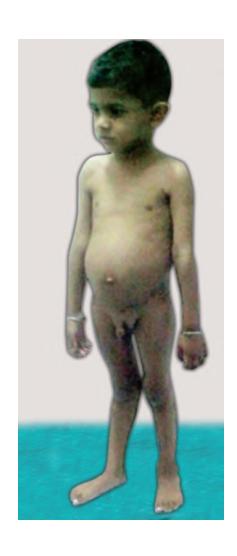
a. What is this condition?
b. Name other serological tests done to diagnose this condition.
c. What will you do to confirm the diagnosis?
d. Name three conditions associated with high frequency of this disease.
Answer
- a. Celiac disease.
- b. Antigliadin and antiendomyseal antibodies.
- c. Small bowel biopsy.
- d. Down's syndrome, Turner's syndrome, William's syndrome, thyroiditis, selective IgA deficiency.
VVK06-003
A 15-year-old girl presents to the emergency department with sudden onset of watery diarrhea tinged with blood. The girl was previously healthy. She has been on topical benzoyl peroxide and oral clindamycin for acne vulgaris for past 4 weeks. Physical examination reveals a slightly distended abdomen that is diffusely tender. Her temperature is 38.1°C (100.5°F). She has not been exposed to any uncooked meat and has not eaten any unusual foods.
a. What is the most likely diagnosis?
b. What is the other name for such type of diarrhea?
c. What drugs can be given to cure this? Give the doses and duration of treatment also.
Answer
- a. Pseudomembranous enterocolitis.
- (It is caused by the toxins produced by Clostridium difficile. It occurs in some patients after treatment with antibiotics (especially clindamycin, cephalosporins, and amoxicillin). Patients develop fever and abdominal pain with diarrhea containing leukocytes and blood).
- b. Antibiotic associated diarrhea.
- c. Most essential step is to discontinue the current antibiotic, if possible. Oral metronidazole 20–40 mg/kg/day q 6-8 hourly for 7–10 days. Intravenous vancomycin 25–40 mg/kg/day q 6 hourly for 7–10 days.
VVK06-004
A mother is being counselled for prevention of allergy. She wants to know which of the following could be (A) food intolerance (B) food hypersensitivity.
i. Lactose intolerance.
Answer
- i. A
- ii. B
- iii. B
- iv. B
- v. A
VVK06-005
Match the following.
a. Cow's milk Paralbumin b. Egg Vicilin c. Peanut Ovomucoid d. Fish Casein
Answer
a. Cow's milk Casein b. Egg Ovomucoid c. Peanut Vicilin d. Fish Paralbumin
VVK06-006
A 15-month-old chubby male child is admitted with regression of motor milestones since 3 months, rhythmic involuntary movements of (distal > proximal) the upper limbs, tremulous cry and generalized hypotonia. He is having loose stools for the last 7–8 days. He has brownish hair, reticular pigmentation of the skin particularly of the dorsum of the hands . There is pallor and mild hepatosplenomegaly. The involuntary movement stops once patient sleeps.
a. What is your most likely diagnosis?
b. What do you expect in peripheral smear and CT head for this patient?
c. What are the changes in liver if you go for liver biopsy?
d. What is the treatment for involuntary movements?
Answer
- a. Nutritional tremor syndrome.
- b. P/S—megaloblastic anemia; CT head—cerebral atrophy.
- c. Liver biopsy—fatty changes.
- d. Carbamazepine and propranolol.
VVK06-007
DRUG-ORS SALT.
a. Write the composition of WHO ORS in gram per liter.
b. Write the composition of WHO ORS in mmol per liter.
c. In which diarrhea is hypo-osmolar ORS used?
Answer
a. NaCl = 3.5 g/L
KCl = 1.5 g/L
NaHCO3 = 2.5 g/L
Glucose = 20 g/L
b. Na+ = 90 mEq/L
K+ = 20 meq/L
Cl– = 80 mEq/L
Glucose = 111 mmol/L
Citrate = 10 mEq/L
c. Rotavirus induced diarrhea
VVK06-008
Study the photograph and answer the following questions.
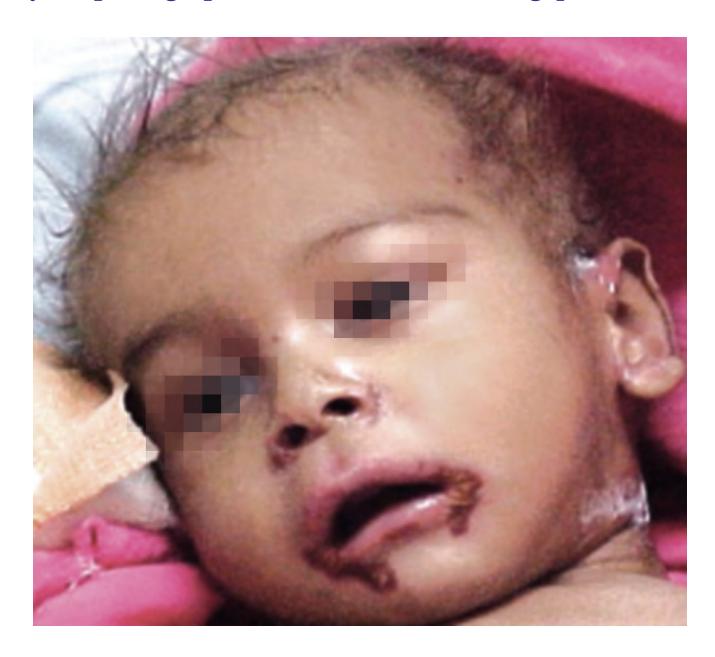
a. Identify this condition which is caused by zinc deficiency.
b. What is the dose of zinc for this condition?
c. Name two other disease where zinc supplements are indicated.
Answer
- a. Acrodermatitis enteropathica.
- b. 50–150 mg/day.
- c. Acute or persistent diarrhea, Wilson's disease.
VVK06-009
A 8-month-old girl has been crying and pulling up her legs as if she has abdominal pain. She has vomited several times and is not interested in taking her bottle. She has a fever of 100.5°F. She has not passed stool today. Her parents think that she looks pale and lethargic.
a. Give 2 most likely differential diagnosis.
b. What additional differential diagnosis will you think if this was a male child?
Answer
- a. Intussusception, gastroenteritis, obstructed hernia.
- b. Testicular torsion.
VVK06-010
A 8-year-old girl has periumbilical pain that began 8 hours ago; since then she has vomited once and has had one small, loose, bowel movement. Her last meal was 12 hours ago, and she is not hungry. She denies dysuria and urinary frequency. On examination, she is lying quietly in bed with temperature of 101.5°F. Her other vital signs are normal. Her abdominal examination reveals few bowel sounds, rectus muscle rigidity, and tenderness to palpation, particularly periumbilically. There is some abdominal tenderness with gentle bimanual palpation. She has pain on digital rectal examination. Breath sounds are clear and she has no rashes.
a. What is the most likely diagnosis?
b. What is the single most reliable clinical finding for diagnosing this?
c. What are the sonographic criterias to diagnose this condition?
Answer
- a. Acute appendicitis.
- b. Localized abdominal tenderness is the single most reliable finding in the diagnosis.
- c. The ultrasound criteria for appendicitis include:
- • Wall thickness <6 mm
- • Luminal distention
- • Lack of compressibility
- • Complex mass in the right lower quadrant
- • Fecalith.
Findings suggestive of advanced appendicitis on ultrasound include:
- • Asymmetric wall thickening.
- • Abscess formation.
- • Associated free intraperitoneal fluid.
- • Surrounding tissue edema.
- • Decreased local tenderness to compression.
VVK06-011
A 5-year-old female with severe abdominal pain feels nauseated but has not vomited. She has noticed a faint rash on her feet, legs and buttocks. The temperature is 101°F.
a. What is the most likely diagnosis?
b. What intestinal complications can occur in this condition?
c. What is the medical management for this?
Answer
- a. Anaphylactoid purpura.
- b. Hemorrhage, obstruction, intussusception.
c. Therapy with oral or intravenous corticosteroids (1–2 mg/kg/day) is often associated with improvement of both gastrointestinal and CNS complications.
VVK06-012
An 8-month-old female has recent onset of diarrhea. Further history reveals recurrent periods of loose stools, frequent otitis media, and upper respiratory infections. She is being followed for failure to thrive. There has been no vomiting or fever. Her celiac serology and HIV ELISA are negative.
a. What is the most likely condition ?
b. What is its mode of inheritance?
c. Which intestinal protozoal infection is commonly associated with this condition?
Answer
- a. IgA deficiency.
- b. Autosomal dominant with variable expression.
- c. Intestinal giardiasis.
VVK06-013
An 18-month-old boy is receiving 'Augmentin' for otitis media. Now he has diarrhea and a diaper rash. There is no fever or vomiting.
a. What is the most likely cause for the diarrhea?
b. Define persistent diarrhea.
c. How do you differentiate between osmotic and secretory diarrhea?
Answer
- a. Antibiotic induced diarrhea due to 'Augmentin'.
- b. Diarrhea persisting for 14 days or beyond and associated with malnutrition.
- c. Diarrhea.
| Osmotic | Secretory | ||
|---|---|---|---|
| • | Volume of stool |
< 200 mL/24 h |
>200 mL/24 h |
| • | Response to fasting |
Diarrhea stops |
Diarrhea continues |
| • | Stool Na+ |
<70 mEq/L |
>70 mEq/L |
| • | Reducing substances |
Positive | Negative |
| • | Stool pH |
<5 | >6 |
VVK06-014
A marriage dinner was followed by the majority of attendees developing vomiting and watery diarrhea with streaks of blood on the next day. Unaffected attendees did not eat the kheer (milk based sweet). A few ill family members are mildly febrile.
a. What is the most likely etiology for this condition?
b. What is the incubation period of this causative organism?
c. What antibiotics will you prescribe to the affected members?
d. What advice will you give to family members to prevent person-to-person transmission?
Answer
- a. Salmonella food poisoning.
- b. 6–72 hours (mean 24 hours).
- c. Antibiotics are not generally recommended for the treatment of Salmonella gastroenteritis because they may suppress normal intestinal flora and prolong the excretion of Salmonella and the remote risk for creating the chronic carrier state.
- d. Clean water supply and education in hand washing and food preparation and storage is critical in reducing person-to-person transmission.
VVK06-015
A 12-year-old female has had diarrhea, abdominal pain and flatulence. She often notices some abdominal pain in the late mornings and early afternoon. She has not noticed blood in her stool . The situation worsens on taking milk.
a. What is the likely cause?
b. How do you make a diagnosis in this case?
c. Name 2 conditions where this condition can occur transiently?
Answer
- a. Lactose intolerance.
- b. • Measurement of carbohydrate in the stool, using a clinitest reagent, which identifies reducing substances, is a simple screening test.
- • Acidic stool with reducing substance >2+ suggests carbohydrate malabsorption. (Sucrose or starch in the stool is not recognized as a reducing sugar until after hydrolysis with hydrochloric acid, which converts them to reducing sugars).
- • Breath hydrogen test.
- • Small bowel biopsies can give a confirmatory evidence.
- c. Celiac disease and after Rota virus infection.
VVK06-016
Match the following.
a. Secretory diarrhea 1. Laxative abuse
c. Increased motility 3. Celiac disease
d. Altered mucosal surface area 4. Cholera
e. Invasiveness 5. Amebiasis
b. Osmotic diarrhea 2. Irritable bowel disease
Answer
| a. | Secretory diarrhea | Cholera |
|---|---|---|
| b. | Osmotic diarrhea | Laxative abuse |
| c. | Increased motility | Irritable bowel disease |
| d. | Altered mucosal surface area | Celiac disease |
| e. | Invasiveness | Amebiasis |
VVK06-017
You are managing a case of persistent diarrhea by taking him to diet plan A (reduced lactose). Three to four days later you are not satisfied with the response and you want to change over to diet B (lactose free).
a. What are the indications for changing diet from A to B or B to C?
b. What are the causes for ineffective ORS therapy while managing a case of acute watery diarrhea ?
Answer
- a. • Stool frequency > 10/day after 48 hrs of starting particular diet.
- • Return of signs of dehydration anytime after starting diet.
- • Failure to establish weight gain by 7th day.
- b. • High purge rate ( >5 mL/kg/h).
- • Persistent vomiting >3 vomiting/h
- • Ileus or abdominal distension.
- • Incorrect preparation.
- • Glucose malabsorption.
VVK06-018
A 2-month-old male, "fussy", baby comes with flatulence, diarrhea and vomiting. He is on breast-feeds. He had viral gastroenteritis 10 days back. Before the infection, mother's milk was well tolerated. Body weight is within normal limits. He is moderately dehydrated. Stool shows presence of reducing sugars with no reaction for glucose. You make a diagnosis of lactose intolerance and start him on reduced lactose diet.
a. What are the indications for changing diet in case of non or poor response?
b. What are diet A, B and C?
Answer
- a. Indications:
- – Stool frequency >10 watery stool/day even after 48 hours of starting diet.
- Return of the signs of dehydration any time after staring diet.
- Failure to establish weight, gain by 7th day of dietary management.
b. Types of diet:
- Diet A (reduced lactose).
- Diet B (lactose free).
- Diet C (Monosaccharide based diet).
VVK06-019
A 2-year-old male child presented with diarrhea of 3 weeks duration with failure to thrive. He was started with nutrition rich feeds (Simyl-MCT drops, HMF sachet and pediasure powder) and antibiotics at a peripheral health center 7 days back. Since then diarrhoea has increased and patient is losing weight. He was moderately dehydrated at admission. His daily stool output is around 185 ml and his stool Na+ is 42 mEq/L and K+ is 3.8 mEq/L. His stool was not yet examined for pH and reducing substance.
a. What is the diagnosis based on these investigations?
b. Calculate the osmotic gap.
c. What is the next line of management for this child?
Answer
- a. Chronic diarrhea (secondary lactose intolerance—Osmotic diarrhea).
- b. Osmotic gap: 290 (2 × Stool Na+ + K+ ) = 290 – [2 × (42 + 3.8)] = 198.4 If Gap >100 its osmotic diarrhoea.
- c. Remove the osmotic load from the diet and stop feeding for 24 hours and then restart with lactose free diet.
VVK06-020
An 18-month-old male infant manifests failure to thrive, poor appetite, abdominal distension, diarrhea and irritability. He has been well till 9 months of age. Thereafter, he was weaned from breast milk to regular foods. He was diagnosed as a case of celiac disease and started on gluten free diet and was symptom free since then. 3 days back parents had gone for a marriage party and there they fed something to the child. 24 hours later, this child started having protracted vomiting, abdominal distension and was brought to casualty in very sick general condition in shock and had to be ventilated.
a. What is the patient suffering from presently?
b. What is the treatment of choice for this patient (Other than symptomatic support)?
c. Write the conditions in which the celiac disease is more prevalent?
Answer
- a. Celiac crises.
- b. Systemic steroids.
- c. IgA deficiency, Down's syndrome, Turner's syndrome, William syndrome, thyroiditis.
VVK06-021
Answer the following questions.
a. Enlist ingredients, calories/100 mL and protein/100 mL of following diet:
b. What are the time frames for initial treatment, rehabilitation and follow up for the management of severe malnutrition?
Answer
- a. F75: Dried skim milk 25 g, sugar 70 g, cereal flour 35 g, vegetable oil 27 g, mineral mix 20 mL,vitamin mix 140 mg, water to make 1000 mL. Calories 75 kcal, protein 0.9 g.
- F 100: Dried skim milk 80 g, sugar 50 g, vegetable oil 60 g, mineral mix 20 ml, vitamin mix 140 mg, water to make 1000 mL. Calories 100kcal, protein 2.9 g.
- b. Day 1–7 for initial treatment; week 2–6 for rehabilitation and week 7 to 26for follow-up.
VVK06-022
A 10-years-old girl known to have cystic fibrosis presents with a 4 day history of increasing abdominal pain and vomiting which on the last two occasions had contained bile. On examination she has a distended abdomen with palpable loops of bowel. There is also some tenderness in the left iliac fossa but no guarding. Plain abdominal films show dilated bowel loops with fluid levels.
a. Give 2 possible diagnosis.
b. Give one investigation which might help to make a diagnosis.
c. Mention 2 neonatal GI complications of cystic fibrosis.
d. How is cystic fibrosis inherited?
Answer
- a. Distal intestinal obstruction syndrome (DIOS) and intussusception.
- b. Abdominal USG or gastrograffin enema.
- c. Meconium ileus, meconium plug, meconium peritonitis.
- d. Autosomal recessive.
VVK06-023
A 11-year-old girl with cystic fibrosis (CF) is found to be pale on routine general examination. On systemic examination, presence of enlarged liver and spleen is noted. She is investigated and found to have Hb-9 g/dL, TLC 2,000/cumm and platelet count of 56,000/cumm. Liver enzymes are moderately raised.
a. What complication of CF has this girl developed?
b. What is the likely cause for this thrombocytopenia ?
c. What proportion of patients affected with CF develop this complication?
Answer
- a. Hepatic cirrhosis with portal hypertension.
- b. Hypersplenism.
- c. <10%.
VVK06-024
State TRUE/ FALSE with regards to infant nutrition.
a. Bottle fed infants put weight on a faster rate than breast fed infants.
b. Breast fed infants spend less time in REM sleep than bottle fed infants.
c. Breast and formula milk fed infants have identical amino acid profiles.
d. Breast milk and formula milk contain identical quantities of PUFA.
Answer
a. True b. True c. False d. False
VVK06-025
An 8-month-old infant is admitted with one day history of persistent crying and not taking his feeds. Crying is episodic and is associated with leg and hip flexion. On abdominal examination, a centrally placed 'sausageshaped' mass is palpable.
a. Give the most likely diagnosis.
b. What finding is noted on rectal examination of this child?
c. What relevant investigation would you like to do for this child?
d. What would be the diagnosis if, in addition to the above, the infant was lethargic and pale with abdominal tenderness and absent bowel sounds?
e. What would be the next two steps in management in order of priority?
Answer
- a. Intussusception.
- b. Blood or bloody mucus.
- c. Plain abdominal X-ray, urine and electrolyte evaluation (as dehydration and electrolyte imbalances are common).
- d. Peritonitis/intestinal perforation.
- e. Fluid replacement followed by open reduction via laparotomy.
VVK06-026
A 4-week-old male baby presents with a history of vomiting for 3days. Despite this, he is eager to feed. On examination there is dehydration but no fever. His investigations are shown below.
Na+—128 mEq/L ; K+—3.0 mEq/L; Cl– —86 mEq/L ; HCO3 —36 mmol/L; pH 7.50.
a. Describe these results.
b. Give 3 differential diagnoses for this condition.
c. What is the most likely diagnosis?
d. Give 3 most useful investigations you will carry out for this child.
Answer
- a. Hypochloraemic, hyponatremic, hypokalemic alkalosis.
- b. UTI, GER, CHPS.
- c. Congenital hypertrophic pyloric stenosis (CHPS).
- d. • TLC/DLC.
- • Test during feeding—palpate the 'pyloric tumour'.
- • Urine for microscopy and culture.
VVK06-027
A 12-month-old infant presents with bilious vomiting and abdominal distention for 10 hours. His mother states that the infant has been constipated since birth and failed to pass meconium during the first 48 hours of life. On examination, he is very irritable. His length and weight are both below the 5th percentile according to his age. His abdomen is moderately distended. After a digital rectal examination, a fair amount of stool ejects out from the anus.
a. What is the most likely diagnosis?
b. Give an alternative name for this condition.
c. What are the common conditions associated with this condition?
d. What is the recent treatment strategy used for this condition?
Answer
- a. Hirschsprung disease.
- b. Congenital aganglionic megacolon.
- c. Hirschsprung disease may be associated with other congenital defects, including:
- · i. Down's syndrome.
- ii. Smith-Lemli-Opitz syndrome.
- iii. Waardenburg syndrome.
- iv. Cartilage-hair hypoplasia syndrome.
- v. Congenital hypoventilation ("Ondine curse") syndromes.
- vi. Urogenital or cardiovascular abnormalities.
- vii. Microcephaly and abnormal facies.
- viii. Mental retardation.
- ix. Autism.
- x. Cleft palate.
- xi. Hydrocephalus.
- xii. Micrognathia.
- d. Laparoscopic endorectal pull-through procedures, are the treatment of choice.