VVK05-001
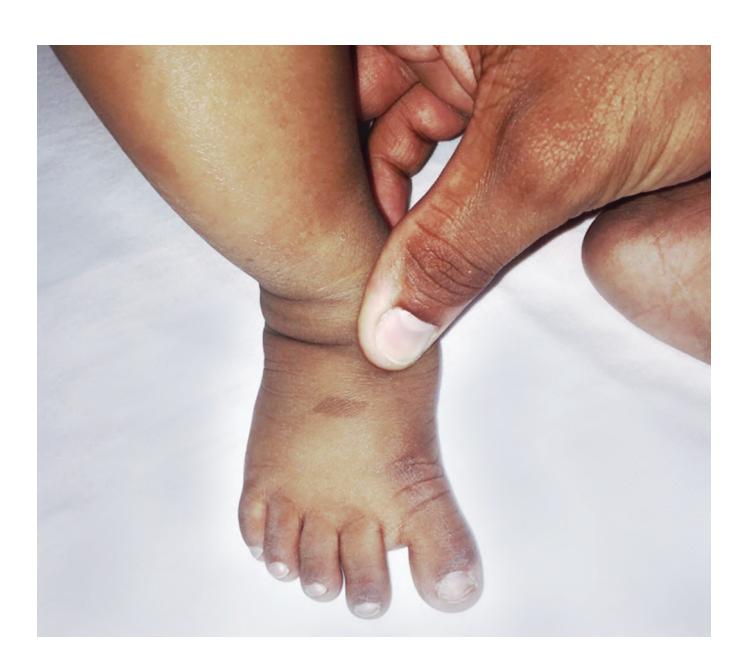
a. What is the finding?
b. What is the commonest condition associated with above finding?
c. Can this be a common variant (Yes/No?)
d. Enlist 1 antenatal cause it can be associated with.
Answer
No model answer in source material.
VVK05-002
For each of the conditions below, choose the most closely associated findings from the list above.
a. Tongue fasciculation
b. Gower sign
c. Heliotrope sign
d. Nonthrombocytopenic purpura
e. Thrombocytopenic purpura
i. Down Syndrome
v. Noonan syndrome
Answer
No model answer in source material.
VVK05-003
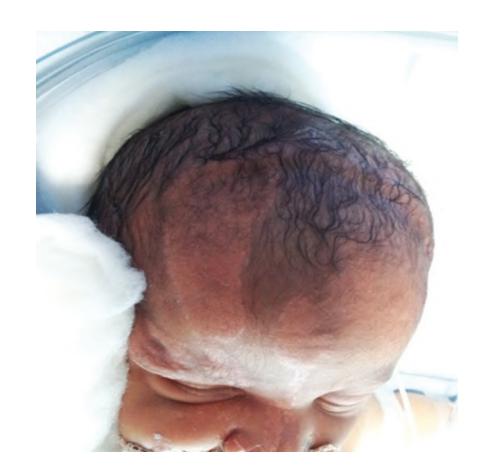
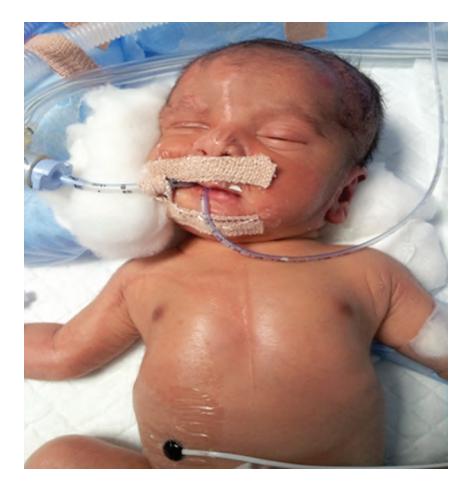
a. What is the diagnosis?
b. What can be the associated abnormalities?
Answer
No model answer in source material.
VVK05-004
Given below is a karotype of a 15 day old child
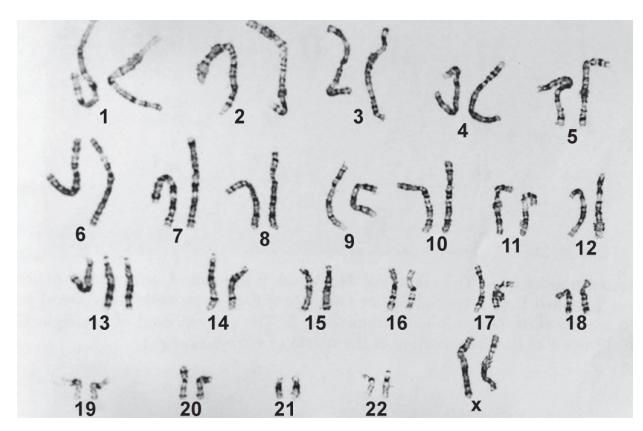
a. Identify the condition and sex of the child
b. Enlist 3 characteristic features
Answer
No model answer in source material.
VVK05-005
Enlist the chromosome location and associated cancer in relation to the Gene/oncogene
| Gene | Location | Cancer tumour |
|---|---|---|
| RBI gene | ||
| APC gene | ||
| WT1gene | ||
| BRCA1 gene | ||
| NF1 | ||
| NF2 | ||
| Nmyc | ||
| Abl | ||
| Erb-A | ||
| RET | ||
| SIS |
Answer
No model answer in source material.
VVK05-006
Study the pedigree chart and answer the questions.
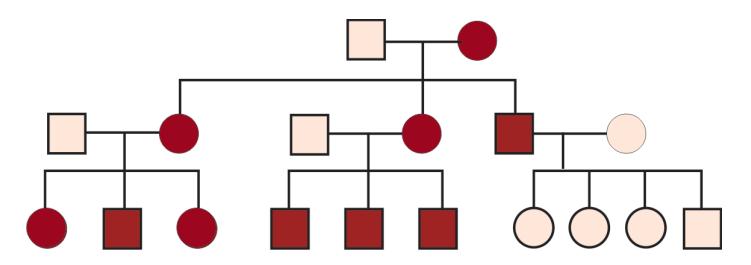
a. Identify the pattern of inheritance in the given pedigree with explanation.
b. Explain the mechanism of this inheritance.
c. Give 2 examples of this pattern of inheritance.
Answer
No model answer in source material.
VVK05-007
Study the pedigree chart given below and answer the questions.
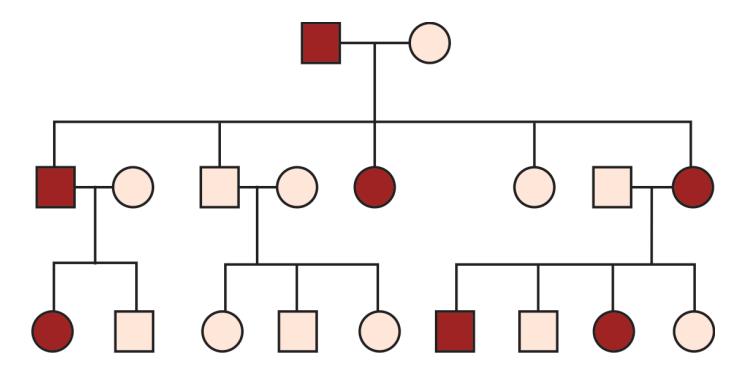
a. What is the pattern of inheritance?
b. Name three conditions with the similar pattern of inheritance.
c. Draw a pedigree chart showing parents with a pair of identical twins.
Answer
No model answer in source material.
VVK05-008
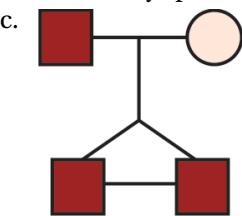
Given below is a pedigree chart of a male child with mental retardation.
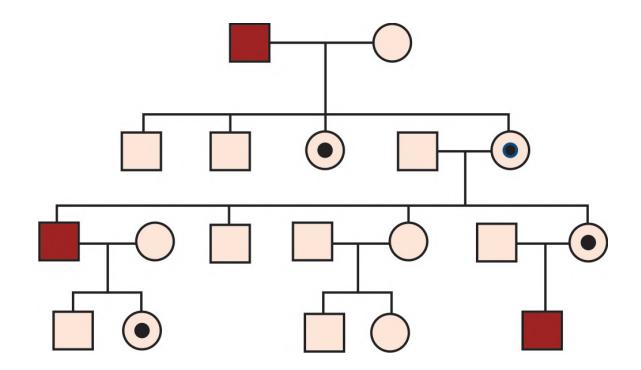
a. Identify the pattern of inheritance.
b. Name three conditions with similar inheritance.
c. What is the risk of getting affected in each pregnancy?
Answer
No model answer in source material.
VVK05-009
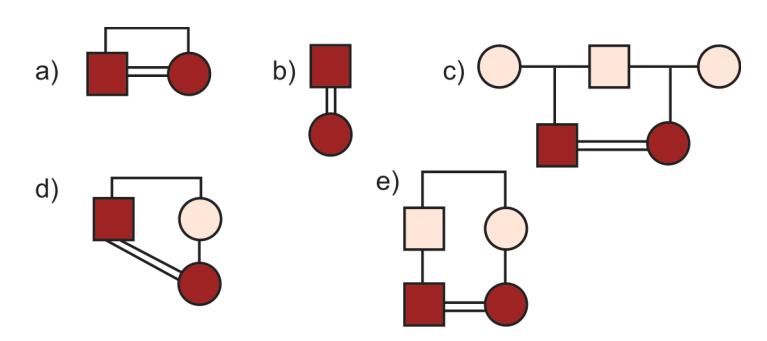
Identify the degree of consanguinity in the relationships shown with dotted lines in the following pedigree charts.
Answer
No model answer in source material.
VVK05-010
Study the pedigree chart shown below and answer the questions.
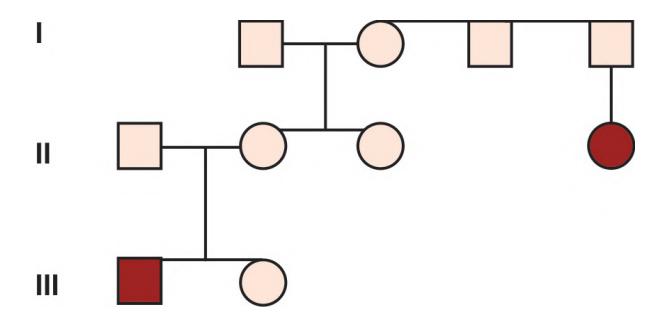
a. Indentify the pattern of inheritance.
b. Give an example of this type of inheritance.
c. If one child of parents with this disorder is already affected, what would be the recurrence risk in the next offspring?
d. It two earlier pregnancies are affected by this disease, what is the recurrence risk in the third offspring?
Answer
No model answer in source material.
VVK05-011
A 1-year-old female infant, born of a consanguineous marriage is brought to you with history of developmental delay. Clinically, there is dysmorhism consisting of coarse facies, short stature and corneal clouding. Liver is palpable, 4 cm below costal margin. There is no other family history of a similarly affected child. You make a clinical diagnosis of Hurler syndrome.
a. What features suggest that the diagnosis is Hurler and not Hunter syndrome?
b. How will you evaluate this child to support the diagnosis?
c. Name two modalities of treatment for this child.
Answer
No model answer in source material.
VVK05-012
Study the pedigree chart and answer the questions.
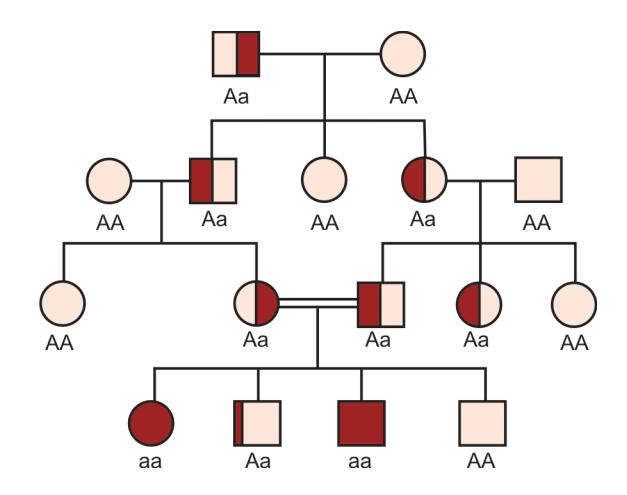
a. What type of inheritance is shown?
b. What is the risk of recurrence in the next pregnancy?
c. Of the following, which is consistent with this type of inheritance?
i. Glucose 6 phosphate dehydrogenase deficiency.
Answer
No model answer in source material.
VVK05-013
What is the pattern of inheritance for each of the following.
a. Achondroplasia.
b. Hemophilia B.
c. Congenital adrenal hyperplasia.
d. Glucose 6 phosphate dehydrogenase deficiency
e. Sickle cell disease.
f. Hemophilia A.
g. Phenylketonuria.
h. Duchenne muscular dystrophy.
i. Marfan's syndrome.
j. Huntington's chorea.
k. Neurofibromatosis.
Answer
No model answer in source material.
VVK05-014
What do the following symbols represent in the pedigree chart?
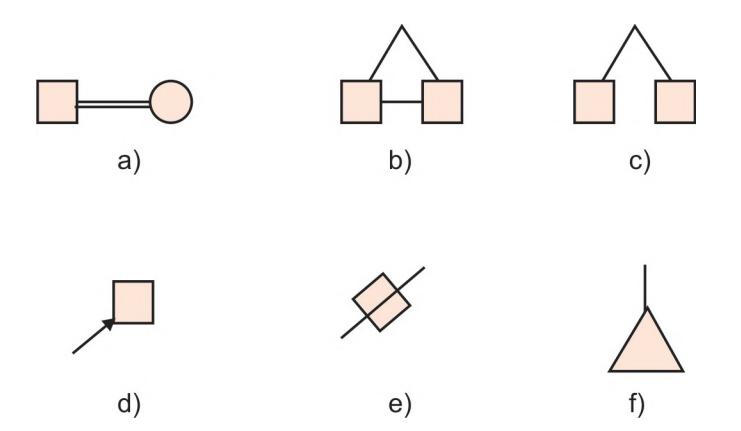
Answer
No model answer in source material.
VVK05-015
Study the pedigree chart given below and answer the questions.
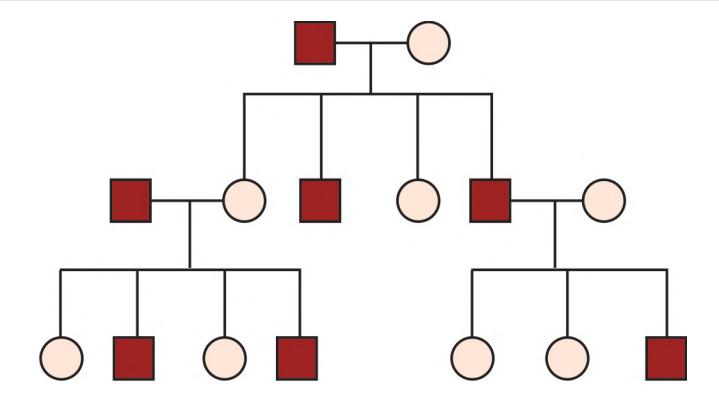
a. What is the mode of inheritance?
b. What is the recurrence risk of the disease?
c. Is it possible for the phenotypically normal members of the family to transmit this disease?
d. Which of the following are transmitted in this fashion?
i. Noonan's syndrome.
Answer
No model answer in source material.
VVK05-016
Full term male neonate was born by normal vaginal delivery to a 23 year old primigravida mother and was noted to have dysmorphic features as mentioned below.
- • Prominent occiput.
- • Head circumference 29 cm.
- • Clenched fist with overlapping 3rd and 4th fingers.
- • Rocker bottom feet.
a. What is the most probable diagnosis?
b. What is the likely chromosomal configuration of this neonate?
c. Name two congenital heart diseases commonly associated with this syndrome.
Answer
No model answer in source material.
VVK05-017
This female child was brought for evaluation of dysmorphic features.
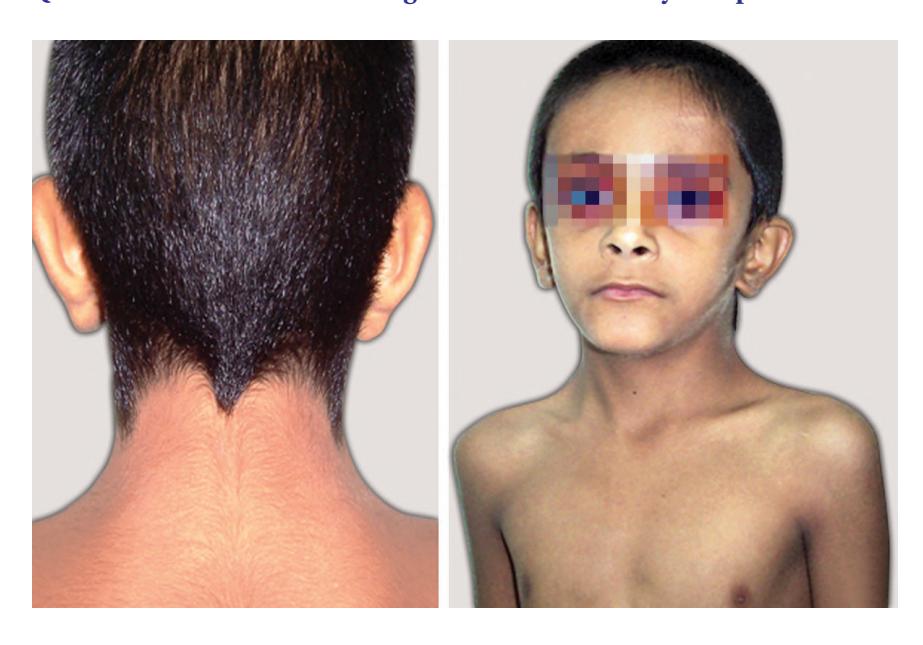
a. What is the most probable diagnosis?
b. Name one cardiac and one renal malformation associated most commonly with this condition.
c. What drug therapy can be provided to these patients?
d. Name one easy OPD procedure to reach a diagnosis.
e. What is the male version of this disease?
Answer
No model answer in source material.
VVK05-018
A 32-year-old pregnant lady is at 20 weeks of gestation. She is referred with a positive triple test result.
a. What are the components of triple test, what constitutes an abnormal test and which disease do they screen for?
b. Name three radiological findings that suggest the presence of the disease.
c. How can a definitive diagnosis that can be offered at this stage?
Answer
No model answer in source material.
VVK05-019
Study the karyotype of a male neonate born to a 26-year-old primigravida mother with an uneventful antenatal history.
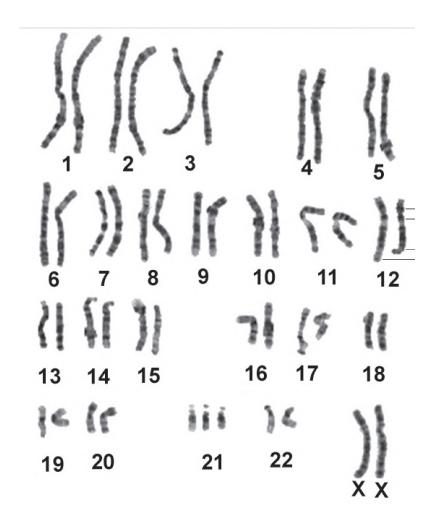
a. The recurrence risk of the condition in the next pregnancy is _____%.
b. If the father is a translocation carrier, the recurrence risk in the next pregnancy is _____%.
c. _____________% of these cases occur due to non-disjunction.
Answer
No model answer in source material.
VVK05-020
A 14-year-old boy is brought with history of poor scholastic performance, poor social interaction with family and peers and hyperactive behavior. Clinically, he has large ears, a prominent jaw and testicular volume of 36 cc bilaterally. IQ testing shows his IQ to be 75.
a. What is the most probable diagnosis?
b. What is the diagnostic test for the condition?
c. Name the chromosomal site affected in this individual.
Answer
No model answer in source material.
VVK05-021
Match the following.
a. Malformation sequence 1. Mechanical (uterine) forces that alter the structure of intrinsically normal tissue
b. Deformation sequence 2. Poor organization of cells into tissues or organs
c. Disruption sequence 3. Single, local tissue morphogenesis abnormality that produces a chain of subsequent defects
d. Dysplasia sequence 4. In utero tissue destruction after a period of normal morphogenesis
Answer
No model answer in source material.
VVK05-022
Match the following:
a. Syndrome Pierre Robin
c. Association Trisomy 21
Answer
No model answer in source material.
VVK05-023
A15-year-old male child was broughtto pediatric OPD for evaluation of small testes and underdeveloped secondary sex characters. On detailed physical examination, he was found to have promiment breasts bilaterally. He was suspected to have some chromosomal anomaly and a karyotype was done, as shown below.
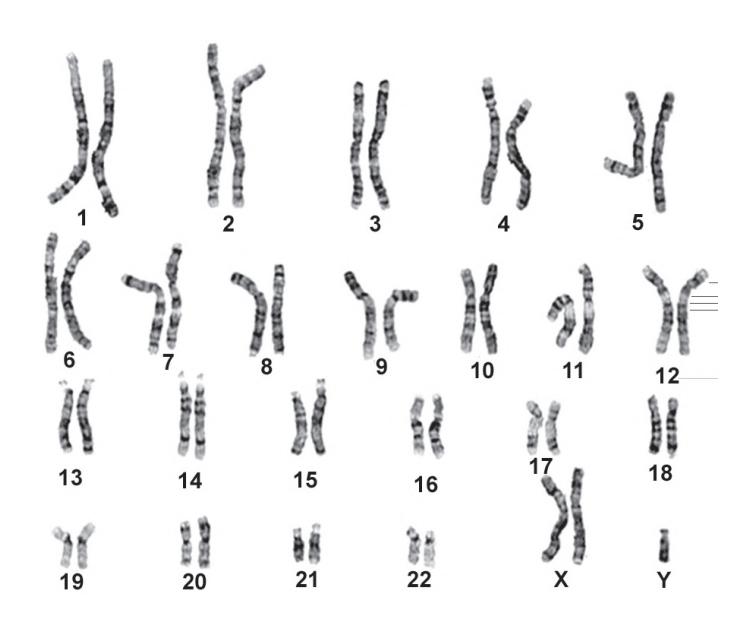
a. What is your diagnosis?
b. Give three salient features of this syndrome.
c. What is the effect on stature in this condition?
Answer
No model answer in source material.
VVK05-024
A lady has come to the OPD. Her husband has hemophilia A. There is no history of hemophilia in her family. She is now pregnant and wants genetic counseling. Answer the following questions.
a. Is her son at a risk for hemophilia?
b. Her daughter marries a normal man. What are the chances of hemophilia occurring in their children?
c. How will you offer prenatal diagnosis for hemophilia in the first trimester?
Answer
No model answer in source material.
VVK05-025
Answer the questions regarding Turner's syndrome.
a. What is the characteristic physical external neonatal manifestation?
b. Name 2 characteristic cardiac anomalies in Turner's syndrome.
c. Name 2 endocrine problems in Turner's syndrome.
d. Which GI problems can occur?
e. Name 3 hormones used in treatment of Turner's syndrome.
f. What are the most common skeletal abnormalities?
Answer
No model answer in source material.
VVK05-026
Answer the following questions with regard to a 5 year old male child with Downs syndrome and mental retardation.
a. Which one joint will you prefer to examine the most and why?
b. What would you like to test as a treatable cause for his mental retardation?
c. Name two blood test you would like do on periodic follow up and why?
d. Elaborate-46, XY, t (4:8) (p21;q22)
Answer
No model answer in source material.
VVK05-027
A 2-year-old girl is brought to the clinic with headache, vomiting, and pallor. Her blood pressure is 130/80 mm Hg. On physical examination, she is noted to have aniridia and a large abdominal mass. Abdominal scanning reveals a poorly vascularized tumor in the upper pole of the right kidney.
a. What is your most likely diagnosis?
b. What is the chromosomal defect seen in this condition?
c. What other abnormalities are associated with this condition?
d. Name 2 other syndromes associated with Wilm's tumor.
Answer
No model answer in source material.
VVK05-028
Study the photograph of this child whose X-ray of one hand is given along with.
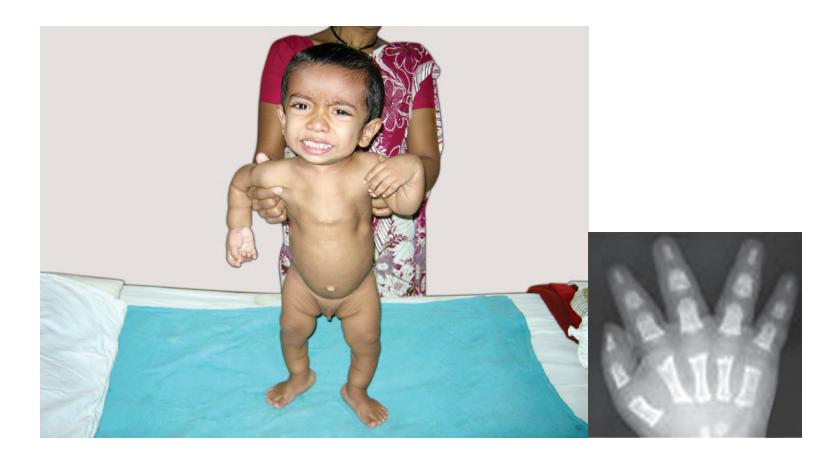
a. What is your likely diagnosis?
b. What inheritance pattern does this disease follows?
c. What is the average IQ in these children?
d. What complications of the vertebral column are likely to occur in this condition?
e. What is this characteristic shortening of limbs called?
f. Where is the abnormal gene in this condition located?
Answer
No model answer in source material.
VVK05-029
Match the following.
| a. | Germline mosaicism | Some individuals manifest the gene mildly |
|---|---|---|
| and some severly | ||
| b. | Reduced penetrance | Development of more severe expression of |
| the disease through successive generations | ||
| c. | Variable expression | Mutation that affects all or some of the germ |
| cells of one parent. | ||
| d. | Anticipation | Genetic picture is confused because the |
| apparent father is not the biological father | ||
| e. | Non paternity | Some individuals who have inherited the |
| disease do not manifest it phenotypically |
Answer
No model answer in source material.
VVK05-030
Match the following.
| Disease | Repeat (abnormal) sequence | |
|---|---|---|
| a. | Myotonic dystrophy | GAA |
| b. | Friedrich's ataxia | CGG |
| c. | Fragile X syndrome | CTG |
| d. | Huntington's disease | CAG |
Answer
No model answer in source material.
VVK05-031
Given below is a karyotype of a 1-month-old child who presented with characteristic sound produced during crying.
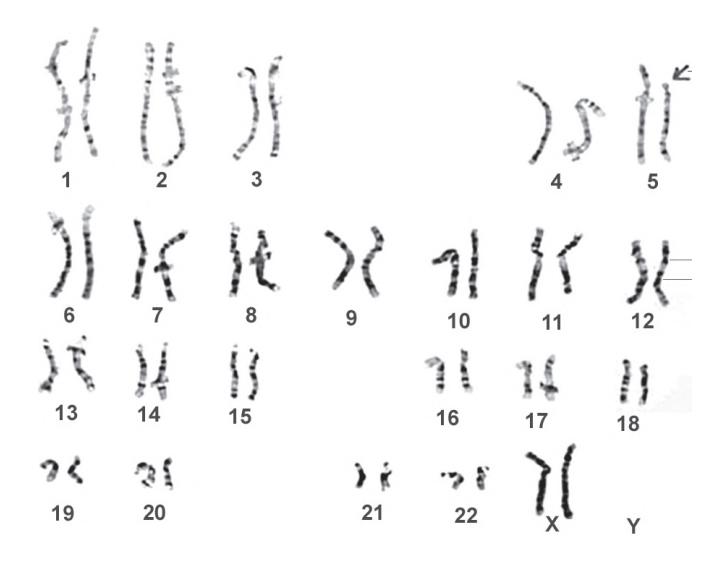
a. Identify the condition and the sex of the child.
b. What is the characteristic presentation in a neonate?
c. What is the life expectancy in this condition?
d. What is the chromosomal defect in this condition?
e. What is the origin of the abnormal chromosome in this condition?
Answer
No model answer in source material.
VVK05-032
This male child aged 10 months has been brought with a large tongue. He was born weighing 4.2 kg and had no perinatal or subsequent complication.
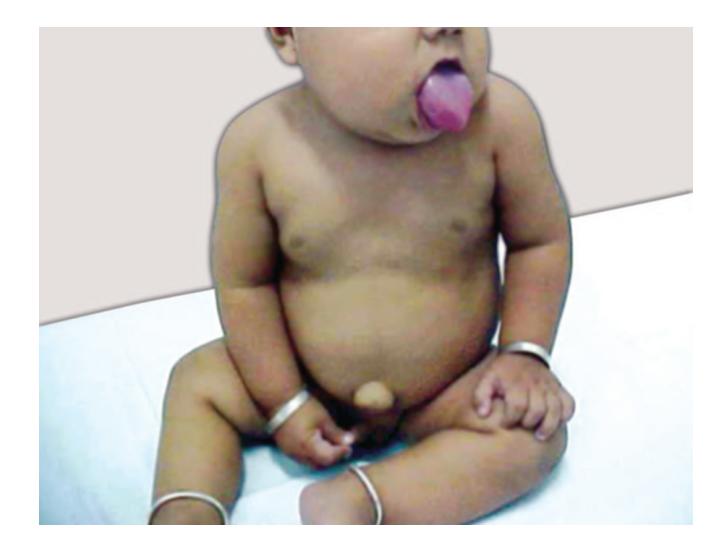
a. What is the most probable diagnosis?
b. What are the components of this syndrome?
c. Which chromosome carries the gene responsible for this disorder?
d. What complications do you expect in such a child?
a. Saddle Gap
b. Trisomy 21
c. Yes
d. Deforming due to an amniotic band.
a. 1
b. 3
c. 2
d. 4
e. 5.
a. Mitochondrial inheritance. All affected females have offspring who suffer from the disease. Affected males do not transmit the disease.
b. Mitochondrial DNA present in the ovum transmits the characteristics to the offspring. Such DNA is not present in the sperm.
c. Leigh disease and MELAS (Mitochondrial encephalopathy with lactic acidosis and stroke like syndromes).
a. Autosomal dominant.
b. Neurofibromatosis type 1, polycystic kidney disease, tuberous sclerosis, hereditary spherocytosis, Marfans syndrome, osteogenesis imperfecta.
a. X-linked recessive.
b. Hemophilia, color blindness, G6PD deficiency, Duchenne muscular dystrophy, Menkes kinky hair disease, adrenoleukodystrophy.
c. The risk is 50% for male child in each pregnancy.
a. First degree—sibs from same parents.
b. First degree—parent-child.
c. Second degree—uncle/aunt-niece/nephew.
d. Second degree—half sibs (from different mothers).
e. Third degree-first cousins—children of brother and sister.
a. Multifactorial inheritance.
b. Neural tube defect, pyloric stenosis, cleft lip/palate.
c. 3–4%.
d. 10%.
a. Hunters syndrome affects males, being X-linked recessive. There is no corneal clouding.
b. X-ray for dysostosis multiplex, urine screening for MPS, enzyme analysis of alpha iduronidase in blood, mutation analysis.
c. Enzyme replacement therapy with alpha iduronidase, bone marrow transplant.
a. Autosomal recessive.
b. 25%.
c. (ii) Niemann-Pick disease.
a. Autosomal dominant.
b. X-linked recessive.
c. Autosomal recessive.
d. X-linked recessive.
e. Autosomal recessive.
f. X-linked recessive.
g. Autosomal recessive.
h. X-linked recessive.
i. Autosomal dominant.
j. Autosomal dominant.
k. Autosomal dominant.
a. Second degree consanguinity.
b. Monozygotic twins.
c. Dizygotic twins.
d. Proband.
e. Stillbirth.
f. Miscarriage.
a. Autosomal dominant.
b. 50%
c. No.
d. (i) Noonan syndrome.
a. Edward syndrome, trisomy 18.
b. 47 XY + 18.
c. Ventricular septal defect, patent ductus arteriosus.
a. Turner syndrome.
b. Bicuspid aortic valve, coarctation of aorta/horse shoe kidney.
c. Growth hormone and estrogens.
d. Buccal smear for barr body.
e. Noonan syndrome.
a. Maternal serum alpha fetoprotein (low), unconjugated estradiol (high), free beta hCG (high). They are used to screen for fetal chromosomal anomalies.
b. Second trimester: Increased nuchal fold thickness, short femur, short humerus length, duodenal atresia. First trimester: nuchal fold thickness, nasal bone evaluation.
c. Fetal karyotype by amniocentesis.
a. 1%
b. 4–5%
c. 95%
a. Fragile X syndrome.
b. Karyotype, DNA studies for fragile X.
c. Xq27.3.
a. A pattern of multiple abnormalities that are related by pathophysiology and result from a common, defined etiology. Trisomy 21, fetal hydantoin syndrome.
b. Multiple malformations that are caused by a single event. Pierre Robin sequence.
c. Non-random collection of malformations where there is unclear relationship amongst the malformations so that they do not fit criteria for a syndrome or sequence VACTERL.
a. Klinefelter syndrome.
b. Hypogenitalism, hypogonadism, infertility, tall stature, mental retardation and behavior concerns.
c. Aggressive behavior, antisocial acts, learning difficulties, anxiety.
d. Tall stature with decreased upper to lower segment ratio.
a. No.
b. Her male children have a 50% risk of hemophilia.
c. Chorionic villus sampling and detection of the mutation in the hemophilia gene present in the affected child.
a. Oedema of hands, feets and posterior neck.
b. • Bicuspid aortic valve
c. Autoimmune thyroid disease and type 2 diabetes mellitus.
d. Celiac disease; GI bleed and delayed gastric emptying.
e. • GH
f. • Shortening of 4th metatarsal and metacarpal bone
a. Atlantoaxial joint as instable joint (ADI >10 mm) caries a significant risk of neurological injury.
b. Hypothyroidism (T3, T4 and TSH).
c. CBC with peripheral smear- for possibility of leukemia T3,T4,TSH- for possibility of hypothyroidism.
d. 46-Total no. of chromosome:
a. WAGR syndrome.
b. Microdeletion at 11p13.
c. Wilms tumor, aniridia, genitourinary abnormalities (cryptorchidism, streak ovaries, bicornate uterus, ambiguous genitalia), and mental retardation.
d. Denys-Drash syndrome and Beckwith-Wiedemann syndrome.
a. Achondroplasia.
b. Autosomal dominant trait.
c. Normal IQ in these patients.
d. In infancy—stenosis at foramen magnum leading to decreased tone, quadriparesis, apnea and SIDS.
e. The patients have a disproportionate short stature—with a normal trunk, short arms and short legs. There is proximal shortening of the limbs (rhizomelic dwarfism).
f. Chromosome 4.
a. Germline mosaicism: A mutation that affects all or some of the germ cells of one parent. Thus a condition that may appear as a one off mutation recurs in subsequent siblings.
b. Reduced penetrance: Some individuals who have inherited the disease do not manifest it phenotypically. They can transmit the gene to next generation, e.g. retinoblastoma.
c. Variable expression: Some individuals manifest the gene mildly and some severly, e.g. tuberous sclerosis.
d. Anticipation: This is the development of more severe expression of the disease through successive generations. Seen in diseases having trinucleotide repeats in their genes. The number of repeats increases through generations and thus the severity of disease.
e. Non paternity: The genetic picture is confused because the apparent father is not the biological father.
a. Cri-du-chat syndrome in a female child
b. Cry like a cat due to abnormal larynx development. Usually have low birth weight and may have respiratory problems. The main features are hypotonia, short stature, microcephaly with protruding metopic suture, moonlike face, hypertelorism, bilateral epicanthic folds, high arched palate, wide and flat nasal bridge, and mental retardation.
c. Most of them have a normal lifespan.
d. Microdeletion at short arm of chromosome 5.
e. In 80% cases the affected chromosome comes from father.
a. Beckwith Weidmann syndrome.
b. Omphalocele, macroglossia, microcephaly, visceromegaly, hemihypertrophy.
c. 11 (11p15.5).
d. Tumors: Wilm's tumor, hepatoblastoma, gonadoblastoma, adrenal carcinoma, rhabdomyosarcoma.
Answer
No model answer in source material.