MNJ10-001
Neonatal Resuscitation Program (NRP) Case Scenarios — Term Delivery:
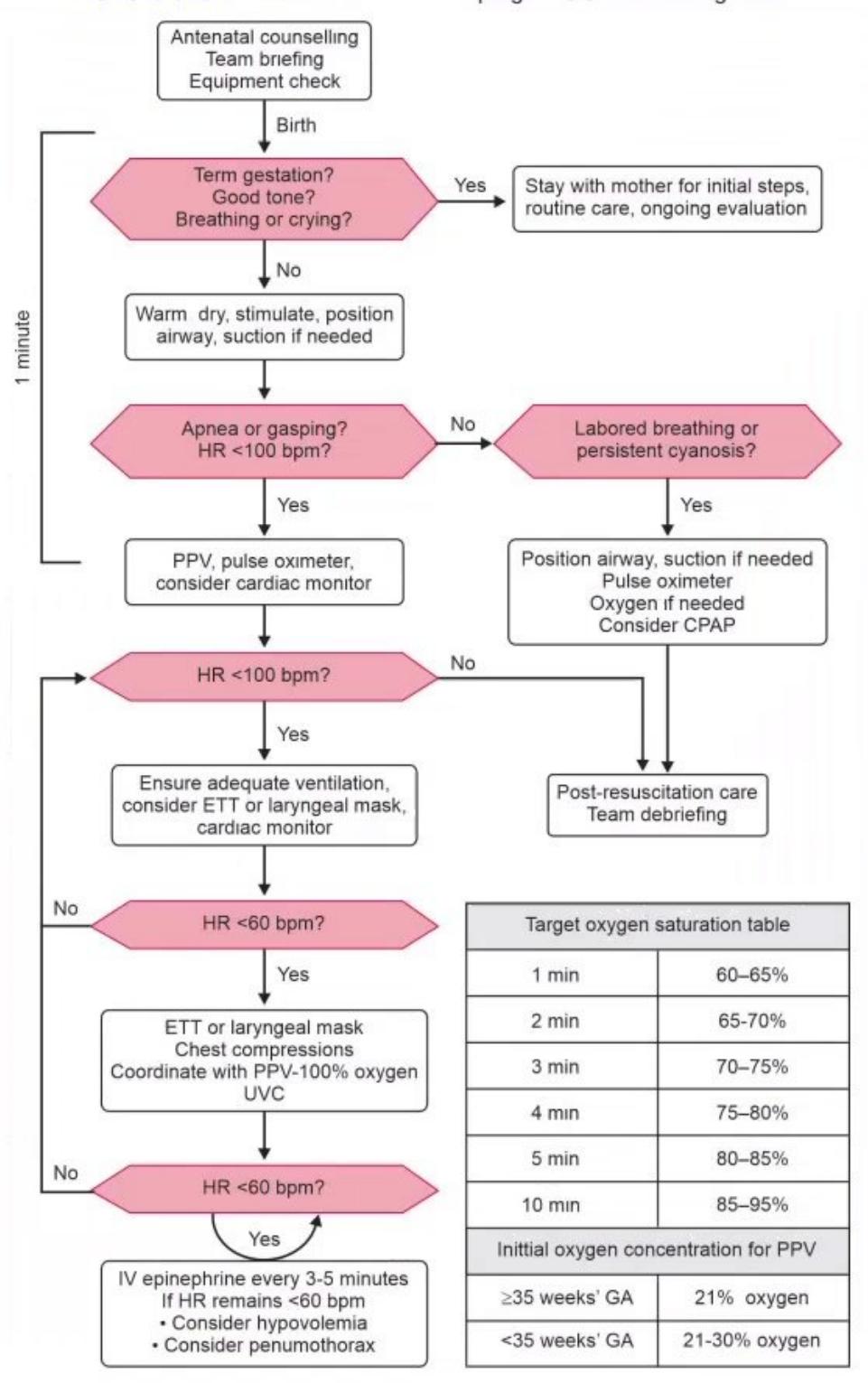
- A baby born at 38 weeks gestation delivered by normal vaginal delivery. Cried immediately after birth with normal tone.
- a. What are the 3 rapid assessment questions at birth?
- b. What is the next step in management?
Answer
-
Three rapid assessment questions:
- Term gestation?
- Good muscle tone?
- Breathing or crying?
-
Next step:
- Routine care: Stay with mother for skin-to-skin contact, provide warmth, clear secretions if needed, dry the baby, and ongoing assessment of breathing, tone, and color.
MNJ10-002
A baby born to a primigravida mother at 30 weeks of gestation, birth weight 1100 g, is delivered by emergency LSCS for PPROM. The mother did not receive antenatal corticosteroids:
- What are the 4 pre-birth questions to ask the obstetrician (NRP 8th Edition)?
- How would you prepare to resuscitate this preterm baby (equipment and pre-resuscitation steps)?
- If the baby did not cry at birth, what are your initial steps?
- If the baby is gasping/apneic with
after initial steps, how will you proceed? - After 15 seconds of Positive Pressure Ventilation (PPV), there is no chest rise and
. What corrective steps will you perform? - After 30 seconds of effective PPV, the baby is crying with
but has labored breathing / grunting. What is the next step?
Answer
-
Four pre-birth questions (NRP 8th Edition):
-
- Gestational age?
-
- Is amniotic fluid clear?
-
- Are there any additional risk factors?
-
- What is our umbilical cord management plan (delayed cord clamping vs milking)?
-
-
Preparation:
- Switch on radiant warmer, wash hands, and team briefing.
- Equipment check: Food-grade plastic bag/wrap and thermal mattress (
), T-piece resuscitator / self-inflating bag with reservoir, blended oxygen set at 21–30%, pulse oximeter and ECG monitor leads, suction catheter (10F/12F), laryngoscope with size 0/00 blade, and ET tubes (sizes 2.5, 3.0).
-
Initial steps (Preterm
weeks): - Place baby directly in polyurethane bag/wrap under radiant warmer without drying the body (dry head only and put on a cap).
- Position airway (sniffing position).
- Suction mouth then nose only if obstructed.
- Gentle tactile stimulation.
-
PPV Initiation:
- Start PPV with T-piece resuscitator / bag at 40–60 breaths/min with initial
. - Attach pulse oximeter probe to right upper extremity (pre-ductal).
- Attach 3-lead electronic cardiac monitor for continuous heart rate display.
- Start PPV with T-piece resuscitator / bag at 40–60 breaths/min with initial
-
Ventilation Corrective Steps (MR. SOPA):
- M: Mask adjustment (ensure tight seal)
- R: Reposition airway (neutral/sniffing position)
- (Re-evaluate PPV for 5 breaths; if no chest rise:)
- S: Suction mouth and nose
- O: Open the mouth slightly and lift jaw
- (Re-evaluate PPV; if no chest rise:)
- P: Pressure increase (in increments of
up to ) - (Re-evaluate PPV; if no chest rise:)
- A: Alternative airway (Endotracheal tube or Laryngeal Mask)
-
Next step for labored breathing:
- Position and clear airway, provide supplemental blended oxygen if needed to meet target
, and initiate Continuous Positive Airway Pressure (CPAP) at .
- Position and clear airway, provide supplemental blended oxygen if needed to meet target
MNJ10-003
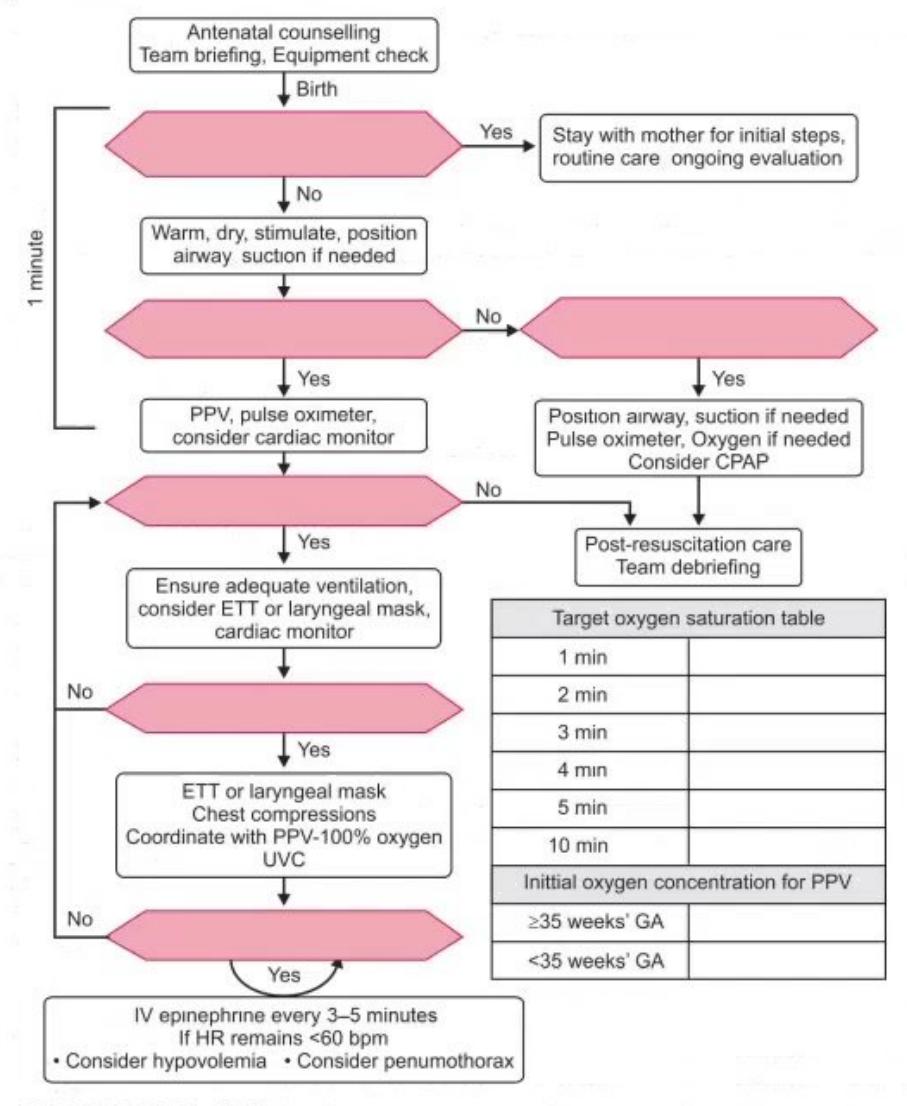
(May 2013) Fill in the blanks in the Neonatal Resuscitation Algorithm:
Answer
Refer to the standard NRP 8th Edition Flowchart:
- Target Pre-ductal
after Birth: - 1 min: 60%–65%
- 2 min: 65%–70%
- 3 min: 70%–75%
- 4 min: 75%–80%
- 5 min: 80%–85%
- 10 min: 85%–95%
- Initial
for PPV: ; . - Chest Compression Ratio: 3:1 (3 compressions : 1 ventilation, 90 compressions and 30 breaths per minute).
- Epinephrine Dose:
- IV/IO:
( of 1:10,000 solution) followed by normal saline flush. - Endotracheal (ET):
( of 1:10,000 solution).
- IV/IO:
MNJ10-004
(May 2014) Practical Demonstration Station:
- You are called to attend a delivery in the labour room where a baby may require resuscitation. You arrive 30 minutes prior to delivery. Enumerate the equipment checklist and pre-resuscitation preparation.
- A 28-week preterm baby is delivered. How will you assess and handle the baby immediately after delivery?
Answer
-
Pre-resuscitation Preparation:
- Form resuscitation team & designate team leader / roles.
- 4 Pre-birth questions: Gestational age, amniotic fluid clarity, number of babies/risk factors, cord clamping plan.
- Equipment Checklist (Warm, Clear airway, Auscultate, Ventilate, Oxygenate, Intubate, Medicate):
- Radiant warmer pre-heated, plastic wrap and warming pad.
- Suction apparatus set at 80–100 mmHg with 10F/12F catheters.
- T-piece resuscitator / self-inflating bag with reservoir and appropriate masks (sizes 0/1).
- Oxygen blender and flowmeter (
). - Pulse oximeter and ECG leads.
- Laryngoscope with size 00/0 blades, ET tubes (2.5, 3.0), stylet,
detector. - Emergency drugs (Epinephrine 1:10,000, Normal saline), UVC catheterization kit.
-
Handling 28-week Preterm Infant:
- Delayed cord clamping (30–60 seconds if hemodynamically stable).
- Place infant directly (without drying) into food-grade polyethylene bag/wrap under radiant warmer; place cap on head.
- Position head in sniffing position, clear airway if obstructed.
- Assess breathing, heart rate, and tone within 30 seconds. If apneic/gasping or
, initiate PPV with blended (21–30%) and apply pulse oximeter probe on right wrist.
MNJ10-005
(Nov 2014) OSCE Station — NICU Nursing & CPAP Care / Acute Resuscitation:
- A new nurse joins the NICU. As the posted doctor, instruct the nurse regarding:
- Care of a preterm infant on a radiant warmer / incubator (modes: servo/skin vs manual, temperature probe placement, neutral thermal environment).
- Care and monitoring of a baby on bubble CPAP.
- You are called to attend the delivery of a term baby with acute fetal distress on NST: Describe the step-by-step interactive resuscitation protocol.
Answer
-
Incubator & Radiant Warmer Instructions:
- Radiant Warmer / Incubator Modes:
- Servo/Skin Mode: Preferred; temperature probe attached securely over right hypochondrium / liver area (avoid bony prominences/brown fat). Target abdominal skin temperature
. - Manual Mode: Used only for initial preheating before delivery; never leave unattended in manual mode due to hyperthermia risk.
- Servo/Skin Mode: Preferred; temperature probe attached securely over right hypochondrium / liver area (avoid bony prominences/brown fat). Target abdominal skin temperature
- Incubator Care: Maintain air temperature at neutral thermal environment based on birth weight/gestational age; access through portholes; minimize draughts; maintain humidity for extreme preterms (
in week 1). - Care on Bubble CPAP:
- Ensure proper prong size (fill 100% of nares without pinching septum).
- Prevent nasal trauma: Use hydrocolloid barrier/nasal mustache, check columella hourly.
- Check bubble chamber for continuous bubbling (confirms circuit patency and PEEP).
- Orogastric tube left open to vent for gastric decompression.
- Change position 4–6 hourly; encourage Kangaroo Mother Care (KMC) once stable.
- Radiant Warmer / Incubator Modes:
-
Resuscitation for Acute Fetal Distress:
- Wash hands, receive baby under radiant warmer in warm dry towel.
- Check Term? Tone? Crying? If not breathing/gasping
provide initial steps (warm, dry, stimulate, position airway, suction mouth then nose). - Check HR and respiration: If
or gasping initiate PPV ( , ) + apply pre-ductal pulse oximeter. - After 15 seconds: If no chest rise
MR. SOPA. - After 30 seconds of effective PPV: If
intubate, increase to 100%, and begin coordinated chest compressions (3:1 ratio). - After 60 seconds of compressions: If
administer IV Epinephrine ( via UVC) followed by normal saline flush.
MNJ10-006
A 2-year-old child was struck by an automobile. On arrival:

- What is the diagnosis based on the clinical presentation and ECG rhythm?
- If initial rhythm assessment confirms a shockable rhythm (VF / Pulseless VT), write down the step-by-step PALS resuscitation algorithm.
Answer
- Diagnosis: Pulseless Ventricular Tachycardia (pVT) / Ventricular Fibrillation (VF) or Pulseless Electrical Activity (PEA) depending on rhythm interpretation; the scenario presents a shockable cardiac arrest rhythm (pVT/VF).
- PALS Shockable Rhythm Management:
- Start CPR: High-quality CPR, give 100% oxygen, attach defibrillator/monitor pads.
- 1st Shock: Defibrillate immediately with
. - Resume CPR immediately: 2 minutes of CPR (15:2 ratio with 2 rescuers; continuous compressions 100–120/min if advanced airway in place). Obtain IV/IO access.
- Check Rhythm: If still VF/pVT
2nd Shock: . - Resume CPR: Give Epinephrine
( of 1:10,000 IV/IO) every 3–5 minutes. Consider advanced airway and capnography. - Check Rhythm: If still shockable
3rd Shock: (up to or adult max). - Resume CPR: Administer Amiodarone
bolus IV/IO (or Lidocaine ). - Treat reversible causes (Hs and Ts).
MNJ10-007
A 5-year-old child was struck by an automobile. On arrival:

- What is the diagnosis after reading the ECG and clinical condition?
- The rhythm is confirmed to be non-shockable. Write down the step-by-step PALS resuscitation steps.
Answer
- Diagnosis: Asystole (cardiac arrest / flat line).
- PALS Non-Shockable Rhythm Management (Asystole / PEA):
- Immediate High-Quality CPR: 15:2 compression-to-ventilation ratio with 100% oxygen.
- Epinephrine as early as possible:
( of 1:10,000) IV/IO, repeat every 3–5 minutes. - Advanced Airway: Endotracheal intubation or SGA with continuous waveform capnography (
). - Rhythm & Pulse Check: Every 2 minutes (switch compressor).
- Search and treat reversible causes (Hs & Ts):
- Hs: Hypovolemia, Hypoxia, Hydrogen ion (acidosis), Hypoglycemia, Hypo/Hyperkalemia, Hypothermia.
- Ts: Tension pneumothorax, Tamponade (cardiac), Toxins, Thrombosis (pulmonary / coronary).
MNJ10-008
PALS Cardiac Arrest / Arrhythmias Fill in the Blanks:
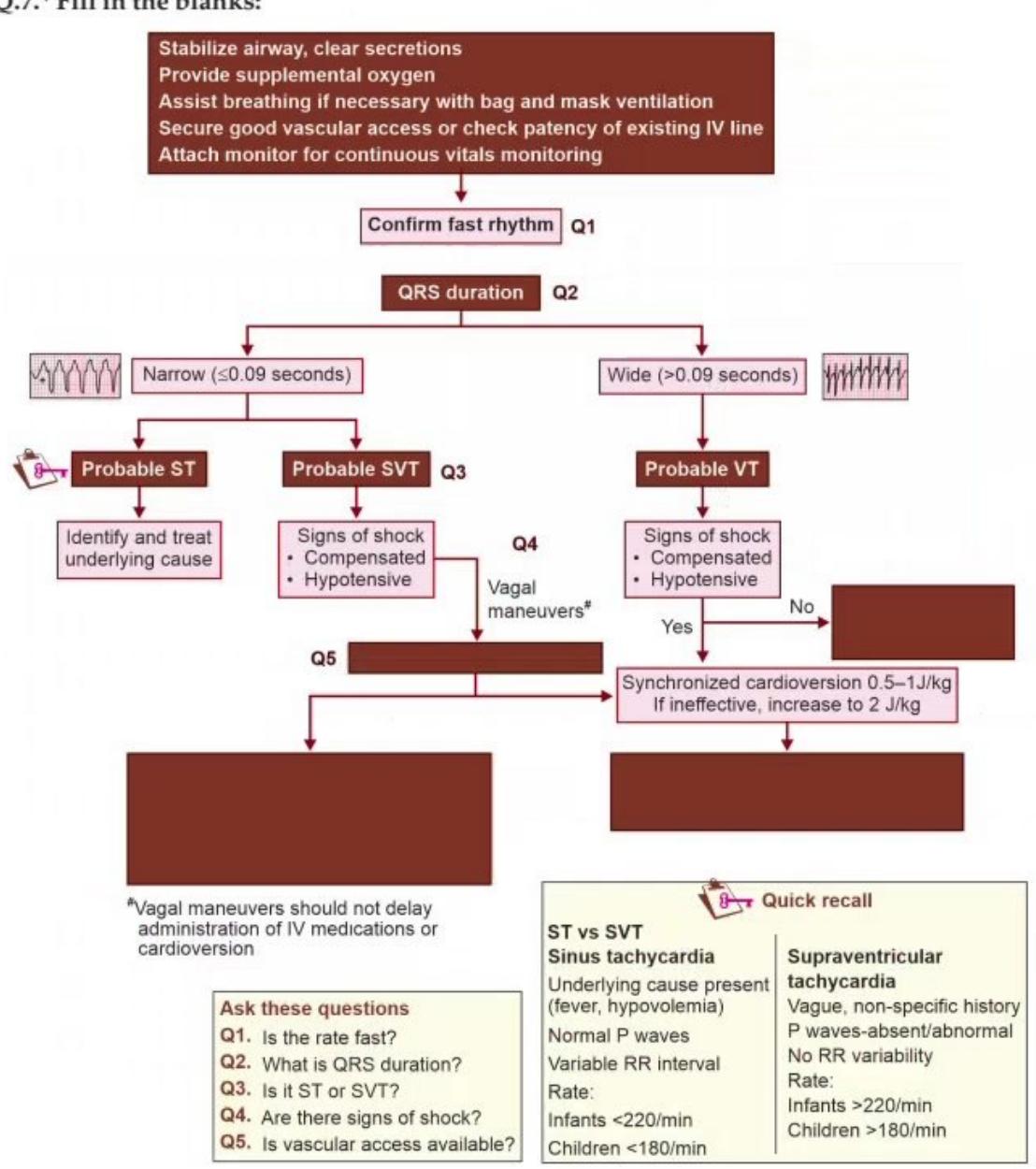

Enumerate the 4 core cardiac arrest rhythms associated with an absent pulse.
Answer
The 4 cardiac arrest rhythms are:
- Shockable Rhythms:
- Ventricular Fibrillation (VF)
- Pulseless Ventricular Tachycardia (pVT)
- Non-Shockable Rhythms:
- Asystole
- Pulseless Electrical Activity (PEA) / Electromechanical Dissociation (EMD)
MNJ10-009
An 8-year-old submersion (drowning) victim presents with apnea and no palpable pulse.
What cardiac arrest arrhythmias could be present in this child?
Answer
- Asystole (most common in pediatric hypoxic/drowning arrest)
- Pulseless Electrical Activity (PEA)
- Severe sinus bradycardia progressing to agonal rhythm
- Ventricular Fibrillation (VF) / Pulseless VT (especially if associated with profound hypothermia or underlying channelopathy / Long QT syndrome)
MNJ10-010
A 4-month-old male infant presents with irritability, sweating, poor feeding, and lethargy. Admitted to PICU. ECG is shown below:
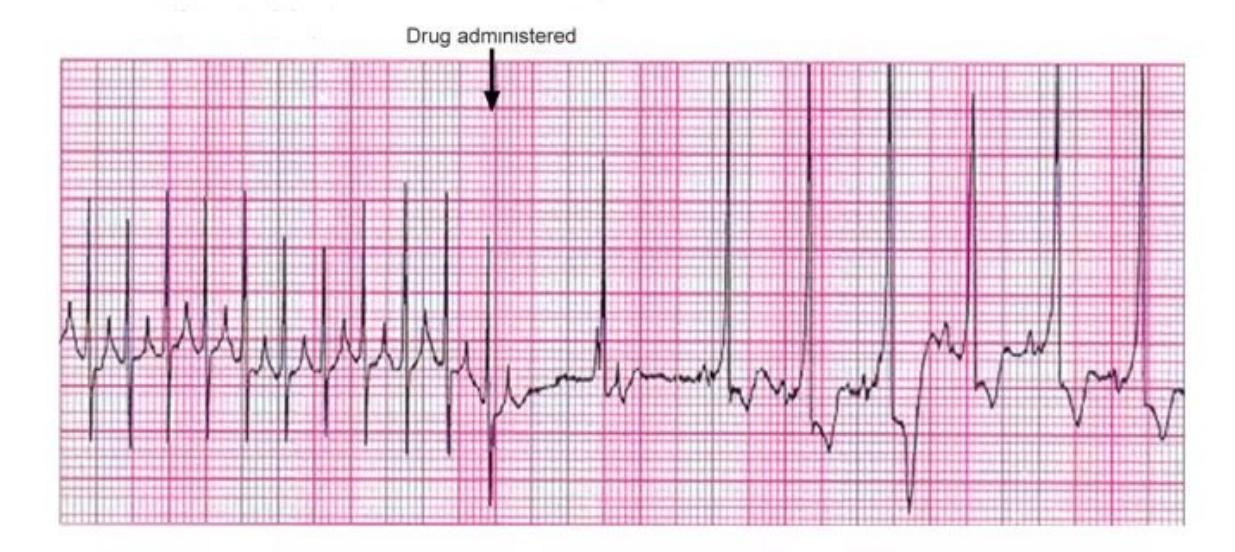
- What is the ECG diagnosis and what drug of choice is given?
- What is the dose of the drug (first dose, second dose, maximum dose) and how is it administered?
Answer
- ECG Diagnosis: Paroxysmal Supraventricular Tachycardia (PSVT) — narrow QRS complex tachycardia with absent P waves and heart rate
in infants. - Drug of choice: IV Adenosine.
- Adenosine Dosing & Administration:
- 1st Dose:
rapid IV push (maximum first dose ). - 2nd Dose:
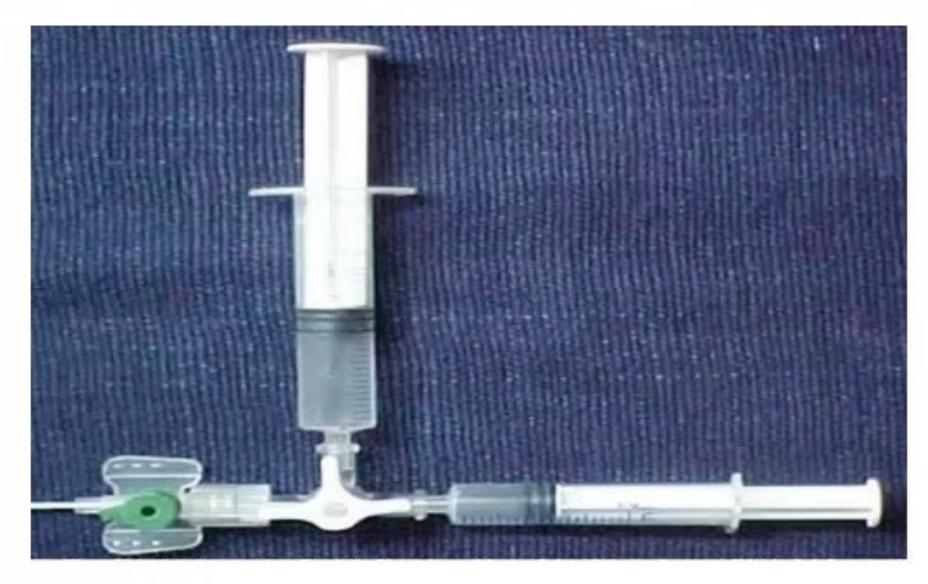
rapid IV push (maximum second dose ) if no response within 1–2 minutes. - Administration Technique: Rapid intravenous bolus via large-bore IV close to central circulation, followed immediately by a rapid
normal saline flush (two-syringe technique).
- 1st Dose:
MNJ10-011
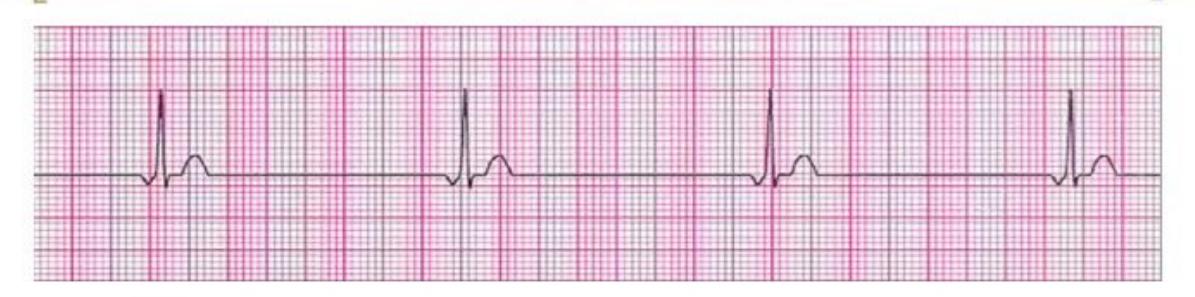
- What is the rhythm shown on the monitor?
- What are the possible reversible contributing factors (Hs and Ts)?
- What emergency interventions should you consider in a child with symptomatic bradycardia?
Answer
- Rhythm: Symptomatic / Severe Sinus Bradycardia.
- Contributing factors:
- Hypoxia (most common cause in children)
- Hypothermia
- Hypovolemia / Shock
- Hyperkalemia / Hypokalemia / Acidosis
- Heart block / Cardiac pathology
- Toxins / Drugs (e.g., digoxin, beta-blockers, organophosphates)
- Increased intracranial pressure (Cushing's triad)
- Emergency Interventions:
- Maintain airway, support breathing with
and ventilation. - If
with poor perfusion despite adequate oxygenation and ventilation start Chest Compressions. - Epinephrine:
( of 1:10,000) IV/IO every 3–5 min. - Atropine:
(minimum , maximum single dose ) if bradycardia is due to increased vagal tone, cholinergic drug toxicity, or primary AV block. - Consider transcutaneous pacing.
- Maintain airway, support breathing with
MNJ10-012
Foreign Body Airway Obstruction (FBAO) Management Station:
- Case 1: An 8-month-old infant presents with sudden onset cough and choking after pea ingestion.
- Case 2: A 4-year-old child presents with sudden severe choking and respiratory distress.
Demonstrate and describe the management steps for both age groups (conscious vs unconscious).
Answer
-
General Principles:
- Do NOT perform blind finger sweeps (can push foreign body deeper into larynx).
- If child is coughing effectively, encourage spontaneous coughing and observe closely.
-
Infant (
): - Conscious infant with severe obstruction (silent cough, cyanosis):
- Position infant face-down (prone) along your forearm/thigh, supporting head with jaw.
- Deliver 5 firm back slaps/blows between scapulae with heel of hand.
- Turn infant face-up (supine) and deliver 5 chest thrusts (lower half of sternum, similar to CPR compressions).
- Repeat cycle of 5 back blows and 5 chest thrusts until foreign body is expelled or infant becomes unresponsive.
- Unresponsive infant:
- Lower infant onto firm flat surface, call for emergency help.
- Start CPR (30:2 single rescuer or 15:2 two rescuers). Look in mouth before ventilations; if foreign body is clearly visible, remove it.
- Conscious infant with severe obstruction (silent cough, cyanosis):
-
Child (
): - Conscious child:
- Perform Heimlich maneuver (subdiaphragmatic abdominal thrusts): Stand behind child, place fist midline between xiphoid process and umbilicus, deliver quick upward and inward thrusts in sets of 5 until dislodged.
- Unresponsive child:
- Position supine, shout for help, initiate CPR (compressions
airway breathing). Inspect oropharynx before each ventilation attempt.
- Position supine, shout for help, initiate CPR (compressions
- Conscious child:
MNJ10-013
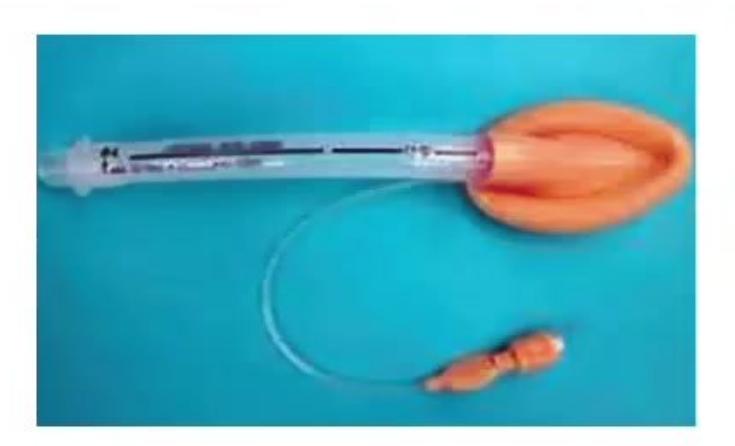
- What is this device?
- What are its indications?
- What are the contraindications?
- Mention two limitations.
- Mention potential complications.
Answer
- Device: Laryngeal Mask Airway (LMA) / Supraglottic Airway Device (SAD).
- Indications:
- Rescue airway in "cannot intubate, cannot oxygenate / cannot ventilate" scenarios.
- Elective airway management for short pediatric surgical procedures under general anesthesia.
- Alternative airway during CPR when endotracheal intubation is difficult or unavailable.
- Contraindications:
- Complete upper airway obstruction below the level of the larynx.
- Severe trismus or limited mouth opening.
- Limitations:
- Does not completely protect against gastric regurgitation and pulmonary aspiration.
- May dislodge easily during patient transfer or resuscitation movements.
- High airway pressures (
) can cause gastric insufflation and air leak.
- Complications: Aspiration of gastric contents, laryngospasm, sore throat, local mucosal trauma, hypoglossal or lingual nerve neuropraxia.
MNJ10-014
A 12-year-old girl Ritu has sustained injury to the neck due to a road traffic accident. She is breathing but cannot move or feel her arms or legs.
- What airway opening maneuver must be used in suspected cervical spine/neck injuries?
- Cervical spine X-ray shows no bony fracture or dislocation. Is it still possible for her to have spinal cord injury? Name the condition and mode of definitive diagnosis.
- What is the emergency medical/pharmacological treatment offered within 8 hours of injury?
Answer
- Airway Maneuver: Modified Jaw-thrust without head tilt (while maintaining manual in-line cervical spine stabilization).
- Spinal Cord Injury without Radiographic Abnormality (SCIWORA):
- Yes, children have high vertebral elasticity compared to the spinal cord.
- Definitive Diagnosis: MRI of the spine (demonstrates cord edema, contusion, hemorrhage, and ligamentous disruption).
- Emergency Medical Treatment:
- High-dose intravenous Methylprednisolone (
IV bolus over 15 minutes, followed 45 minutes later by continuous infusion of for 23 hours if started within 3–8 hours of injury).
- High-dose intravenous Methylprednisolone (
MNJ10-015
- Define: (a) Drowning, (b) Non-fatal drowning (formerly near-drowning).
- List 3 predisposing risk factors for drowning in children.
- List 2 electrolyte disturbances and 1 hematological disturbance in drowning victims.
- What is the most common radiological finding on chest X-ray?
Answer
- Definitions (WHO consensus):
- Drowning: The process of experiencing respiratory impairment from submersion/immersion in liquid resulting in death.
- Non-fatal drowning: Survival (at least temporarily) following respiratory impairment from submersion/immersion.
- Predisposing factors:
- Seizure disorder (epilepsy)
- Underlying cardiac channelopathy (Congenital Long QT Syndrome, e.g., Jervell and Lange-Nielsen / Romano-Ward syndrome)
- Lack of adult supervision / inability to swim
- Head/cervical trauma or intoxication (older adolescents)
- Laboratory disturbances:
- Electrolytes: Hyperkalemia (from hemolysis/acidosis/tissue hypoxia), Hyponatremia or Hypernatremia, Metabolic acidosis.
- Hematological: Intravascular hemolysis, Disseminated Intravascular Coagulation (DIC).
- CXR finding: Bilateral diffuse alveolar/interstitial pulmonary edema (ARDS / chemical pneumonitis).
MNJ10-016
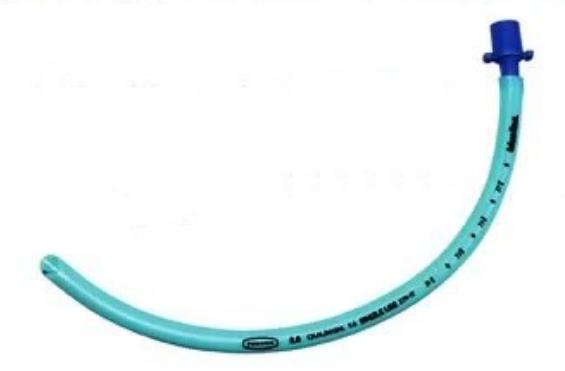
- Identify the instrument.
- Name its parts.
- What internal diameter (ID) size would you use in a 6-year-old child?
- Mention physiological/hemodynamic changes that occur during laryngoscopy and tracheal intubation in children.
Answer
- Instrument: Uncuffed Endotracheal Tube (ETT).
- Parts:
- 15 mm machine connector/adaptor
- Tube shaft with length depth markings (in cm)
- Radiopaque longitudinal marker line
- Vocal cord guide mark
- Murphy's eye (side hole at distal bevel)
- Distal beveled tip
- Size calculation for 6-year-old child:
(always keep sizes 5.0 mm and 6.0 mm ready). . - Depth of insertion:
(or ).
- Physiological changes during intubation:
- Raised Intracranial Pressure (ICP) and Intraocular Pressure (IOP)
- Reflex laryngospasm and bronchospasm
- Hypoxia and hypercapnia if delayed
- Hypertension and tachycardia in older children (sympathetic reflex)
- Vagal-mediated bradycardia and hypotension in infants and young children
MNJ10-017
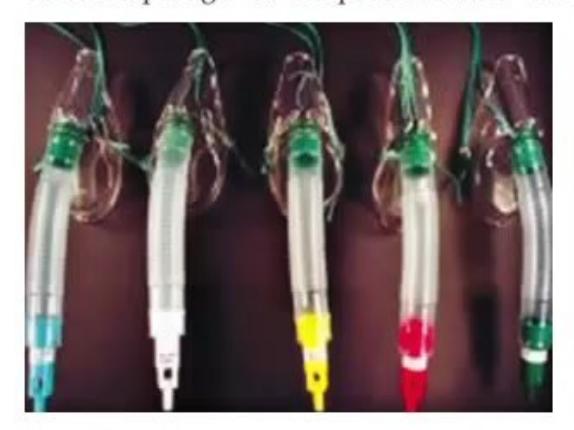
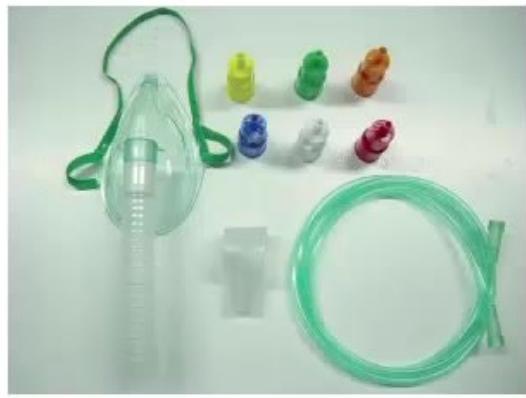
- Name the device shown.
- What does the color of the mask's adaptors reflect?
- Mention the
achieved with various color-coded adaptors. - Mention the typical delivered
and flow rates for: - a. Nasal prongs (cannula)
- b. Simple face mask
- c. Non-rebreathing mask (NRBM) with reservoir bag
Answer
- Device: Venturi Mask (Air-entrainment mask / Fixed-performance oxygen delivery system).
- Significance: The color of each adaptor indicates the specific fixed fraction of inspired oxygen (
) delivered at a designated minimum oxygen flow rate. - Color-Coded Venturi Adaptors:
- Blue:
(at 2–4 L/min) - White:
(at 4–6 L/min) - Yellow:
(at 6–8 L/min) - Red:
(at 8–10 L/min) - Green:
(at 12–15 L/min)
- Blue:
- Oxygen Delivery Systems:
- a. Nasal Prongs: Flow 1–4 L/min
(approx ). - b. Simple Face Mask: Flow 6–10 L/min
. - c. Non-Rebreathing Mask (NRBM): Flow 10–15 L/min
.
- a. Nasal Prongs: Flow 1–4 L/min
MNJ10-018
You are asked to perform Rapid Sequence Intubation (RSI) in a critically ill child. Enumerate the sequential 7 Ps / steps of RSI, mentioning the names and classes of drugs used.
Answer
The 7 Ps of Rapid Sequence Intubation (RSI):
- Preparation: Check suction, airway equipment (ETT, laryngoscopes, bag-mask), monitors, and prepare medications.
- Preoxygenation: 100%
via non-rebreather mask for 3–5 minutes to wash out nitrogen and create oxygen reservoir. - Pretreatment / Premedication:
- Atropine (
, min ) in infants to prevent reflex bradycardia. - Lidocaine (
) in raised ICP. - Fentanyl (
) to attenuate sympathetic response.
- Atropine (
- Paralysis with Induction (Sedation):
- Induction agents: Ketamine (
), Propofol ( ), Etomidate ( ), or Midazolam ( ). - Neuromuscular blocking agents: Succinylcholine (
) or Rocuronium ( ).
- Induction agents: Ketamine (
- Protection and Positioning: Sniffing position (with shoulder roll in infants). Apply Sellick maneuver (cricoid pressure) if indicated.
- Placement with Proof: Direct/video laryngoscopy, pass ETT through vocal cords. Confirm placement with continuous waveform capnography (
), bilateral equal breath sounds, and absence of gastric insufflation. - Post-intubation Management: Secure ETT, note cm mark at lips, chest radiography for depth confirmation, mechanical ventilation, and continuous post-intubation sedation/analgesia.
MNJ10-019
A 3-year-old child is brought to the ER at 10:30 AM with a weight of 12 kg and 45% burns sustained in a house fire at 5:30 AM.

- Calculate his fluid requirement in the first 48 hours as per the Parkland formula.
- By what exact clock time should the first 24-hour resuscitation fluid be completed?
- What is the target serum albumin level in this child?
- How much 5% Albumin should be infused in this patient?
Answer
-
Fluid Requirement Calculations:
- First 24-Hour Resuscitation Fluid (Parkland Formula):
- First 8 hours from time of injury (5:30 AM to 1:30 PM): Half volume =
. (Since child arrived at 10:30 AM, 5 hours have already elapsed; remaining must be run over the next 3 hours by 1:30 PM). - Next 16 hours (1:30 PM to 5:30 AM next day): Remaining half volume =
( ). - Plus Maintenance Fluid:
( ).
- First 8 hours from time of injury (5:30 AM to 1:30 PM): Half volume =
- Second 24-Hour Fluid:
- Colloid / 5% Dextrose in half-normal saline or RL at
of first day requirement ( ) plus maintenance.
- Colloid / 5% Dextrose in half-normal saline or RL at
- First 24-Hour Resuscitation Fluid (Parkland Formula):
-
Completion Time: First 24-hour cycle is completed at 5:30 AM the next day (24 hours from the exact time of burn injury).
-
Desired Serum Albumin:
( minimum). -
Colloid (5% Albumin) Infusion:
- For 30%–50% burns:
of 5% albumin/kg/% burn over 24 hours:
- For 30%–50% burns: