THG32-001
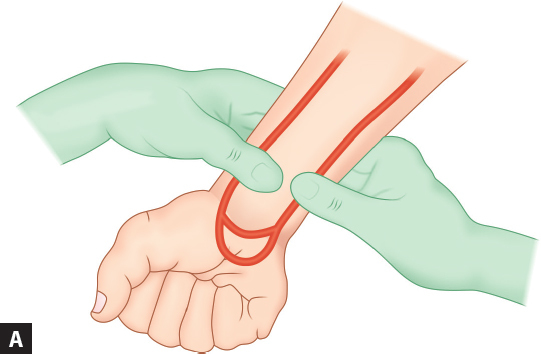
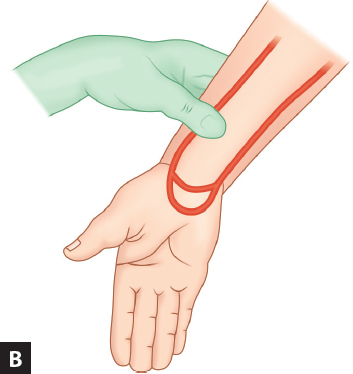
a. Name the test shown in the images A and B given above and its utility.
b. Mention the recommended sites for the procedure.
c. List of materials required.
d. What are the precautions to be taken?
e. What are the reasons for the precautions?
Answer
- a. Modified Allen test: It is used to assess the integrity of the ulnar artery before radial artery puncture or cannulation at that site, to verify ulnar artery collateral circulation, and to ensure blood flow to the hand if occlusion of radial artery occurs due to thrombus or embolization.
- b. Radial artery is the common site chosen; other sites include femoral artery, brachial artery, and rarely dorsalis pedis artery.
- c. Preheparinized ABG syringes if available or a normal syringe flushed with 0.05 mL of 1:1,000 heparin solution and emptied, gloves, and alcohol swabs.
- d. Procedure is performed after taking aseptic precautions, needle directed at an angle of 30–45° from the surface, and after 2 mL is collected, needle is removed, firm occlusive local pressure applied for over 5 minutes, check for hemostasis and apply adhesive plaster. If ABG syringe is used, needle protective sleeve applied, untwisted and removed with needle and placed in sharp container. Excess air removed by holding upright, gently tapped to bring air bubble if any to the top so that air can be expelled and after capping placed in ice bag and sent for analysis immediately after noting the details of the patient’s name, FiO2, temperature, date, and time.
- e. Reasons for precautions:
- Aseptic precautions to prevent sepsis.
- Needle is directed at an angle 30–45° in the direction of the artery to avoid trauma and allow smooth muscle fibers to occlude the site of puncture after the procedure.
- Firm occlusion to avoid bleeding and hematoma.
- Air bubbles expelled as they will increase PaO2 and cause error in interpretation.
- Sent in ice because change in pH is 0.001, PCO2 is 0.1 mm Hg and PaO2 is 0.01% in ice; without ice, change in pH is 0.01, PCO2 is 1 mm Hg and PaO2 is 0.1%.
- Patient’s details for avoiding errors and correct interpretation based on parameters like FiO2.
THG32-002
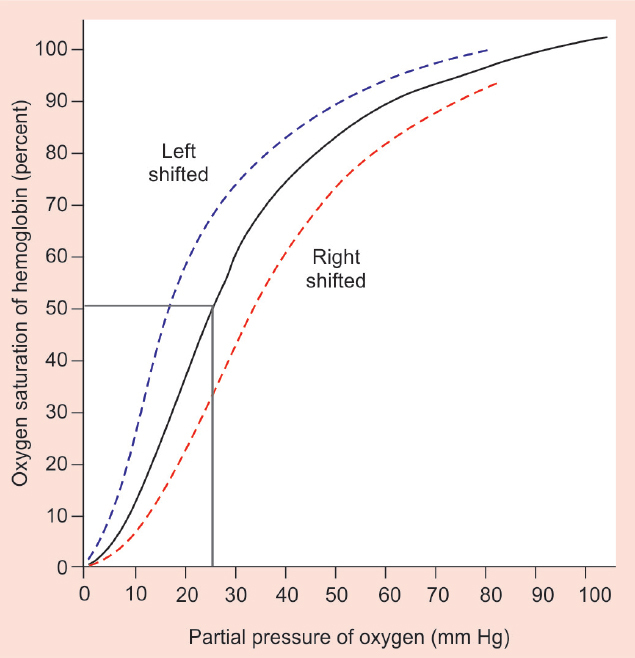
a. What is this curve seen in the image given above?
b. What is p50?
c. State two conditions which will cause shift of the curve to the left.
d. State two conditions which cause shift of the curve to the right.
e. What are the determinants of partial pressure of arterial oxygen (PaO2)?
Answer
- a. Oxygen—hemoglobin dissociation curve: Correlates the oxygen saturation of hemoglobin across a range of partial pressures of oxygen.
- b. The p50 is the pressure at which hemoglobin is 50% saturated (27 mm Hg on the X-axis).
- c. Left shift (dashed blue line) increases oxygen affinity (hemoglobin holds more tightly to oxygen and delivers less to tissues at a given arterial oxygen pressure): e.g., fetal hemoglobin (HbF), carboxyhemoglobin, methemoglobinemia (MetHb), low 2,3-diphosphoglycerate (2,3-DPG), higher pH (alkalosis), decrease in body temperature (hypothermia).
- d. Right shift (dashed red line) decreases oxygen affinity (hemoglobin delivers more oxygen to tissues at a given arterial oxygen pressure): e.g., increase in body temperature (fever/hyperthermia), higher 2,3-DPG, lower pH (acidosis), increased PaCO2.
- e. Determinants of PaO2: Age (as age increases PaO2 decreases: PaO2 ≈ 104.2 − 0.27 × age in years), FiO2 (roughly 5 × FiO2 percentage), barometric pressure, alveolar ventilation, and ventilation-perfusion matching.
THG32-003
Calculate the alveolar-arterial oxygen difference (AaDO2) for the arterial blood gas (ABG) given below:
| Parameter | Value |
|---|---|
| pH | 7.6 |
| PaCO2 | 65 mm Hg |
| PaO2 | 160 mm Hg |
| HCO3 | 24 mmol/L |
| FiO2 | 50% |
Answer
The AaDO2 is calculated as follows:
Inference: Marked increase in alveolar-arterial oxygen gradient.
THG32-004
A 5-year-old child admitted in pediatric intensive care unit (PICU) with the following results:
Arterial blood gas report shows:
- pH: 7.199
- PCO2: 32 mm Hg
- HCO3: 12 mEq/L
- PO2: 86.6 mm Hg
- Na: 136 mEq/L
- K: 4 mEq/L
- Cl: 100 mEq/L
a. Calculate the anion gap.
b. What is the metabolic abnormality?
c. What is the exact compensation?
d. What are the delta anion gap, delta HCO3, and delta-delta ratio?
e. Name two conditions with decreased anion gap?
Answer
- a. Anion gap:
. - b. High anion gap metabolic acidosis (HAGMA) with normal oxygenation.
- c. Compensation using Winter’s formula:
Actualis ( ), so there is concurrent respiratory acidosis. - d.
(Pure HAGMA with concurrent respiratory acidosis).
- e. Conditions with decreased anion gap: Hypoalbuminemia, paraproteinemia (multiple myeloma), bromide intoxication, lithium toxicity, and hypermagnesemia.
THG32-005
A 7-year-old child admitted with repeated vomiting was evaluated and as her serum electrolytes were Na 132 mEq/L, K 3.1 mEq/L, Cl 84 mEq/L, and HCO3 34 mEq/L, ABG was done which showed pH 7.48, PaCO2 47 mm Hg, HCO3 34 mEq/L, PaO2 96 mm Hg, and arterial oxygen saturation (SaO2) 100%, Hb 8 gm/dL.
a. What is the disorder?
b. What is the compensation?
c. Is there another disorder?
d. What is the cause for low Na and K?
e. Comment on the oxygenation and oxygen content.
Answer
- a. Disorder: Metabolic alkalosis as the HCO3 is high (34 mEq/L) with alkalemia (pH 7.48).
- b. Compensation: Expected PaCO2 rises 0.5–1 mm Hg for each 1 mEq/L rise in HCO3:
Actual PaCO2 is 47 mm Hg, indicating appropriate respiratory compensation. - c. Is there another disorder: No.
- d. Cause for low Na and K: Loss of HCl through gastric vomiting, contraction alkalosis, secondary hyperaldosteronism leading to renal potassium loss, and hypovolemic hyponatremia.
- e. Oxygenation and oxygen content: Normal oxygenation (PaO2 96 mm Hg).
THG32-006
ABG of a 5-year-old child is as follows:
- pH: 7.32
- PaCO2: 33 mm Hg
- HCO3: 18 mEq/L
- BE: −6.2
- PaO2: 85 mm Hg
- SaO2: 94%
- Anion gap: 12
a. What is the metabolic abnormality?
b. How is the compensation estimated?
c. What is the inference?
d. Comment on the anion gap.
Answer
- a. Metabolic acidosis (acidemia with low HCO3 18 mEq/L).
- b. Estimated compensation using Winter’s formula:
- c. Simple metabolic acidosis with appropriate respiratory compensation (actual PaCO2 is 33 mm Hg).
- d. Normal anion gap metabolic acidosis (NAGMA / hyperchloremic metabolic acidosis) as AG is 12.
THG32-007
The ABG of a 5-week-old infant with persistent vomiting is given below:
- pH: 7.51
- HCO3: 36 mEq/L
- PaCO2: 49 mm Hg
- BE: +12
- PaO2: 93 mm Hg
- SaO2: 95%
a. What is primary disturbance?
b. Is the compensation appropriate?
c. What is the oxygenation status?
d. Is it a simple or mixed disorder?
e. What is the clinical application?
Answer
- a. Primary disturbance: Metabolic alkalosis (elevated pH 7.51 and HCO3 36 mEq/L).
- b. Compensation: Expected PaCO2 rises 0.5–1 mm Hg for each 1 mEq/L rise in HCO3:
Actual PaCO2 is 49 mm Hg; compensation is appropriate. - c. Oxygenation status: Normal oxygenation (PaO2 93 mm Hg, SaO2 95%).
- d. Simple metabolic alkalosis.
- e. Clinical implication: Classic for hypochloremic hypokalemic metabolic alkalosis seen in infantile hypertrophic pyloric stenosis (IHPS). Look for visible peristalsis, palpable olive mass, perform abdominal ultrasound, and obtain surgical consultation.
THG32-008
An 8-year-old girl presented with history of polyuria and polydipsia of 2 weeks duration. On examination, child is dehydrated, comatose with deep and rapid breathing.
Laboratory values: Sodium 136 mEq/L, chloride 99 mEq/L, HCO3 11 mEq/L, capillary blood glucose (CBG) 600 mg/dL, ketonuria present. pH 7.1, BE −15, PCO2 16 mm Hg, PO2 90 mm Hg, HCO3 11 mEq/L, SaO2 95%.
a. What is the initial impression and oxygenation?
b. What is the comment on the clinical condition?
c. What is the compensation?
d. What is the anion gap?
e. Name two conditions with high anion gap metabolic acidosis (HAGMA).
Answer
- a. Initial impression: Severe high anion gap metabolic acidosis, hyperglycemia with normal oxygenation.
- b. Diabetic ketoacidosis (DKA).
- c. Compensation: Using Winter’s formula:
Actual PCO2 is 16 mm Hg (), indicating additional/superimposed respiratory alkalosis (or partial overcompensation). - d. Anion gap:
(High anion gap). - e. Conditions with HAGMA: Diabetic ketoacidosis, uremia/renal failure, toxic ingestions (methanol, ethylene glycol, salicylates), and lactic acidosis (sepsis, tissue hypoperfusion).
THG32-009
A 5-month-old admitted with afebrile seizures, acute encephalopathy, shock, fast breathing, and normal chest X-ray (CXR). No history of poisoning. On ventilator, FiO2 90%. Investigations: Glucose, Ca, Mg, renal function test (RFT), CT, and cerebrospinal fluid (CSF) analysis were normal. Sodium 138 mEq/L, K 3.5 mEq/L, chloride 100 mEq/L, pH 6.648, PCO2 25.8 mm Hg, PO2 396.4 mm Hg, SaO2 100%, HCO3 2.7 mmol/L.
a. What is the anion gap?
b. What is the initial interpretation of the above ABG?
c. What is the expected PCO2?
d. What are the delta anion gap, delta HCO3, delta gap, and delta-delta ratio?
e. What is the final interpretation?
Answer
- a. Anion gap:
. - b. Severe uncompensated high anion gap metabolic acidosis with hyperoxia (PaO2 396.4 mm Hg).
- c. Expected PCO2:
.
Actual PCO2 is 25.8 mm Hg (), indicating concurrent respiratory acidosis. - d.
- e. Final interpretation: Mixed High Anion Gap Metabolic Acidosis (HAGMA) + Respiratory Acidosis (delta gap between −6 and +6 and ratio between 0.8 and 2.0 confirms pure HAGMA component with superimposed respiratory failure).
THG32-010
Child resuscitated following cardiac arrest:
- pH: 6.86
- HCO3: 12.7 mEq/L
- BE: −18.3
- PaCO2: 75 mm Hg
- PaO2: 38.6 mm Hg
- SaO2: 75%
- Anion gap: 24
a. What is the initial interpretation of the above ABG result?
b. Calculate delta anion gap and delta bicarbonate.
c. What is the final interpretation and oxygenation?
Answer
- a. Severe mixed respiratory acidosis (PaCO2 75 mm Hg) and metabolic acidosis (HCO3 12.7 mEq/L, AG 24) with severe hypoxemia (PaO2 38.6 mm Hg).
- b.
- c.
and , confirming pure HAGMA with severe respiratory acidosis and severe hypoxemia (PaO2 < 40 mm Hg).
THG32-011
A 15-year-old boy presented with repeated vomiting of 4 days duration with mental confusion, giddiness, and tiredness for 1 day. Examination revealed tachycardia, hypotension, and dehydration.
Arterial blood gas report shows:
- pH: 7.5
- PaCO2: 49 mm Hg
- HCO3: 33 mEq/L
- PaO2: 92 mm Hg
- Na: 138 mEq/L
- K: 4 mEq/L
- Cl: 85 mEq/L
a. What is the interpretation of oxygen status?
b. How is hypoxia classified and what are the clinical features?
c. What is the initial impression?
d. What is the final interpretation?
Answer
- a. Normal oxygenation (PaO2 92 mm Hg, normal > 80 mm Hg).
- b. Classification of hypoxemia:
- Mild hypoxemia: PaO2 60–79 mm Hg (tachypnea)
- Moderate hypoxemia: PaO2 40–59 mm Hg (tachycardia, cool extremities)
- Severe hypoxemia: PaO2 < 40 mm Hg (cyanosis, arrhythmias, brain injury, and arrest)
- c. Initial impression: Metabolic alkalosis.
- d. Final interpretation: For 1 mEq/L rise in HCO3, PCO2 increases by 0.5–1 mm Hg. For
, expected PCO2 rise is 4.5–9 mm Hg (expected PCO2: 44.5–49 mm Hg). Actual PCO2 is 49 mm Hg, confirming adequately compensated metabolic alkalosis.
THG32-012
A 11-month-old infant presented with effortless tachypnea with depressed consciousness. The ABG is as follows:
- pH: 6.99
- PCO2: 34 mm Hg
- HCO3: 8 mEq/L
- Na: 141 mEq/L
- Cl: 105 mEq/L
a. What is the initial impression?
b. What is the anion gap?
c. What is the expected PCO2 and its interpretation?
d. What are the delta anion gap, delta bicarbonate, and final impression?
e. Mention the possible clinical condition with this result?
Answer
- a. Severe metabolic acidosis.
- b.
(High anion gap). - c.
. Actual PCO2 is 34 mm Hg ( ), so there is superimposed respiratory acidosis. - d.
; ; ; . Final impression: Pure HAGMA with concurrent respiratory acidosis. - e. Possible clinical conditions: Inborn errors of metabolism (IEM) with respiratory depression, chronic kidney disease (CKD) with pneumonia, septic shock with respiratory failure, or postcardiac arrest state.
THG32-013
ABG report:
- pH: 7.24
- PaCO2: 60 mm Hg
- PaO2: 47.6 mm Hg
- HCO3: 26 mEq/L
- FiO2: 0.6
a. Interpret the ABG.
b. What is the normal PaO2 if child breathes room air with normal lungs?
c. What is the normal PaCO2 and write the unit of measurement?
d. What is normal serum bicarbonate? Write the unit of measurement.
Answer
- a. Acute respiratory acidosis with moderate hypoxia on FiO2 0.6 and adequate metabolic compensation (in acute respiratory acidosis, for every 10 mm Hg rise in PaCO2, HCO3 rises by 1 mEq/L:
). - b. Normal PaO2 in room air with normal lungs: 80–100 mm Hg.
- c. Normal PaCO2: 35–45 mm Hg (average 40 mm Hg).
- d. Normal serum bicarbonate: 22–26 mmol/L (average 24 mmol/L or mEq/L).
THG32-014
ABG values of a 3-year-old child who is hyperventilating are as follows:
- pH: 7.57
- PaCO2: 30 mm Hg
- HCO3: 28 mEq/L
- PaO2: 70 mm Hg
a. What is the likely disorder?
b. Comment on final interpretation and oxygenation.
Answer
- a. Mixed disorder: Respiratory alkalosis with metabolic alkalosis.
- b. Compensation: For a 10 mm Hg acute fall in PCO2, HCO3 should fall by 2 mEq/L (expected HCO3: 22 mEq/L). Actual HCO3 is 28 mEq/L, confirming concurrent metabolic alkalosis with mild hypoxemia (PaO2 70 mm Hg).
THG32-015
ABG shows the following:
- pH: 7.39
- HCO3: 6 mEq/L
- PCO2: 12 mm Hg
- PaO2: 90 mm Hg
- Na: 134 mEq/L
- Cl: 106 mEq/L
a. What is the initial impression?
b. What is the anion gap and its inference?
c. What is the expected compensation and its inference?
d. What are the delta anion gap, delta bicarbonate, delta-delta ratio, delta gap, and its inference?
e. Mention a clinical situation where this is likely.
Answer
- a. Normal pH (7.39) with markedly abnormal HCO3 (6 mEq/L) and PCO2 (12 mm Hg), indicating a mixed acid-base disorder (metabolic acidosis + respiratory alkalosis) with normal oxygenation.
- b.
(High anion gap). - c. Expected compensation: For
, expected . Actual PCO2 is 12 mm Hg ( ), indicating added primary respiratory alkalosis. - d.
( ) ( ) - Inference: Mixed High Anion Gap Metabolic Acidosis (HAGMA) + Normal Anion Gap Metabolic Acidosis (NAGMA) + Respiratory Alkalosis.
- e. Clinical situation: Inborn error of metabolism (IEM) complicated by diarrhea and dehydration, chronic kidney disease (CKD) with gastroenteritis/diarrhea, or salicylate toxicity with vomiting.