THG03-001
A 12-year-old boy presented with learning concerns and epilepsy. Below are the images of the child.
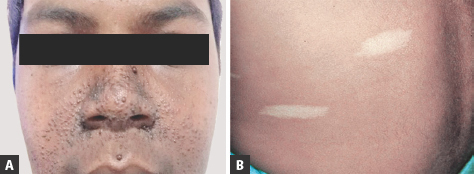
a. What are the clinical findings depicted here?
b. What is the most likely clinical diagnosis?
c. What is the characteristic neuroimaging feature of this condition?
d. What is the drug of choice for myoclonic seizures associated with this condition?
e. What drugs are recently being tried for treatment of this condition?
Answer
- a. (i) Adenoma sebaceum and (ii) Ash leaf macules
- b. Tuberous sclerosis
- c. Cortical tubers seen on MRI brain and subependymal giant cell astrocytomas (SEGAs)
- d. Vigabatrin is the treatment of choice for myoclonic epilepsy associated with tuberous sclerosis.
- e. Mammalian target of rapamycin (mTOR) inhibitors: Sirolimus and everolimus are tried for tuberous sclerosis.
THG03-002
An 8-month-old girl was brought with complaints of not looking at faces and not crawling yet. She has repetitive head turning and body rocking when she is made to sit. She responds to mother’s voice by cooing and smiles to tickle. On examination, she has a preferential downward gaze. When you give her a rattle, she is not reaching for it although she is attentive to sounds and tries to search for it and pick. Neurologically tone is normal. Ophthalmological examination is suggestive of normal anterior segment and normal fundus. Her magnetic resonance imaging (MRI) is shown here.
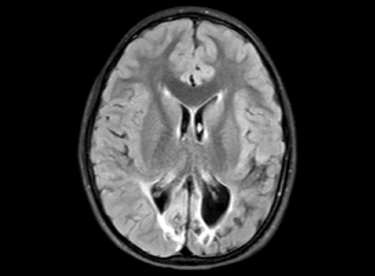
a. What is the most likely clinical diagnosis? Reason out.
b. What is the MRI feature shown here?
c. What is the neonatal history that you would like to elicit?
d. What are the risk factors for the neonatal complication that leads to this condition?
Answer
- a. Diagnosis: Cerebral visual impairment. Reasoning: Social smile to voices, but not looking at faces or tracking toys. Repetitive stereotypies noted. Vision concerns are present with normal ocular examination.
- b. Parieto-occipital gliosis with prominent posterior horn of lateral ventricles.
- c. Symptomatic neonatal hypoglycemia—poor feeding, jitteriness, cold peripheries, low blood glucose that was documented, lethargy, and seizures on day 2 or day 3.
- d. Preterm babies, infant of diabetic mothers, small for gestational age babies, children with hypoxic-ischemic encephalopathy (HIE), and hyperinsulinemic conditions can predispose to hypoglycemia.
THG03-003
Image of an infant is given below. Answer the questions that follow.
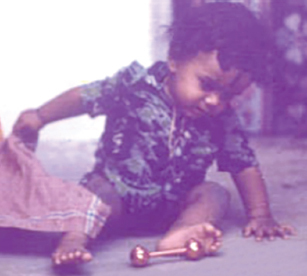
a. What is the cognitive milestone depicted here?
b. According to Piaget, during which stage of development do children attain this milestone?
c. What is the age at which child attains this milestone?
Answer
- a. Object permanence
- b. Sensorimotor stage (0–2 years)
- c. Emerges by 9–12 months
THG03-004
A 3-month-old infant was brought with a history of passing stool only once in 7–8 days. He was the third born to his parents, term child, weighing 3.2 kg. He cried at birth. He is on breastfeeds and has been immunized in the nearby primary health center. Mother mentioned that he rarely cries when hungry and she has noted his voice to be hoarse. On asking about development history, his mother mentioned that he has not attained head control yet and he occasionally smiles to himself. His current weight is 6 kg and his length is 52 cm. His image is shown below.
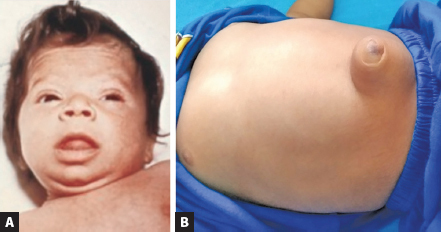
a. What are the red flag signs from the history and what are the clinical features?
b. What is the most likely diagnosis?
c. How will you confirm the diagnosis?
d. What specific test will suggest an etiological diagnosis?
e. What is the best option available to prevent the devastating sequelae of this condition?
Answer
- a. Coarse facies, dull appearance, hoarse cry, delayed attainment of head control, umbilical hernia, and decreased length but normal weight.
- b. Congenital hypothyroidism
- c. Elevated thyroid-stimulating hormone (TSH) with low T4/free T4 levels.
- d. Radionuclide scan (technetium-99m pertechnetate thyroid scintigraphy) and ultrasonography of neck.
- e. Newborn thyroid screening and early institution of levothyroxine.
THG03-005
A 7-year-old boy brought with history of instability in walking and difficulty in writing increased over the past 3 years. Child also has recurrent respiratory infections. Clinical image and MRI are shown here.
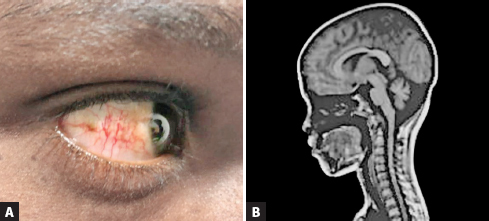
a. What are the findings depicted?
b. What is the most likely diagnosis? Justify by reasoning out.
c. What is the inheritance pattern of this disease?
d. What biochemical findings will be suggestive of the clinical diagnosis?
Answer
- a.
- Figure A: Ocular telangiectasia
- Figure B: Cerebellar atrophy on MRI
- b. Ataxia telangiectasia. Children present with telangiectasia in the eyes, progressive ataxia, recurrent infections, and may also have oculomotor apraxia. MRI shows diffuse cerebellar atrophy.
- c. Autosomal recessive
- d. Immunoglobulin A (IgA) levels will be low and α-fetoprotein (AFP) will be elevated.
THG03-006
A 2-year-old child is brought with concerns of not being able to walk independently and associated focal epilepsy. MRI is shown here.
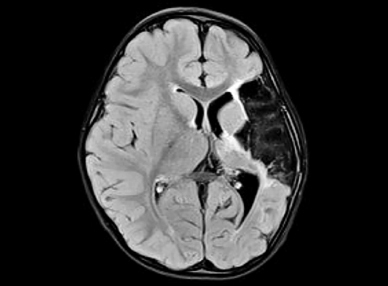
a. Outline the MRI findings.
b. What is the most likely clinical picture of cerebral palsy in this child? On which side are you likely to have findings?
c. What neonatal history you will ask for?
Answer
- a. Left cortical atrophy involving parts of the frontal, temporal, and parietal lobes predominantly with cystic encephalomalacia changes.
- b. Right-sided spastic hemiplegic cerebral palsy.
- c. Perinatal stroke, intracranial bleed (e.g. vitamin K deficiency bleed, thrombocytopenia), neonatal seizures, and birth asphyxia.
THG03-007
A 1-year-old child is brought with complaints of not holding neck yet and not reaching for objects. On examination, you notice that child has abnormal twisting movements of hands and legs, and arching of back intermittently. MRI is shown here.
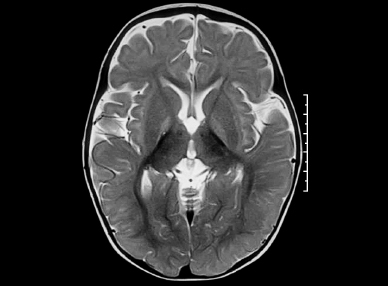
a. Describe the MRI findings.
b. What is the most likely diagnosis? What is the likely clinical image?
c. What neonatal history you will ask for?
d. What important comorbid condition would you evaluate for?
Answer
- a. Bilateral symmetrical T2 hyperintensities in the basal ganglia (globus pallidus).
- b. Dyskinetic cerebral palsy secondary to kernicterus sequelae (athetoid/dystonic CP).
- c. Neonatal jaundice with history of kernicterus, exchange blood transfusion, phototherapy, and blood group incompatibility (Rh/ABO) between baby and mother.
- d. Auditory neuropathy spectrum disorder (ANSD) / sensorineural hearing impairment.
THG03-008
A 3-year-old boy Raja is brought with concerns of not being able to sit and not being able to stand. He has associated difficulty in feeding and he is on nasogastric tube feeds to prevent aspiration. His parents have felt that he has always been floppy when picked up. On examination, his tone is reduced and deep tendon reflexes are not elicitable. His clinical image is depicted here. Answer the following questions.
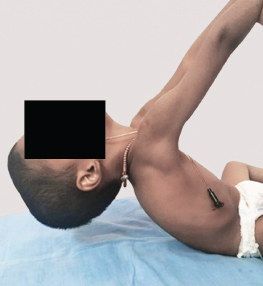
a. What is the clinical finding shown? What else you will look for in the oral cavity examination?
b. What is the most likely diagnosis? Substantiate your most likely diagnosis.
c. Name some drugs that have been developed for the management of this condition.
Answer
- a. Complete head lag on pull-to-sit. Look for tongue fasciculations in the oral cavity.
- b. Spinal muscular atrophy (SMA). Substantiation: Floppy child with severe hypotonia, absent deep tendon reflexes, feeding difficulty, and preserved cognition.
- c.
- Nusinersen (antisense oligonucleotide)
- Risdiplam (mRNA splicing modifier)
- Onasemnogene abeparvovec (Zolgensma) (AAV9 vector-based gene replacement therapy)
THG03-009
A 2-year-old child is brought with concerns of not being able to walk without support. He was delivered as a 30-weeker with a birth weight of 1.3 kg and had a neonatal intensive care unit (ICU) care for around 4 weeks at birth. His clinical image is given here.
a. (i) Identify the motor milestone delayed. (ii) What clinical sign is depicted in the image?
b. (i) What is the likely type of cerebral palsy? (ii) What risk factors are present?
c. What is the likely MRI finding?
Answer
- a.
- i. Delayed gross motor milestone (delayed independent walking).
- ii. Scissoring of legs.
- b.
- i. Spastic bilateral cerebral palsy (spastic diplegia).
- ii. History of prematurity (30 weeks), very low birth weight (1.3 kg), and prolonged neonatal ICU stay.
- c. Periventricular leukomalacia (PVL) with squaring/enlargement of lateral ventricles.
THG03-010
Karyotype image of mother of a child with Down syndrome is shown here. Answer the following questions.
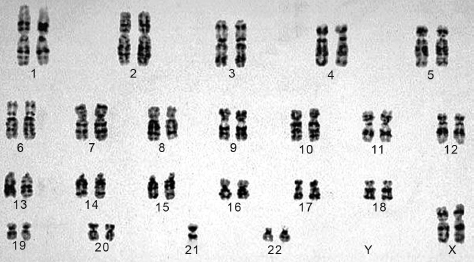
a. Interpret the karyogram. What are the findings?
b. What is the recurrence risk of Down syndrome in subsequent pregnancies of the mother?
c. What are the other genetic variants of Down syndrome?
Answer
- a. Mother’s karyotype shows a Robertsonian translocation between chromosome 21 and chromosome 21, written as 45,XX,rob(21;21)(q10;q10). The karyotype shows that the mother is a balanced translocation carrier involving chromosome 21. She is phenotypically normal, but all viable offspring will inherit the translocated chromosome, leading to a 100% recurrence risk of Down syndrome.
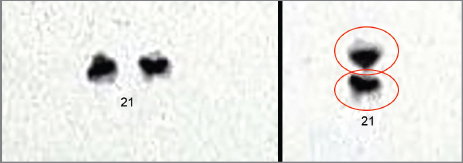
- b. Recurrence risk for Down syndrome in subsequent pregnancies is 100%.
- c.
- Free Trisomy 21 (95%)
- Translocation involving chromosomes 13, 14, 15, and 21 (e.g., rob(14;21)) (3-4%)
- Mosaicism (1-2%)
THG03-011
A 3-year-old child with autism presented with concerns of severe pain on moving left knee and refusal to walk for the past 3 days. He is on regular therapy. He is nonverbal and is attending a day care center. He drinks milk and eats plain boiled rice. He does not take any vegetables, fruits, or nonvegetarian diet. There are no external bruises on examination. The X-ray is shown here.
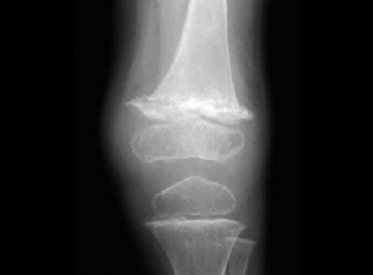
a. What are the radiological findings?
b. What is the most likely clinical diagnosis? Substantiate.
c. How will you manage the child?
Answer
- a. Diffuse osteopenia, thinning of cortices, radiolucent band at metaphysis (Trümmerfeld zone), small corner spur fractures (Pelkan spur), dense zone of provisional calcification in physis (white line of Fraenkel), and periosteal reaction due to subperiosteal hemorrhage (Wimberger ring sign around epiphysis).
- b. Scurvy secondary to severe avoidant and restrictive food intake disorder (ARFID). The child completely avoids fruits and vegetables, causing severe dietary Vitamin C deficiency.
- c.
- Oral Vitamin C supplementation (100–200 mg/day) and monitor clinical response.
- Dietary modification and feeding therapy for ARFID.
THG03-012
Answer the following questions on the drug provided below:
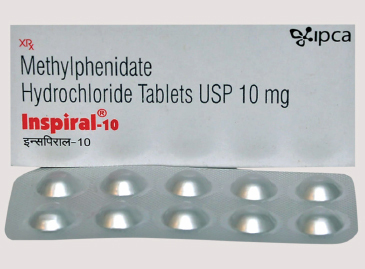
a. Name the condition in which this drug is used.
b. What class of drug does this belong to?
c. Name two adverse events that you will monitor for when giving this medication.
d. What are the other drugs that can be used instead of this drug for the condition?
Answer
- a. Attention-deficit hyperactivity disorder (ADHD).
- b. Central nervous system (CNS) stimulants.
- c. Appetite suppression leading to growth faltering, sleep disturbances (insomnia), tachycardia, and hypertension.
- d.
- Stimulant group: Dextroamphetamine, mixed amphetamine salts
- Non-stimulants: Atomoxetine, clonidine, guanfacine
THG03-013
See the image given here.
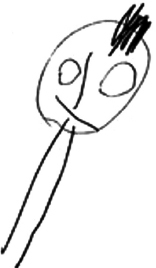
a. What is this simple bedside test that can be done for assessing the cognition of a child called?
b. How will you calculate the mental age of the child that has drawn image?
c. Beyond what age can this test be used?
Answer
- a. Goodenough Draw-a-Man test.
- b. Six parts drawn:
- Formula: Mental age = 3 + (number of parts / 4)
- Calculation: Mental age = 3 + (6 / 4) = 4.5 years.
- c. This test can be used for children aged 3 years and above.
THG03-014
See the image here.
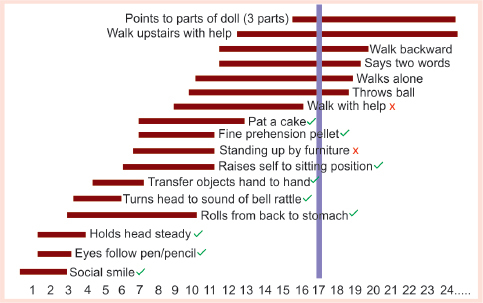
a. What is this simple developmental screening tool?
b. What is the interpretation of the 17-month-old child who has been screened using the tool?
c. Name other developmental screening tools that can be used.
Answer
- a. Trivandrum Developmental Screening Chart (TDSC).
- b. All items whose horizontal bars lie completely to the left of the vertical age line must be passed. Here, the 17-month-old child has failed to attain two items—"standing up on furniture" and "walk with help". Thus, the TDSC screening is positive (suspect developmental delay) and warrants referral for detailed developmental evaluation.
- c.
- Ages and Stages Questionnaires (ASQ)
- Denver Developmental Screening Test (DDST-II)
- Parents’ Evaluation of Developmental Status (PEDS)
- Baroda Development Screening Test
THG03-015
Look at the images depicted here.

a. What developmental milestone is being demonstrated here?
b. By what age this milestone emerges?
c. When attainment of this milestone is delayed, which neurodevelopmental disorder in children would you consider and evaluate for?
Answer
- a. Joint attention—the ability of the child to direct the attention of others to a common focus (initiating joint attention) or to respond to another person's attempt to direct attention (responding to joint attention).
- b. Emerges by 9–12 months.
- c. Autism spectrum disorder (ASD).
THG03-016
A child, 6 years of age, was brought with concerns of speech delay and losing some language skills and behavioral changes in the form of increasing hyperactivity for the past 2 years. He was indicating toilet needs by 3.5 years which he has stopped doing for the past 1 year. On examination, head circumference was normal. He had coarse facies with thick eyebrows but no hepatosplenomegaly. The vision was normal. He had bilateral conductive hearing loss. He had a systolic ejection click with an ejection systolic murmur. Neurologically his tone and deep tendon reflexes were normal. Clinical image is shown here.
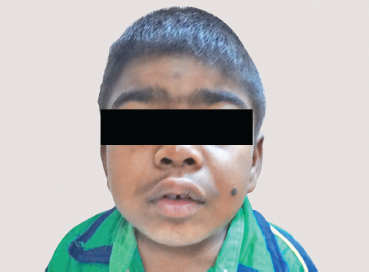
a. What is the most likely diagnosis? Justify the diagnosis.
b. Which enzyme is deficient in the most common subtype of this condition?
c. What are the X-ray findings that you can see?
Answer
- a. Sanfilippo syndrome (Mucopolysaccharidosis Type III). Justification: Speech and language regression, behavioral disturbances/hyperactivity, coarse facial features with thick eyebrows, absence of marked organomegaly/corneal clouding, conductive hearing loss, and cardiac murmur.
- b. Heparan N-sulfatase (sulfamidase) deficiency in MPS IIIA (the most common subtype).
- c. Dysostosis multiplex features:
- Skull: Dolichocephaly, calvarial thickening, J-shaped sella turcica.
- Chest: Oar-shaped (spatulate) ribs.
- Spine: Oval/rounded vertebral bodies with anterior inferior beaking.
- Hands: Bullet-shaped phalanges with proximally tapered metacarpals.
THG03-017
An 8-year-old boy was brought with concerns of hyperactivity, poor scholastic performance, and speech delay. He does not get along with peers during play and is not yet fully toilet trained. He had no perinatal risk factors. On examination, he has prominent ears, and prominent jaw; joint hyperlaxity, but he was normal neurologically.
a. What is the most likely diagnosis? Justify the diagnosis.
b. What genetic test would you order to confirm the diagnosis? What would be the genetic defect seen?
c. What are the other features that you would look for on clinical examination of genitalia in older boys with the condition?
Answer
- a. Fragile X syndrome. Justification: Intellectual disability, speech delay, hyperactivity/autistic features, long narrow face with prominent large ears, prominent jaw (prognathism), and joint hyperlaxity.
- b. PCR and Southern blot analysis to determine CGG trinucleotide repeat expansion in the FMR1 gene on the X chromosome (>200 CGG repeats indicates full mutation).
- c. Postpubertal macro-orchidism (enlarged testicular volume >25 mL).
THG03-018
Assess the gross motor and fine motor development of this 3-year-old child.
Answer
Developmental Milestones at 3, 4, and 5 Years:
| Domain | 3 years | 4 years | 5 years |
|---|---|---|---|
| Ask | • Pedals tricycle | • Catches bounced ball | • Skipping |
| Look | • Goes up stairs without holding railing (alternate feet on each step) • Pours water from one glass to another |
• Uses scissors to cut circle pattern • Throws ball overhand to >10 ft |
• Walks downstairs holding railing (alternate feet on each step) • Jumps backward |
| Do | • Balances on one foot for 3 seconds • Copies circle  • Imitates bridge of 3 cubes  |
• Hops on one foot • Copies square 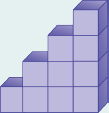 • Imitates gate with cubes • Draws a man with 4 parts |
• Balances on one foot for 10 seconds • Copies triangle • Writes first name • Imitates stairs with cubes • Draws a man with 8–10 parts |
THG03-019
Assess the gross motor and fine motor development of this 4-year-old child.
Answer
- Ask: Catches a bounced ball.
- Look:
- Uses scissors to cut a circular pattern.
- Throws ball overhand >10 feet.
- Do:
- Hops on one foot.
- Copies a square
- Imitates a gate with cubes.
- Draws a man with 4 parts.
(See full 3–5 year developmental matrix under THG03-018)
THG03-020
Assess the gross motor and fine motor development of this 5-year-old child.
Answer
- Ask: Skipping.
- Look:
- Walks downstairs holding railing with alternate feet on each step.
- Jumps backward.
- Do:
- Balances on one foot for 10 seconds.
- Copies a triangle.
- Writes first name.
- Imitates stairs with cubes.
- Draws a man with 8–10 parts.
(See full 3–5 year developmental matrix under THG03-018)
THG03-021
Assess the motor, language, and social development of this 9-month-old infant.
Answer
Developmental Milestones at 9 Months, 1 Year, and 2 Years:
| Domain | 9 months | 1 year | 2 years |
|---|---|---|---|
| Ask | • Starts crawling on hands and knees | • Starts walking with support (also takes few independent steps) • Finger feeds self • Calls parents using kinship words (at least "amma", "appa") |
• Kicks a ball • Pulls off loose pants • Parallel play with peers • Uses two-word sentences |
| Look | • Pulls to stand • Bell—shakes and rings a bell • Responds well to name call |
• Points to get desired object • Recognizes names of 2 objects and looks when named (fan, light, etc.) • Waves bye-bye |
• Walks downstairs holding railing (both feet on one step at a time) • Speaks 2-word sentences • Points to 5–10 body parts |
| Do | • Bangs two cubes together • Uncovers toy hidden under cloth • Enjoys peek-a-boo play • Follows gaze when told "Oh.. look at that.." |
• Holds crayon and scribbles with demonstration (cylindrical grasp) 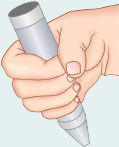 • Removes hat • Lifts box lid to find a toy |
• Draws horizontal line with pronator digital grasp 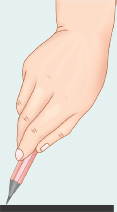 • Points to 5 pictures and names them • Builds a tower of 6 cubes |
THG03-022
Assess the motor, language, and social development of this 1-year-old infant.
Answer
- Ask:
- Starts walking with support; takes a few independent steps.
- Finger feeds self.
- Calls parents using kinship words (e.g. "amma", "appa").
- Look:
- Points to get a desired object.
- Recognizes names of 2 objects and looks when named (e.g. fan, light).
- Waves bye-bye.
- Do:
- Holds crayon and scribbles with demonstration (cylindrical grasp)
- Removes hat.
- Lifts box lid to find a hidden toy.
- Holds crayon and scribbles with demonstration (cylindrical grasp)
(See full developmental matrix under THG03-021)
THG03-023
Assess the motor, language, and social development of this 2-year-old toddler.
Answer
- Ask:
- Kicks a ball.
- Pulls off loose pants.
- Parallel play with peers.
- Uses 2-word sentences.
- Look:
- Walks downstairs holding railing with both feet on one step at a time.
- Points to 5–10 body parts.
- Do:
- Draws a horizontal line with pronator digital grasp
- Points to 5 pictures and names them.
- Builds a tower of 6 cubes.
- Draws a horizontal line with pronator digital grasp
(See full developmental matrix under THG03-021)
THG03-024
A 20-month-old boy was brought with concerns of speech and interaction. He still has not started speaking well. He does not respond to name calls. He does not seem to look at the face of anyone who speaks to him. He does not regard or copy when you wave to him. You wind up a toy in front of him and he immediately pays attention to the winding noise and the subsequent actions of the toy. He picks up the toy but does not seem to share the joy with his mother. After the toy stops playing, he shakes it and shouts. Mostly he plays alone. He attained age-appropriate developmental milestone in all other domains. His vision and hearing were reported normal. A portion of the MCHAT-R questionnaire of this child is shown here.
a. What are the red flags in development that are evident?
b. What is the most likely cause of speech delay in this child?
c. Score the MCHAT of this child based on above responses.
d. What is the next appropriate action based on the above MCHAT score?
e. MCHAT as a screening tool is approved for what age group?
Answer
- a. Delay in social and language developmental domains.
- Red flags:
- Speech delay
- Not responding to name call
- Poor eye contact / lack of facial regard
- Lack of joint attention and shared enjoyment; prefers solitary play
- Red flags:
- b. Autism spectrum disorder (ASD).
- c. M-CHAT-R Scoring:
- For all items except 2, 5, and 12: score 1 if 'No'.
- For items 2, 5, and 12: score 1 if 'Yes'.
- In this scenario:
- Items 1, 3, 6, 7, 8, 9, 10 are 'No' = 7 points
- Items 2, 5 are 'Yes' = 2 points
- Total score = 9 (High Risk for ASD).
- d. Action based on M-CHAT-R score:
- High Risk (Score 8–20): Immediate referral for diagnostic evaluation and early intervention services.
- Medium Risk (Score 3–7): Administer Follow-Up Interview (M-CHAT-R/F).
- Low Risk (Score 0–2): Rescreen at 24 months or routine developmental surveillance.
- e. Approved for toddlers aged 16 to 30 months.
THG03-025
A 9-year-old boy was brought with concerns of poor scholastic performance. He had to repeat class 3 twice. Mother says he is lazy and has “poor memory”. He has a lot of spelling errors. Teacher complains that he would answer orally, but in examinations, he does not bring out what he knows. Of late, he dislikes going to school and is becoming defiant to mother. He started speaking only after 2 years of age but no other developmental concerns. He is good in sports, drawing, and dance. He is independent in his activities of daily living and can ride a bicycle, helps mother and father with their chores. He is cheerful and social. He remembers all relatives’ birthdays and wishes them. On examination, he is a calm child. His vision and hearing is good, and he is neurologically normal. He reads with reluctance and takes time to read and pronounce words. During dictation of words, he finds it difficult to spell and makes mistakes.
a. What is the most likely diagnosis? Substantiate your most likely diagnosis.
b. What is the pathological basis for this problem?
c. What is the characteristic functional MRI pattern you would see if you were to subject this child to imaging?
Answer
- a. Specific Learning Disability: Dyslexia (Reading disorder).
- Substantiation: Discrepancy between preserved intellectual/adaptive abilities (good at sports, drawing, dance, chores, normal social skills) and academic performance; persistent reading/spelling deficits despite oral proficiency; secondary behavioral issues (school reluctance/defiance); past history of mild speech delay.
- b. Deficits in phonological processing (inability to decode, segment, and blend phonemes accurately).
- c. Functional MRI Pattern (Dyslexia Signature):
- Hypoactivation / under-activation of the left temporo-parietal and left occipito-temporal (visual word form area) reading circuits.
- Compensatory hyperactivation / over-activation of the left inferior frontal gyrus (Broca's area) and contralateral right hemisphere regions.