THG35-001
Answer the following questions from US cranium of a preterm infant born at 28 weeks gestational age (GA).
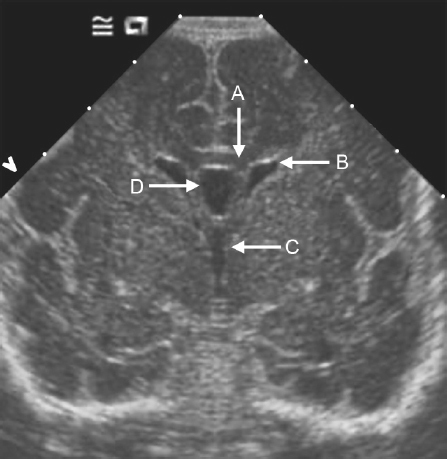
a. What is the section of scan?
b. Name the structures A, B, C, and D.
Answer
- a. Coronal section
- b.
- A: Corpus callosum
- B: Lateral ventricle (frontal horn)
- C: Third ventricle
- D: Cavum septum pellucidum
THG35-002
Answer the following questions from US cranium of a preterm infant born at 30 weeks GA.
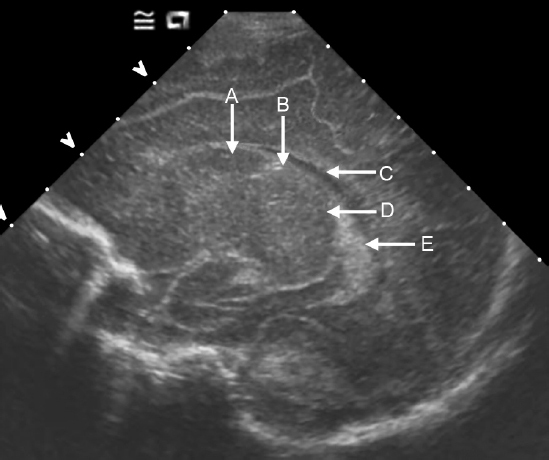
a. What is the section of scan?
b. Name the structures A, B, C, D, and E.
Answer
- a. Parasagittal section
- b.
- A: Caudate nucleus
- B: Caudothalamic groove
- C: Lateral ventricle
- D: Thalamus
- E: Choroid plexus
THG35-003
A 26-week-old GA preterm baby had a cranial US on day 2.
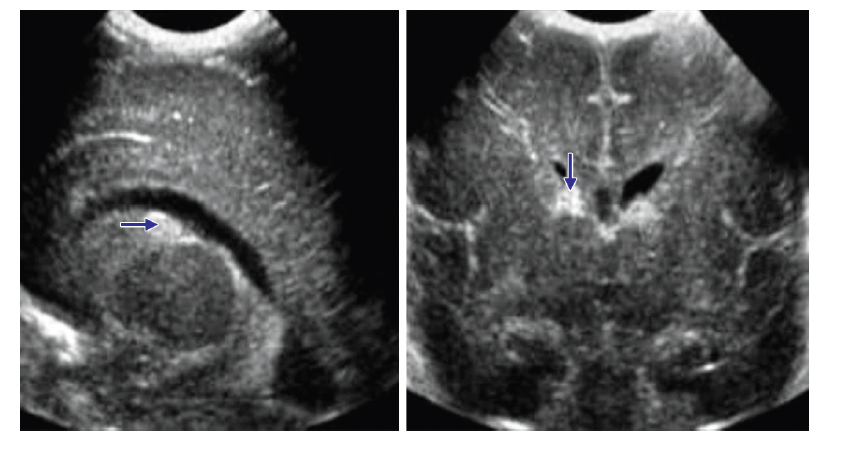
a. What does the highlighted area (blue arrow) show?
b. What grade is this?
Answer
- a. Germinal matrix hemorrhage (GMH) at the caudothalamic notch
- b. Grade 1 IVH (subependymal germinal matrix hemorrhage without intraventricular extension)
THG35-004
A 27-week-old GA preterm baby was very sick at birth, needing ventilation, and been hypoxic for hours before recovering. She also suffered an Escherichia coli sepsis in the first week of life. She had a cranial US at 6 weeks of age (previous scans were normal).
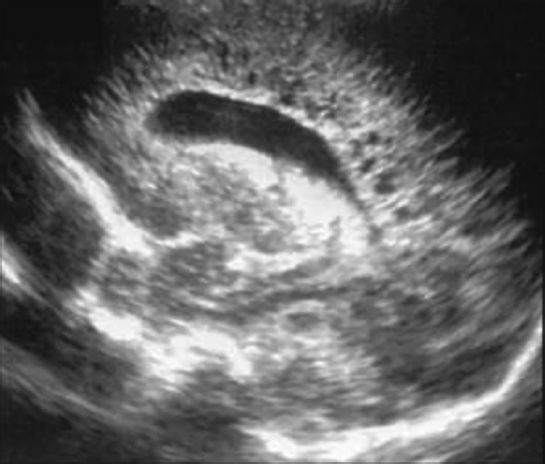
a. What does this scan show?
b. What grade is this?
c. What is the likely neurodevelopmental outcome of this baby if this finding is bilateral?
Answer
- a. Extensive cystic periventricular leukomalacia (PVL)
- b. Severe: Grade 4 PVL (extensive cystic lesions in deep periventricular white matter extending into subcortical white matter)
- c. High risk of abnormal neurodevelopmental outcome — spastic cerebral palsy / diplegia/quadriplegia (in 80–90% of infants with bilateral cystic PVL)
THG35-005
A 24-week-old GA preterm baby was hypotensive for 3 days after birth, needed maximum support with ventilation requiring high frequency oscillation during the first week before recovering. He had a cranial US at 6 weeks of age.
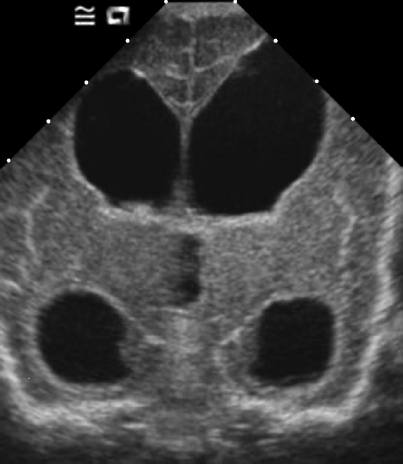
a. Bilateral cystic periventricular leukomalacia (PVL)
b. Bilateral porencephalic cyst
c. Bilateral ventriculomegaly following severe intraventricular hemorrhage (IVH) early on
d. Normal scan
Answer
c. Bilateral ventriculomegaly following severe intraventricular hemorrhage (IVH) early on (post-hemorrhagic ventricular dilatation)
THG35-006
Term baby had a cranial US at 24 hours of age. Answer the following questions:
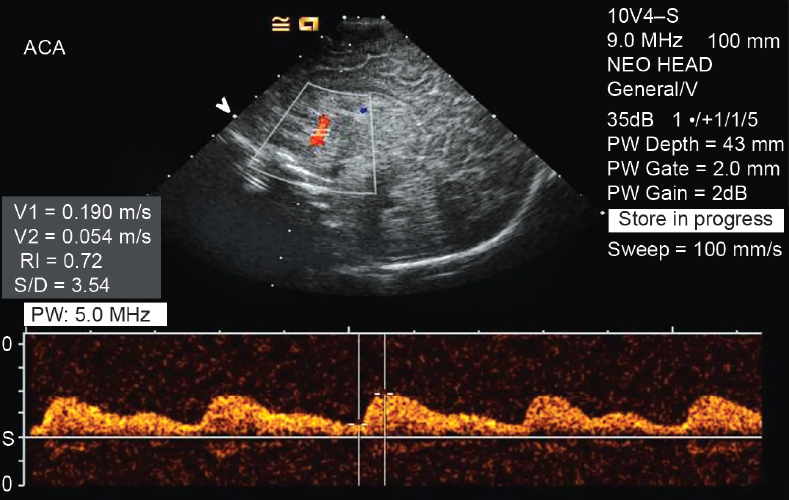
a. What type of US is this?
b. What is the expansion of RI?
c. What is the normal value?
d. In which condition, RI is useful to prognosticate the outcome?
Answer
- a. Cranial Doppler ultrasound (anterior cerebral artery Doppler)
- b. Resistive Index (
) - c. Normal RI in term neonate: 0.6–0.8 (or 0.6–0.9)
- d. Hypoxic Ischemic Encephalopathy (HIE) (an abnormally low RI < 0.55 indicates luxury cerebral reperfusion and predicts poor neurodevelopmental outcome)