VVK10-001
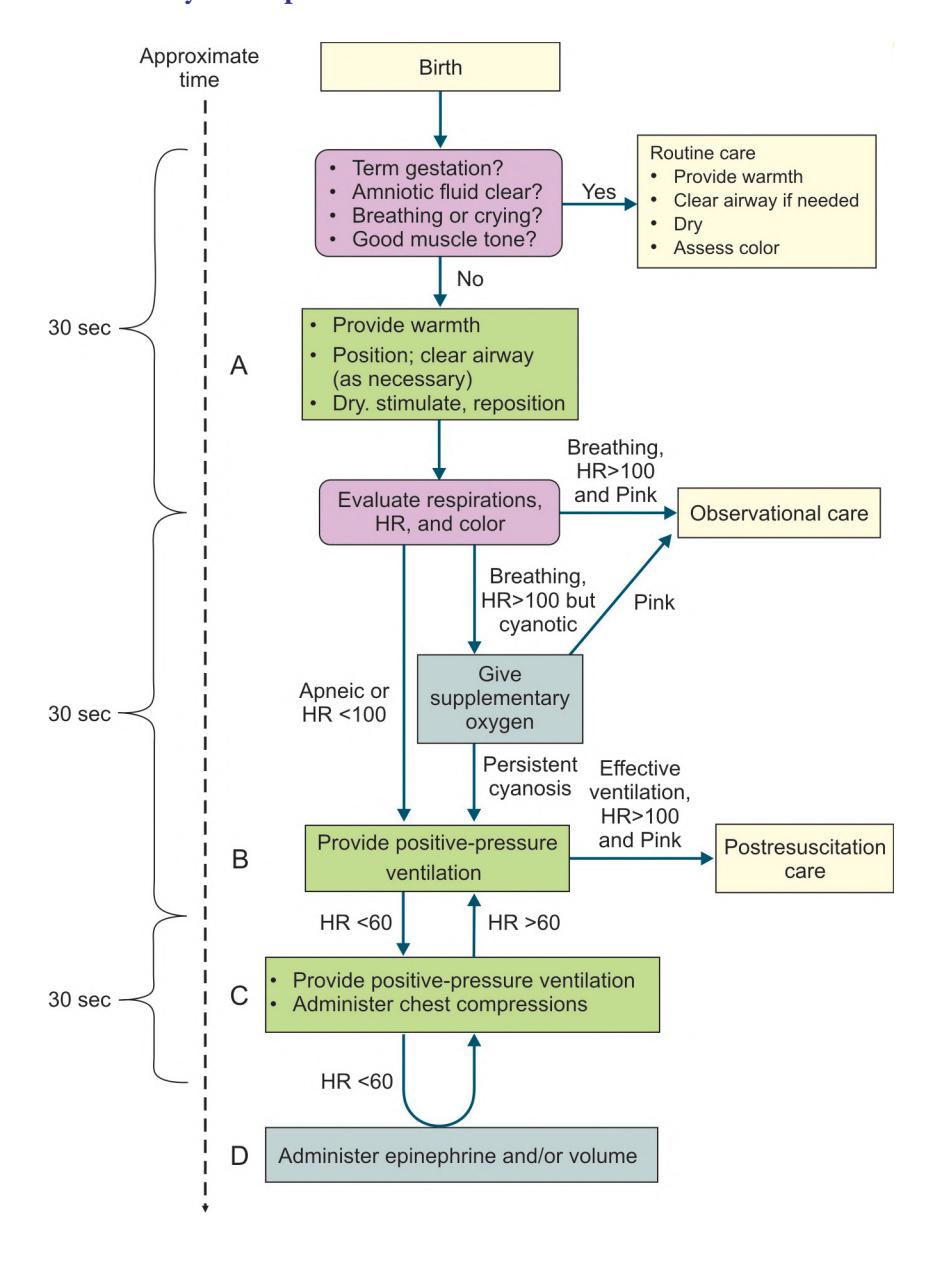
NRP Chart:
Enlist 5 points in the routine care of a healthy newborn at birth.
Answer
-
- Provide warmth: Dry the baby thoroughly on the mother's abdomen/chest and establish immediate skin-to-skin contact.
-
- Clear airway if needed: Wipe secretions from mouth and nose (routine vigorous suctioning not required if breathing well).
-
- Delayed cord clamping: Clamp and cut the umbilical cord after 1–3 minutes in stable neonates.
-
- Promote early initiation of breastfeeding: Initiate breastfeeding within the first hour of birth.
-
- Ongoing evaluation: Continuously assess breathing, heart rate, tone, and color; maintain normothermia.
VVK10-002
Positive Pressure Ventilation (PPV) in Neonatal Resuscitation:
a. Enlist 4 common problems encountered during PPV.
b. Mention the corrective steps (MR. SOPA) to improve PPV using bag and mask if the chest is not rising.
Answer
- a. Common problems encountered:
-
- Inadequate mask seal
-
- Inappropriate / incorrect head and neck positioning (hyperextension or hyperflexion)
-
- Airway obstruction (secretions, tongue, or closed mouth)
-
- Inadequate ventilation pressure / squeeze
-
- b. Corrective Ventilation Steps (MR. SOPA):
| Step | Action / Technique |
|---|---|
| M — Mask adjustment | Reapply mask to face with gentle downward pressure to establish an airtight seal |
| R — Reposition airway | Place the baby's head in a neutral or slight "sniffing" position |
| (Attempt PPV and assess chest rise) | |
| S — Suction mouth & nose | Clear secretions from mouth first, then nose using a bulb syringe or suction catheter |
| O — Open mouth | Open the infant's mouth and lift the jaw forward |
| (Attempt PPV and assess chest rise) | |
| P — Pressure increase | Increase peak inspiratory pressure incrementally (by 5–10 cm H2O) until bilateral chest movement is visible |
| A — Alternative airway | Consider endotracheal intubation or laryngeal mask airway (LMA) |
VVK10-003
Fill in the appropriate Endotracheal Tube size and Suction Catheter size according to neonatal weight and gestational age:
| Weight (g) | Gestational Age (weeks) | ET Tube Size (mm ID) | Suction Catheter Size (Fr) |
|---|---|---|---|
| Below 1000 | Below 28 | ? | ? |
| 1000–2000 | 28–34 | ? | ? |
| 2000–3000 | 34–38 | ? | ? |
| Above 3000 | Above 38 | ? | ? |
Answer
| Weight (g) | Gestational Age (weeks) | ET Tube Size (mm ID) | Suction Catheter Size (Fr) |
|---|---|---|---|
| Below 1000 | Below 28 | 2.5 mm | 5F / 6F |
| 1000–2000 | 28–34 | 3.0 mm | 6F / 8F |
| 2000–3000 | 34–38 | 3.5 mm | 8F |
| Above 3000 | Above 38 | 3.5–4.0 mm | 8F / 10F |
VVK10-004
Answer the following questions on Pediatric Advanced Life Support (PALS):
a. What is the recommended initial and subsequent dose of energy to be delivered by a manual defibrillator for shockable rhythms in children?
b. State True or False (as per pediatric resuscitation guidelines):
- i. Cuffed tracheal tubes are unsafe and ineffective in the pediatric population.
- ii. Pulse check is de-emphasized for lay rescuers.
- iii. "Look, listen, and feel" step has been removed from basic life support sequence.
c. Fill in the blanks: - i. Ventricular Fibrillation (VF) and pulseless Ventricular Tachycardia (VT) contribute to ____________ % of initial pediatric cardiac arrest rhythms.
- ii. The major primary cause of pediatric cardiac arrest is ____________.
- iii. ILCOR stands for ____________.
- iv. The primary resuscitation sequence in CPR is changed from ABC to ____________.
d. What is the recommended depth and rate of chest compressions in pediatric CPR?
Answer
- a.
- Initial shock energy: 2 J/kg
- Subsequent shock energy: 4 J/kg (may escalate up to
, max adult dose 200 J biphasic / 360 J monophasic).
- b.
- i. False (Cuffed endotracheal tubes are safe, effective, reduce air leak, and decrease re-intubation rates in infants and children when cuff pressure is maintained
). - ii. True (Lay rescuers do not check pulses; healthcare providers check for
seconds). - iii. True (Removed to prevent delay in initiating chest compressions).
- i. False (Cuffed endotracheal tubes are safe, effective, reduce air leak, and decrease re-intubation rates in infants and children when cuff pressure is maintained
- c.
- i. 5–15% (asphyxial arrest/PEA/asystole accounts for ~85–90%).
- ii. Asphyxia / Hypoxia / Respiratory failure and shock.
- iii. International Liaison Committee on Resuscitation.
- iv. C-A-B (Compressions - Airway - Breathing).
- d.
- Rate: 100–120 compressions per minute.
- Depth:
- Children: At least
the AP diameter of the chest, approximately 5 cm (2 inches). - Infants (< 1 year): At least
the AP diameter of the chest, approximately 4 cm (1.5 inches).
- Children: At least
VVK10-005
A term baby is born by normal vaginal delivery. Amniotic fluid was not stained with meconium. The baby is born limp and is not crying. Demonstrate the step-by-step resuscitation protocol with equipment and actions based on vital sign reassessments.
Answer
-
- Preparation & Universal Precautions: Perform hand hygiene, wear sterile gloves/PPE. Ensure preheated radiant warmer, functional suction (80–100 mmHg), self-inflating bag with reservoir, appropriate mask sizes, pulse oximeter, and blenderized oxygen source are ready.
-
- Initial Steps (First 30 seconds):
- Place neonate under radiant warmer.
- Position head in "sniffing" position.
- Clear airway if obstructed (suction mouth then nose).
- Dry thoroughly with warm towels and remove wet linen.
- Tactile stimulation (flick soles / rub back).
-
- First Evaluation (at 30 seconds): Assess respiration and heart rate (by auscultation with stethoscope / pulse oximeter / ECG).
- Finding: Apnea / gasping OR Heart Rate < 100 bpm.
-
- Positive Pressure Ventilation (PPV):
- Initiate PPV with bag and mask at 40–60 breaths/min with room air (21% O2 for term neonate).
- Target rhythm: "Breathe (squeeze) - Two - Three - Breathe - Two - Three".
- Attach preductal pulse oximeter to right wrist.
-
- Second Evaluation (after 30 seconds of effective PPV):
- If HR < 60 bpm despite MR.SOPA / effective ventilation:
- Increase FiO2 to 100%.
- Secure advanced airway (Endotracheal intubation).
- Initiate coordinated Chest Compressions using 2-thumb encircling-hands technique at a 3:1 compression-to-ventilation ratio (90 compressions + 30 breaths = 120 events/min).
- Cadence: "One-and-Two-and-Three-and-Breathe-and...".
-
- Third Evaluation (after 60 seconds of chest compressions + ventilation):
- If HR remains < 60 bpm: Administer IV Epinephrine (0.01–0.03 mg/kg = 0.1–0.3 mL/kg of 1:10,000 solution) via umbilical venous catheter.
VVK10-006
You are resuscitating a newborn at birth. The baby has gasping respirations and bradycardia at 30 seconds after birth. Demonstrate what steps you would take for the next 30 seconds.
Answer
-
- Immediate Initiation of Positive Pressure Ventilation (PPV):
- Select proper sized anatomical mask covering chin, mouth, and nose without covering eyes.
- Apply airtight seal using C-clamp / E-C hand grip technique.
- Connect resuscitation bag to oxygen blender (start at 21% O2 for term, 21–30% for preterm).
- Provide PPV at 40–60 breaths per minute with peak inspiratory pressure adequate to produce visible chest rise (initial PIP ~20–25 cm H2O).
- Count cadence aloud: "Breathe — Two — Three — Breathe — Two — Three".
-
- Monitor Oxygenation: Apply pulse oximeter probe to right wrist/palm (preductal SpO2).
-
- Assess Chest Movement: Within first 15 seconds, confirm bilateral chest rise. If chest is not rising, initiate MR. SOPA corrective ventilation steps.
-
- Re-evaluate at end of 30 seconds: Auscultate apical pulse for 6 seconds (multiply by 10) to determine heart rate (< 60, 60–99, or
).
- Re-evaluate at end of 30 seconds: Auscultate apical pulse for 6 seconds (multiply by 10) to determine heart rate (< 60, 60–99, or
VVK10-007
You are resuscitating a newborn at birth. The baby is limp and cyanotic with heart rate < 100 bpm. You have performed initial steps, followed by bag-and-mask PPV for 30 seconds. Heart rate is now < 60 bpm. Chest compressions (3:1 ratio) and endotracheal intubation were performed with 100% oxygen, but heart rate remains < 60 bpm. Demonstrate what next steps you would take for the resuscitation of this newborn.
Answer
-
- Vascular Access: Immediately establish emergency Umbilical Venous Catheter (UVC) (insert 3.5F/5F catheter 2–4 cm below skin until free blood flow is obtained) or intraosseous (IO) access.
-
- Administer Epinephrine:
- Intravenous / IO dose: 0.01–0.03 mg/kg (0.1–0.3 mL/kg of 1:10,000 / 0.1 mg/mL solution) followed by 0.5–1 mL normal saline flush.
- (Endotracheal dose if IV not yet ready: 0.05–0.1 mg/kg = 0.5–1.0 mL/kg of 1:10,000 solution, but IV route is strongly preferred).
- Repeat every 3–5 minutes if HR remains < 60 bpm.
-
- Volume Expansion (if acute blood loss or hypovolemic shock suspected):
- Normal Saline (0.9% NaCl) or O-negative packed RBCs: 10 mL/kg IV over 5–10 minutes.
-
- Troubleshoot Technical Factors (DOPE / Equipment Check):
- D — Dislodged / displaced ET tube (verify depth and bilateral breath sounds)
- O — Obstructed ET tube (suction tube with catheter)
- P — Pneumothorax (transillumination / needle thoracocentesis)
- E — Equipment failure (confirm 100% O2 delivery and bag function)
-
- Consider other medications:
- Sodium bicarbonate (1–2 mEq/kg of 4.2% solution slowly) only in documented severe refractory metabolic acidosis with adequate ventilation.
- Naloxone is contraindicated in acute resuscitation.
VVK10-008
You have been called to attend a delivery from the operation theatre of a primigravida mother with a 35-week IUGR fetus. Mother has pregnancy-induced hypertension (PIH) with fetal bradycardia and abnormal Doppler flows. Meconium staining of amniotic fluid was noted 30 minutes ago. How will you prepare and what actions will you take in the first 60 seconds of life?
Answer
-
- Anticipation & Team Briefing: Ensure complete resuscitation team is present with assigned roles; set radiant warmer to 100% manual mode; prepare 3.0 and 3.5 mm ET tubes, stylet, laryngoscope with size 0 and 1 straight Miller blades, suction catheters (8F, 10F), and meconium aspirator.
-
- At Delivery (Time 0–30 seconds):
- Receive infant under preheated radiant warmer.
- Assess vigour: If baby is non-vigorous (depressed respiration, poor tone, HR < 100 bpm), place in sniffing position and gently suction mouth and nose with suction catheter under direct vision if obstructed.
- (Note: Routine endotracheal intubation for direct tracheal suctioning in non-vigorous meconium-stained infants is no longer mandatory under updated NRP guidelines; priority is immediate establishment of effective ventilation).
- Dry, stimulate, and reposition.
-
- Time 30–60 seconds ("The Golden Minute"):
- If apneic/gasping or HR < 100 bpm, initiate PPV with 21–30% blended oxygen at 40–60 breaths/min.
- Apply preductal pulse oximeter and 3-lead ECG monitor.
- Re-evaluate heart rate and chest movement at 60 seconds.
VVK10-009
Calculate the size of cuffed and uncuffed endotracheal tube required for a 4-year-old child who requires intubation. Also calculate the depth of insertion of the tube. State the standard formulas used.
Answer
-
a. Uncuffed Endotracheal Tube Size (Internal Diameter in mm):
(Always keep one size smaller [4.5 mm] and one size larger [5.5 mm] available). -
b. Cuffed Endotracheal Tube Size (Internal Diameter in mm) (Motoyama formula):
-
c. Depth of Insertion (at lip level in cm):
VVK10-010
Complete the table indicating the acceptable routes of administration for resuscitation drugs (write "Yes" or "No"):
| Drug | Intravenous (IV) | Intraosseous (IO) | Endotracheal / Intratracheal (ET / IT) |
|---|---|---|---|
| a. Lignocaine (Lidocaine) | ? | ? | ? |
| b. Epinephrine (Adrenaline) | ? | ? | ? |
| c. Atropine | ? | ? | ? |
| d. Naloxone | ? | ? | ? |
| e. Sodium bicarbonate | ? | ? | ? |
| f. Adenosine | ? | ? | ? |
| g. Dopamine | ? | ? | ? |
| h. Calcium gluconate | ? | ? | ? |
Answer
| Drug | Intravenous (IV) | Intraosseous (IO) | Endotracheal / Intratracheal (ET / IT) |
|---|---|---|---|
| a. Lignocaine | Yes | Yes | Yes (L-A-N-E) |
| b. Epinephrine | Yes | Yes | Yes (L-A-N-E) |
| c. Atropine | Yes | Yes | Yes (L-A-N-E) |
| d. Naloxone | Yes | Yes | Yes (L-A-N-E) |
| e. Sodium bicarbonate | Yes | Yes | No (causes severe alveolar chemical injury) |
| f. Adenosine | Yes | Yes | No |
| g. Dopamine | Yes | Yes | No |
| h. Calcium gluconate | Yes | Yes | No |
(Memory aid for drugs given via endotracheal tube: LANE — Lidocaine, Atropine, Naloxone, Epinephrine).
VVK10-011
A 9-year-old boy is brought to the emergency department in a pulseless state. ECG shows electrical activity suggestive of pulseless Ventricular Tachycardia (pVT) / Pulseless Electrical Activity (PEA).
a. Name 8 reversible etiologies (Hs & Ts) that can precipitate pulseless arrest / PEA.
b. What is the initial energy dose for defibrillation in shockable rhythms?
c. Name three antiarrhythmic drugs that can be used if defibrillation and adrenaline fail.
d. What is the ratio of chest compressions to ventilations prior to and after endotracheal intubation?
Answer
- a. Reversible Causes (Hs and Ts):
- Hs:
-
- Hypovolemia
-
- Hypoxia
-
- Hydrogen ion (Acidosis)
-
- Hypoglycemia
-
- Hypokalemia / Hyperkalemia
-
- Hypothermia
-
- Ts:
-
- Tension pneumothorax
-
- Tamponade (cardiac)
-
- Toxins / Drug overdose
-
- Thrombosis (pulmonary embolism / coronary)
-
- Hs:
- b. Initial defibrillation energy: 2 J/kg (second dose: 4 J/kg; subsequent doses
up to 10 J/kg). - c.
-
- Amiodarone (5 mg/kg IV/IO rapid bolus, may repeat twice)
-
- Lidocaine (1 mg/kg IV/IO initial bolus)
-
- Magnesium sulfate (25–50 mg/kg IV/IO, max 2 g, specifically for Torsades de Pointes)
-
- d.
- Prior to advanced airway (two healthcare rescuers): 15:2 (15 compressions to 2 breaths).
- After endotracheal intubation: Continuous uninterrupted chest compressions at 100–120/min with asynchronous ventilations at 1 breath every 2–3 seconds (20–30 breaths/min).
VVK10-012
The following are complications related to severe accidental hypothermia in children except:
a. Ventricular fibrillation
b. ARDS (Acute Respiratory Distress Syndrome)
c. Hyperglycemia
d. Thrombocytosis
Answer
- d. Thrombocytosis
(Hypothermia characteristically causes thrombocytopenia [due to splenic/hepatic sequestration of platelets and bone marrow suppression] and coagulopathy / platelet dysfunction, along with shivering thermogenesis leading to hyperglycemia, cold-induced diuresis, ARDS, and fatal ventricular arrhythmias/VF).
VVK10-013
A 14-month-old baby is brought with history of choking while playing with beads. On arrival, he has inspiratory stridor, suprasternal retractions, silent coughing, and poor air entry. Demonstrate the sequence of initial actions that you will perform for foreign body airway obstruction (FBAO) in an infant/toddler.
Answer
-
- Assess Severity: Differentiate mild obstruction (effective cough, responsive) from severe/complete obstruction (silent cough, inability to vocalize, cyanosis, falling consciousness).
-
- Position the Infant for Back Blows: Rest the infant prone along your forearm supporting the head and jaw with your hand, keeping the head lower than the trunk resting on your thigh.
-
- Deliver 5 Back Slaps / Blows: Deliver up to 5 firm back slaps with the heel of your hand between the infant's shoulder blades (scapulae).
-
- Deliver 5 Chest Thrusts: Turn the infant supine on your opposite forearm, keeping head lower than trunk. Deliver up to 5 chest thrusts using two fingers on the lower half of the sternum (just below nipple line).
-
- Repeat Sequence: Alternate 5 back blows and 5 chest thrusts until foreign object is expelled or infant becomes unresponsive.
-
- Visual Inspection: If foreign body is seen in the oral cavity, remove it with a careful finger sweep. Never perform blind finger sweeps (risks pushing foreign body deeper into larynx).
-
- If child becomes unresponsive: Place on flat firm surface, activate EMS, and immediately start CPR (beginning with 30 chest compressions; check airway before delivering ventilations).