THG31-001
Match the toxidromes with the toxins:
| Clinical features | Toxins |
|---|---|
| 1. Hyperglycemia, high anion gap metabolic acidosis (HAGMA), and seizure | a. Salicylate |
| 2. Hypoglycemia, lactic acidosis, and renal injury | b. Phenobarbitone |
| 3. Respiratory depression, bradycardia, and pinpoint pupil | c. Organophosphorus compounds (OPC) |
| 4. Respiratory alkalosis, metabolic acidosis, tachycardia, and hyperthermia | d. Iron |
| 5. Mydriasis, seizure, and cardiogenic shock | e. β-blockers |
| 6. Miosis, tachycardia, bradycardia, convulsion, muscle twitching, and excessive secretions | f. Tricyclic antidepressants (TCAs) |
| 7. Hyperglycemia, bradycardia, and seizure | g. Oral hypoglycemic agents (OHAs) such as metformin |
| 8. Hypoglycemia, bradycardia, and seizure | h. Calcium channel blocker (CCB) |
Answer
1: d, 2: g, 3: b, 4: a, 5: f, 6: c, 7: h, 8: e
THG31-002
A 3-year-old male child underwent abdominal surgery and is in postoperative ward. Staff nurse had secured a nasogastric (NG) tube with lubricant in view of abdominal distension. Child became cyanosed and breathless half an hour later. Vitals: Heart rate (HR)—140 beats/minute, respiratory rate (RR)—34 breaths/minute, normal work of breathing, and SpO2—84% in room air (previous SpO2 was 97% in room air). Chest X-ray showed NG tube in place and normal lung fields, no cardiomegaly. Investigations showed the following:
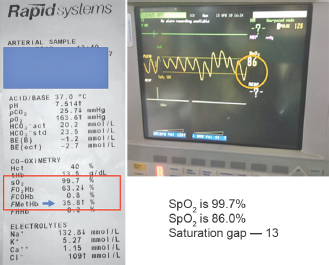
a. Identify the investigation (as shown in below image) and interpret, particularly data highlighted in the rectangle?
b. Identify the predisposing agent responsible for the current scenario. List other agents precipitating the above condition?
c. What is the mechanism of toxicity?
d. Mention the antidote to the above condition?
e. Mention a contraindication of the antidote usage for the above condition and why?
f. What is saturation gap and explain the facts behind it?
g. What is co-oximetry?
Answer
- a. Co-oximetry shows higher percentage of methemoglobin concentration above the normal range
- b. (i) Lignocaine jelly used for NG tube insertion and (ii) dapsone and naphthalene
- c. Methemoglobin contains iron in ferric form which reduces the ability of red blood cell (RBC) to release oxygen causing hypoxia
- d. Intravenous (IV) methylene blue
- e. Glucose-6-phosphate dehydrogenase (G6PD) deficiency and hemolysis
- f. Normally there is no gap between peripheral or pulse oximeter saturation (SpO2) and arterial oxygen saturation (SaO2) or minimal (about 2–3%). If the gap is more, it indicates the presence of an abnormal hemoglobin (Hb) like methemoglobin, carboxyhemoglobin and sulfhemoglobin. The gap exists because SpO2 is directly measured, but in SaO2, saturation is calculated from PaO2, which is not altered by the presence of abnormal Hb.
- g. Co-oximetry detects concentrations of different Hbs in the blood, such as oxyhemoglobin, carboxyhemoglobin, methemoglobin, and reduced Hb.
THG31-003
A 3-year-old boy brought to emergency department (ED) by his parents for having seizure. Child had been staying with grandparents and they found an empty bottle of tablets that his grandfather uses for heart ailment. Before the seizure, child appeared agitated and unsteady on his feet and vomited few times. On examination, he is febrile, tachypneic with RR—60 breaths/minute. Venous blood gas showed: pH—7.36, PCO2—18, and HCO3—12.
a. Interpret the venous blood gas.
b. What is the suspected poisoning?
c. What is the closest differential diagnosis?
d. Mention the other metabolic disturbance in the above poisoning.
e. Describe management of the above poisoning.
f. List few toxins requiring hemodialysis.
Answer
- a. Partially compensated metabolic acidosis and respiratory alkalosis. Salicylates are weak acids cause metabolic acidosis. It also stimulates respiratory center leading to hyperventilation and respiratory alkalosis. Hyperglycemia occurs because of glycogenolysis, gluconeogenesis, and decreased peripheral utilization.
- b. Salicylate poisoning
- c. Diabetic ketoacidosis
- d. Hypokalemia, hyperglycemia or hypoglycemia, high anion gap metabolic acidosis
- e. IV fluids, IV bicarbonate infusion (alkalinization of urine and drug excretion), correction of electrolyte disturbances, extracorporeal removal of salicylates, using hemodialysis, continuous venovenous hemodiafiltration (CVVHDF), or peritoneal dialysis
- f. Salicylate, lithium, isoniazid, methanol, ethylene glycol, and phenobarbital
THG31-004
Match the appropriate combination:
| Toxin | Characteristic feature |
|---|---|
| I. Mercury | a. Radiopaque shadows in X-ray |
| II. Iron | b. Anemia, basophilic stippling |
| III. Arsenic | c. Acrodynia |
| IV. Lead | d. Mees’ lines |
Answer
I: c, II: a, III: d, IV: b
THG31-005
A 4-year-old boy was found playing in garden, he suddenly started screaming with pain following an unknown bite. Child presented to emergency room (ER) after 6 hours with breathing difficulty and excessive sweating. Vitals on arrival—child was hyperalert, HR—170 beats/minute, RR—50 breaths/minute, blood pressure (BP)—120/80 mm Hg, and peripheral pulse—feeble. Chest X-ray done in view of breathing difficulty is as follows:
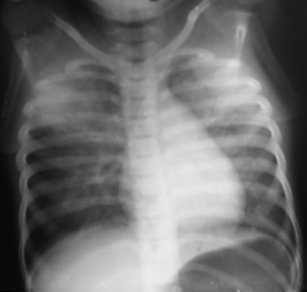
a. What is suspected unknown bite?
b. Explain the phases and clinical features.
c. Interpret the chest X-ray and diagnosis.
d. List few life-threatening complications of the above envenomation if untreated.
e. What is the antidote of choice, its mechanism of action, and route of administration?
f. How will you manage this child?
Answer
- a. Scorpion sting
- b.
- Parasympathetic: Muscarinic storm (bradycardia, hypotension, increased salivation, bronchial secretion, urinary incontinence, and miosis)
- Sympathetic: Adrenergic storm (tachycardia, hypertension, hyperpyrexia, tremor, sweating, urinary retention, and mydriasis)
- c. Pulmonary edema (bat wing opacity)
- d. Myocardial ischemia, ventricular fibrillation, and pulmonary edema
- e. Prazosin is a selective α-1 receptor blocker given orally or through NG tube.
- f. Oxygen, IV fluids and diuretics (based on urine output and renal function), prazosin, and IV dobutamine
THG31-006
A 2-year-old toddler was brought with accidental ingestion of toilet cleaning liquid at home. Mother had tried to induce vomiting with her hands and salt water. Child was brought with discomfort and drooling following ingestion.
a. Explain the mechanism of toxicity.
b. List two don’ts in the above poisoning.
c. List four indications for early intubation in the above condition.
d. Name the investigation that aids in assessing severity.
Answer
- a. Liquefactive necrosis
- b. Don’ts: Induce emesis, gastric lavage, and decontamination
- c. Drooling, stridor, hoarse voice, and subcutaneous emphysema
- d. Upper gastrointestinal endoscopy
THG31-007
A 4-year-old developmentally normal male child staying with his father who works at construction site presents with afebrile seizure for the first time. Mother gives history of hyperactivity and behavioral problem since last few months. Evaluation showed features of anemia and normal brain imaging. Peripheral smear showed basophilic stippling.
a. What is the suspected poisoning?
b. What is the mechanism of basophilic stippling formation?
c. What is the mechanism of hematological toxicity?
d. Name the enzyme affected by the above toxin.
e. What are the neurological and renal complications of the above poisoning?
f. Mention the antidote of choice.
Answer
- a. Lead poisoning
- b. It indicates aggregates of ribosomes or fragments of ribosomal RNA precipitated in the cytoplasm of RBCs
- c. Lead inhibits heme biosynthesis by inhibiting enzyme D-amino levulinic acid dehydratase inhibiting the formation of porphobilinogen
- d. Erythrocyte protoporphyrin
- e. Renal—reversible Fanconi anemia, renal tubular dysfunction; Neural—motor neuropathy, wrist and foot drop, behavioral abnormality, seizure (due to altered calcium-dependent neurotransmitter activity)
- f. Dimercaptosuccinic acid (DMSA), calcium ethylenediaminetetraacetic acid (EDTA), Dimercaprol or British Anti-Lewisite (BAL), and penicillamine
THG31-008
Fill-up the blanks with their appropriate antidotes:
| Toxin | Antidote |
|---|---|
| a. Benzodiazepine | |
| b. Opioid | |
| c. Isoniazid | |
| d. Iron | |
| e. Beta-blocker | |
| f. Methemoglobin | |
| g. Carbon monoxide | |
| h. Datura | |
| i. Digoxin | |
| j. Paracetamol |
Answer
- a. Flumazenil
- b. Naloxone
- c. Pyridoxine
- d. Deferoxamine
- e. Glucagon
- f. Methylene blue
- g. Hyperbaric oxygen
- h. Physostigmine
- i. Digoxin-specific Fab fragments (Digibind/Digifab)
- j. N-acetylcysteine
THG31-009
A 14-year-old female child (weight 40 kg) was brought to hospital after 1 hour following ingestion of 20 tablets of paracetamol at home after a fight with her parents. She is alert and hemodynamically stable.
a. What is the toxic dose of paracetamol?
b. What are the initial steps of management?
c. Mention the toxic metabolite.
d. What is the mechanism of metabolization of paracetamol?
e. State the condition where Rumack–Matthew nomogram cannot be used.
f. What is the mechanism of action of N-acetylcysteine (NAC)?
g. What are King’s College criteria for liver transplant?
Answer
- a. 150 mg/kg
- b. Hospitalization, gastric lavage, activated charcoal, and start NAC infusion
- c. N-acetyl-p-benzoquinone
- d. Sulfation and glucuronidation
- e. Not useful when sample collected before 4 hours or after 24 hours, not useful in multiple ingestion, used with caution when given with drugs with slow gastric emptying
- f. NAC provides a source of glutathione which helps in glucuronidation of acetaminophen into the nontoxic pathway
- g. King’s criteria for liver transplant:
- i. pH < 7.3 (after resuscitation)
- ii. Prothrombin time (PT) > 100 seconds, international normalized ratio (INR) > 6.5
- iii. Hepatic encephalopathy stage III/IV
THG31-010
A 7-year-old male child sleeping at native farm was found to have an unknown bite. Child was brought with left lower limb swelling, ptosis, and breathing difficulty. Vitals on arrival were HR—98 beats/minute, RR—28 breaths/minute (paradoxical breathing), CRT—prolonged, and SpO2—84% in room air.
a. Enlist a few don’ts in snakebite envenomation.
b. How will you manage this child?
c. With respect to antisnake venom (ASV) administration, what are the steps of preparation and what precautions to be taken?
Answer
- a. Do not apply tight tourniquet, incision, suction, electric shock, cryotherapy
- b. ABCDE:
- A: Open airway—jaw thrust chin lift/mouth gag
- B: Breathing—respiratory failure—intubate and ventilate
- C: Circulation—Shock—10 mL/kg, NS bolus—reassess and decide on inotropes
- D: Assess consciousness, pupil
- E: Look for fang mark and bleeding manifestation, look for other local swelling/cellulitis to treat accordingly
- Start ASV (polyvalent available in India)
- Suspected cobra bite—atropine and neostigmine
- Supportive care—IV antibiotic (local cellulitis), tetanus prophylaxis (based on immunization schedule)
- c. ASV:
- Dose: 10 vials to begin with given over 1 hour
- Keep emergency drugs (epinephrine) ready in case of anaphylaxis
- No test dose is required
- If anaphylactic reaction to ASV—stop ASV, administer adrenaline IM (0.01 mg/kg 1:1,000) maximum three doses 5 minutes apart, and hydrocortisone. Watch for resolution of symptom and restart slowly.
- If there is inadequate response after the first 10 doses of ASV followed by atropine/neostigmine therapy, start second 10 vials after an hour
THG31-011
A 16-year-old girl presents to the ED with 1 day history of incoordination. She has become generally clumsier with increasing difficulty in writing and buttoning. She has been previously well. Her father is a known epileptic well controlled on antiepileptic drugs (AEDs). On examination, she appears well. Her pulse is 72 beats/minute and BP is 116/68 mm Hg. Heart sounds are normal and her chest is clear. Abdominal examination is unremarkable. Neurological examination reveals bilateral nystagmus on lateral gaze, mild tremor affecting her hands, scanning dysarthria, bilateral dysmetria and dysdiadochokinesia, and an ataxic gait. When further questioned child is on regular multivitamin, taken from the same pill case as that of her father.
a. What is the suspected drug causing the above syndrome?
b. What is the mechanism of action of the above drug?
c. Mention the investigations that would be helpful in diagnosis.
d. State the medical conditions mimicking the above.
e. Mention the antidote and treatment modality.
Answer
- a. Phenytoin toxicity
- b. Block voltage-gated sodium channel. Delay inactivation of potassium channel, prolonging neural refractory period
- c. Serum phenytoin level
- d. Posterior fossa tumor and cerebellitis
- e. No antidote, only supportive management
THG31-012
The following image shows a staff nurse performing decontamination procedure with activated charcoal for a child with suspected poisoning.
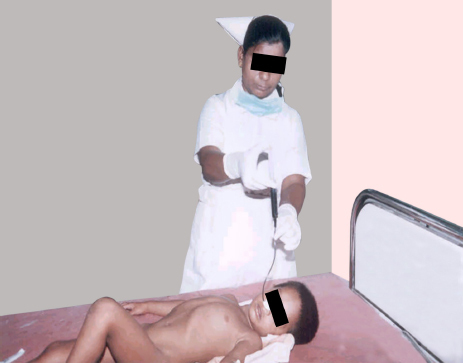
a. What is the mechanism of decontamination procedure shown in below image?
b. Mention the contraindications for the above procedure.
c. State the complications of this procedure.
d. Name four toxins where multi-dose activated charcoal can be used, mechanism involved.
e. Name two toxins where this procedure cannot be used.
Answer
- a. Adsorption of toxin due to large surface area preventing absorption from gastric lumen
- b. Unprotected airway, decreased peristalsis—bowel obstruction
- c. Pulmonary aspiration, bowel obstruction
- d. Carbamazepine, dapsone, phenobarbitone, theophylline (interrupt enterohepatic and enteroenteric circulation—act as enteral dialysis)
- e. Iron, alcohol, hydrocarbon, and pesticide
THG31-013
A 4-year-old child on treatment for attention deficit hyperactivity disorder (ADHD) was brought with accidental ingestion of kerosene oil at home. Child was admitted and observed in ward for complications and planning to get discharged after 2 days. Counsel the mother for preventive education to avoid such accidental poisoning in future.
Answer
- a. Greetings and introduction
- b. Explaining the reason for admission, treatment given and current status of the child and follow-up
- c. Preventive education
- d. Avoid keeping toxic material in familiar containers
- e. Do not keep any stool or object in vicinity that can be used for climbing up to take the toxin kept at higher level.
- f. Cabins or cupboards containing household products should be kept closed and locked.
- g. Medication should be kept closed and kept away from the reach of children.
- h. Medications should not be given in the dark environment.
- i. Medication name, strength, dose to be verified before administering
- j. Identifying nearby hospital in case of emergency
- k. Follow up of ADHD with occupational therapy
- l. Check for her understanding and any doubts
- m. Greetings and thank her
THG31-014
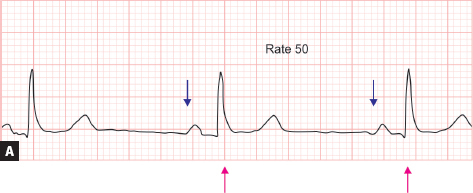
A mother and her 2-year-old child were brought to hospital after confessing to have consumed some plant toxin at home. Child is conscious. Vitals were HR—50 beats/minute, RR—28 breaths/minute, BP—84/60 mm Hg, and capillary blood glucose (CBG)—95 mg/dL. In view of bradycardia, ECG was done and is shown in image A.
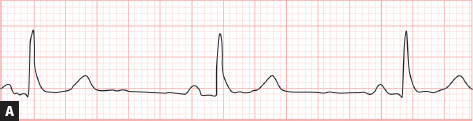

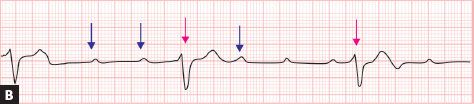
a. List the findings of both the ECGs first (image A) and second (image B) and probable ECG diagnosis.
b. What is the suspected toxin consumed?
c. What is treatment of bradycardia in this child?
Answer
First ECG:
Second ECG:
- a.
- First ECG (Image A): HR—50 beats/minute. P-QRS sequence maintained well. P wave morphology and PR interval is constant. Blue arrows—P waves, pink arrows—QRS. PP interval and RR interval are same, meaning atrial and ventricular rate are similar.
- Diagnosis: Sinus bradycardia.
- Second ECG (Image B): HR—28–30 beats/minute. PP interval and RR interval are different. Atrial impulses are not conducted to the ventricles. QRS complexes conduct independently of P waves. Atrial rate is 100, but ventricular rate is 28. QRS duration is 0.12 seconds or three small squares.
- Diagnosis: Complete heart block.
- First ECG (Image A): HR—50 beats/minute. P-QRS sequence maintained well. P wave morphology and PR interval is constant. Blue arrows—P waves, pink arrows—QRS. PP interval and RR interval are same, meaning atrial and ventricular rate are similar.
- b. Oleander poisoning, because of the presence of bradycardia and absence of hypoglycemia. If there is bradycardia associated with hypoglycemia one should suspect beta blocker poisoning.
- c. Urgent admission in intensive care unit for cardiac monitoring, IV atropine, adrenaline infusion, temporary cardiac pacing, and insertion of a permanent pacemaker.
THG31-015
A 4-year-old male child was brought to ED after ingesting unknown number of tablets. His father is taking medications for his mood depression.
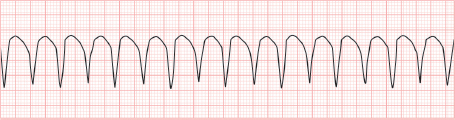
a. Interpret the ECG.
b. Enlist the ECG features expected in the above poisoning.
c. What is the suspected poisoning?
d. Name two drugs/toxins that cause dilated pupil.
e. Name the antidote and antiarrhythmic agent of choice.
f. Phenytoin is the antiepileptic of choice in case of seizure in the above—True/False.
g. Describe all the features of this condition.
Answer
- a. HR—170 beats/minute (tachycardia), wide complex QRS, No P wave—suggestive of ventricular tachycardia
- b. Prolonged QTc interval, widened QRS complex, ventricular tachycardia, ventricular fibrillation
- c. TCA poisoning
- d. Datura and cocaine
- e. Sodium bicarbonate and lidocaine
- f. False. Phenytoin is contraindicated in most of the toxin-induced seizures.
- g. TCA—three Cs and one A: coma, convulsions, cardiac arrhythmia, and acidosis
THG31-016
Family of four people was found unconscious in their native house with an (unserviced) air conditioner on. There were no source of any toxin consumed. On examination—found be unconscious, flushed. Their SpO2 was ranging from 96 to 98%.
a. What is the suspected poisoning?
b. PaO2 is normal in the above poisoning—True/False.
c. What is the characteristic lesion on computed tomography (CT) brain?
d. What is the treatment and its mechanism of action?
Answer
- a. Carbon monoxide poisoning
- b. True. But SaO2 will be reduced in the presence of carboxyhemoglobin
- c. Changes in globus pallidus
- d. 100% oxygen; if ventilatory drive is reduced, mechanical ventilatory support. In severe carbon monoxide poisoning, hyperbaric oxygen therapy is used. An increase in PaO2 decreases the half-life of carboxyhemoglobin, thereby causing elimination of carbon monoxide.
THG31-017
Match the following combination:
| Features | Toxins |
|---|---|
| 1. SpO2 and SaO2—low | a. Methemoglobin |
| 2. SpO2 low and SaO2—normal | b. Cyanide poisoning |
| 3. SpO2 and SaO2—normal | c. Hydrocarbon poisoning |
Answer
1: c, 2: a, 3: b
THG31-018
A 5-year-old male child was brought with sudden onset of drowsiness, excessive salivation, and miosis. On examination, HR—50 beats/minute, RR—26 breaths/minute, peripheries cool with prolonged capillary refill time CRT of 4 second. OPC poisoning is suspected.
a. Name two toxins that cause miosis.
b. Name two nicotinic features of OPC poisoning.
c. Name the investigation to confirm the above poisoning.
d. On day 4 of recovery, child developed breathing difficulty and was unable to lift the neck, explain the probable reason.
e. Use of aminoglycoside does not aggravate muscle weakness—True/False.
f. What is antidote of choice and its mechanism of action?
g. Pralidoxime antagonizes the nicotinic effect of OPC—True/False.
Answer
- a. Opioid and phenobarbitone
- b. Muscle weakness, fasciculation, paralysis, autonomic effects (hypertension, tachycardia, mydriasis, and pallor)
- c. RBC cholinesterase
- d. Intermediate syndrome occurs 1–4 days following ingestion due to long-lasting inhibition of cholinesterase and muscle necrosis
- e. False
- f. IV atropine: It reverses muscarinic effect in central nervous system (CNS) and peripheral nervous system. Not effective against nicotinic effect of toxin.
- g. Pralidoxime: It reverses neuromuscular blockage by reactivating the inhibited acetylcholinesterase—True.
THG31-019
A previously healthy 4-year-old boy brought to ER with nausea, vomiting, acute onset of unconsciousness. He was in compensated shock and normal saline (NS) bolus started. Skin color was cherry red. No history of trauma, when last seen an hour before, he was eating an apricot. Within 20 minutes, he started vomiting and, he became unconscious. On examination, he had a Glasgow Coma Scale (GCS) score of 7/15, RR—28 breaths/minute, temperature of 36.8°C, and SpO2 of 97% on room air. Pupils were found to bilaterally equally reacting to light. Blood sugar was 220 mg/dL, serum electrolytes, urea, creatinine, and liver function tests were normal. Arterial blood gas showed high anion gap metabolic acidosis. Lactate is high. Venous blood oxyhemoglobin concentration is high, resulting in a bright red appearance of venous blood. An unusual cause was suspected.
a. What is the probable cause?
b. Give reason to ascertain your findings.
c. On what clinical situations, this poisoning is suspected?
d. What are the laboratory features?
e. Outline the management for this poisoning.
Answer
- a. Probable cyanide poisoning
- b. Rapid deterioration within an hour, normal SpO2 on presentation, increased venous oxygen saturation, high anion gap metabolic acidosis, and high lactate
- c. Clinical situations:
- Death or rapid deterioration within 30 minutes of ingestion
- Sudden collapse of laboratory or industrial workers—jewelry shop and plastic industry (using nitriles as solvents)
- Fire victim or attempted suicide patient with unexplained coma or acidemia, ingestion of acetonitrile, and solvent remover of acrylic sculptured nails
- Ingestion of seeds, fruits, or plants containing cyanogenic glycosides (apricot seed, apple seed, and tapioca). The pits and seeds of many fruits contain amygdalin—a plant compound that our body converts to cyanide after eating.
- d. High anion gap metabolic acidosis, high lactate, high venous PaO2 resulting in a decreased arteriovenous oxygen difference (<10%). Given there are limitations of cyanide concentration testing, antidote should be administered empirically based on the clinical presentation and other biochemical results.
- e. First, stabilization of airway, breathing, and circulation. Topical and gastrointestinal decontamination should be done.
- Hydroxocobalamin: First-line antidote at the dose of 70 mg/kg. Cobalt in hydroxocobalamin (precursor of vitamin B12) binds to intracellular cyanide forming cyanocobalamin which is stable and readily excreted in the urine. In some countries, hydroxocobalamin is commonly used in conjunction with sodium thiosulfate.
- Cyanide antidote package: Three drugs in combination work—amyl nitrite, sodium nitrite, and sodium thiosulfate. Clearance of toxin happens in three stages: (1) Amyl nitrite and sodium nitrite induce methemoglobin formation, (2) which reversibly binds with cyanide to form cyanmethemoglobin, and (3) Sodium thiosulfate helps cyanide convert to thiocyanate, which is excreted renally.