THG06-001
An 8-week-old male infant, with infantile hypertrophic pyloric stenosis (IHPS) presents with multiple episodes of vomiting. Appears dehydrated, blood urea—22 mg/dL, serum creatinine—0.5 mg/dL, serum sodium—129 mEq/L, serum potassium—2.7 mEq/L, chloride— 72 mEq/L, bicarbonate—37 mEq/L, arterial blood gas (ABG) showed pH—7.56, partial pressure of carbon dioxide (pCO2)—52.8 mm Hg, and HCO3—46.2 mEq/L.
a. What is the classical metabolic abnormality seen in this child with IHPS?
b. How do you classify hypokalemia in this child?
c. List two electrocardiogram (ECG) findings of hypokalemia.
d. What is spurious hypokalemia?
e. What other conditions can cause similar abnormality?
Answer
- a. Hypochloremic, hypokalemic metabolic alkalosis.
- b. Moderate hypokalemia.
- Classification of hypokalemia based on severity is as follows:
- (Apart from numbers, any child with neuromuscular weakness or cardiac rhythm disturbances are considered as severe hypokalemia)
| Serum potassium levels | Severity |
|---|---|
| 3–3.5 mEq/L | Mild hypokalemia |
| 2.5–3 mEq/L | Moderate hypokalemia |
| <2.5 mEq/L | Severe hypokalemia |
- c. Prolonged PR interval, slightly peaked P wave, ST depression, shallow T wave, and prominent U wave.
- d. Hypokalemia is due to an increased potassium uptake by metabolically active cells like leukemic white blood cells (due to enhanced activity of sodium-potassium ATPase pump).
- e. Other gastrointestinal (GI) losses—gastroenteritis with predominant vomiting and renal losses—diuretic therapy.
THG06-002
A 4-year-old child treated for acute exacerbation of wheeze with back to back nebulizations following which serum electrolytes done as a part of routine investigations showed serum sodium—142 mEq/L, serum potassium—3 mEq/L, chloride—105 mEq/L, and bicarbonate— 22 mEq/L.
a. What is the cause of hypokalemia in this child?
b. Name any other two conditions which cause hypokalemia by the above similar mechanism.
c. How does acid base status affect the serum potassium level?
Answer
- a. Salbutamol nebulization causing intracellular shift of potassium.
- b. Insulin administration in DKA, high insulin levels in refeeding syndrome, thyrotoxicosis, and familial periodic paralysis.
- c. Acidosis: The increase in H+ ion concentration reduces the activity of sodium-potassium ATPase (Na/K/ATPase) pump thereby reducing the cellular uptake of potassium resulting in high potassium levels in ECF.
Alkalosis has the opposite effect. Sodium-potassium ATPase pumps 3 sodium ions out of the cell and 2 potassium ions into the cell.
THG06-003
Answer the following questions regarding potassium?
a. What is transtubular potassium gradient TTKG and how is it useful in hypokalemia?
b. What is fractional excretion of potassium (FEK)?
c. What is the role of assessment of urine potassium levels in a child with hypokalemia?
d. Name two conditions associated with renal loss of potassium and normal blood pressure (BP).
Answer
- a. TTKG is an index that measures or determines renal response to hypo/hyperkalemia. It is the reflection of potassium conservation by cortical collecting duct. It is calculated as:

TTKG values >4 indicates renal loss of potassium.
- b. FEK is the percentage of potassium filtered by kidney that is excreted in urine. It is calculated as:

FEK values >6% indicates renal loss of potassium.
- c. Urine potassium assessment helps to differentiate between GI and renal loss of potassium. Urine potassium >15 mEq/L indicates renal loss.
- d. Renal tubular acidosis (RTA), Bartter syndrome, Gitelman syndrome, drugs like thiazides, and loop diuretics (RTA—metabolic acidosis, Bartter and Gitelman syndrome—alkalosis). Remember mineralocorticoid excess can also lead to renal wasting of potassium but it will be associated with hypertension and metabolic alkalosis.
THG06-004
A 6-year-old girl admitted with history of diarrhea, vomiting, weakness, palpitations on and off, and hypertension. Laboratory investigations revealed metabolic alkalosis, hypokalemia, reduced renin, and aldosterone levels.
a. What is the most probable diagnosis?
b. What is the pathology of the above said condition?
c. Expand SAME.
d. What is the specific treatment of the above said condition?
Answer
- a. Triad of hypertension, hypokalemia, and metabolic alkalosis—Liddle syndrome or pseudohyperaldosteronism (autosomal dominant inheritance) which mimics mineralocorticoid excess but has low renin and aldosterone levels.
- Interpretations based on paired renin and aldosterone levels are as follows:
| Paired renin and aldosterone | Interpretation |
|---|---|
| Raised renin and aldosterone | Renal artery stenosis |
| Raised aldosterone and low renin | Adrenal tumor and familial hyperaldosteronism |
| Low renin and aldosterone | Congenital adrenal hyperplasia (CAH), Liddle syndrome, and glucocorticoid excess |
- b. Gain of function mutations of epithelial sodium channel (ENaC) located in collecting duct resulting in enhanced activity leading to excessive sodium reabsorption and potassium secretion.
- c. Syndrome of apparent mineralocorticoid excess.
- d. Oral amiloride or triamterene blocks the ENaC channels, correcting both hypertension and hypokalemia.
THG06-005
A 3-year-old male child admitted for acute gastroenteritis and dehydration was resuscitated with normal saline (NS) and simultaneously investigated in view of dehydration. Reported values are: Blood urea—26 mg/dL, serum creatinine—0.6 mg/dL, serum sodium—135 mEq/L, serum potassium—2 mEq/L, chloride—100 mEq/L, and bicarbonate—18 mEq/L.
a. How do you correct hypokalemia in this child?
b. What is the fluid of choice to mix potassium for intravenous (IV) infusion and why?
c. What is the potassium concentration of Ringer’s lactate (RL)?
Answer
- a. This child is having severe hypokalemia due to GI loss which requires urgent correction by potassium infusion (never give potassium as IV bolus!). The dose is 0.3 mEq/kg/h over 1–3 hours through central line under cardiorespiratory monitoring preferably in an ICU. Here IV KCl is used, e.g., for a 20 kg child 6 mEq/h over 3 hours. This means KCl 9 mL (containing 18 mEq) mixed with 30 mL of NS and given over 3 hours in a syringe pump. The subsequent therapy is guided by repeat values of potassium after correction. Remember, mEq and mmol are same for Na+ and K+.
- Treatment plan based on severity of hypokalemia is as follows:
| Severity of hypokalemia | Treatment |
|---|---|
| Mild | Oral potassium supplement: 1–2 mEq/kg/day |
| Moderate | Increase the maintenance potassium to 40 mEq/L if given through peripheral line. |
| Severe | IV correction as mentioned above |
- b. Normal Saline. Never infuse potassium with a glucose containing solution as it will cause release of insulin which will exaggerate hypokalemia by shifting the potassium inside the cells.
- c. RL—4 mEq/L
- Potassium concentration in different IV fluids is as follows:
| Fluid | Potassium concentration |
|---|---|
| RL and PlasmaLyte | 4 mEq/L and 5 mEq/L |
| Isolyte P | 20 mEq/L |
| KCl (15%) | 2 mEq/mL |
| Normal saline and DNS | Nil |
THG06-006
A 6-year-old male child, known case of chronic kidney disease presents with a serum potassium of 7 mEq/L.
a. What is the cause of hyperkalemia in this child?
b. List two ECG changes of hyperkalemia.
c. What will be the urine potassium level in this child?
d. Name two drugs causing hyperkalemia.
Answer
- a. Reduced renal excretion of potassium due to intrinsic renal disease.
- b. ECG changes: Tall T waves, prolonged PR interval, loss of P wave, prolonged QRS complex, and ST segment elevation.
- c. Urine potassium will be <15 mEq/L due to defective renal excretion.
- d. ACE inhibitors, angiotensin receptor blockers, potassium-sparing diuretics, and nonsteroidal anti-inflammatory drugs (NSAIDs).
THG06-007
A 6-month-old infant presented with failure to thrive. Routine investigations revealed serum potassium—7.5 mEq/L and sodium— 128 mEq/L. Her BP, genital and systemic examinations were normal. Urine potassium—10 mEq/L, serum osmolarity—290 mOsm/L, and urine osmolarity—480 mOsm/L. Serum aldosterone was undetectable with high plasma renin activity (PRA). Serum cortisol and 17-hydroxyprogesterone were normal.
a. What is the diagnosis in this child?
b. Calculate TTKG in this child.
c. What is the role of TTKG in a child with hyperkalemia?
d. What is the role of assessment of paired renin and aldosterone level in a child with hyperkalemia?
e. What is meant by paired renin activity aldosterone level assessment and in which situation it is useful?
Answer
- a. Hyperkalemia with low sodium suggests reduced mineralocorticoid activity. Low urine potassium and TTKG indicates defective mineralocorticoid action which is confirmed by low aldosterone level. Normal cortisol and 17 hydroxyprogesterone rules out CAH. Hence the diagnosis is isolated hypoaldosteronism.
- b.

- Substituting the above indicates values, TTKG comes as 0.8
- c. TTKG values above 7 indicate appropriate aldosterone action while the levels <7 indicates aldosterone deficiency or resistance. Aldosterone resistance has high levels of aldosterone whereas deficiency state will have low or undetectable levels. Transtubular potassium gradient (TTKG) values are also used to find out the cause for defective renal excretion of potassium.
- d. Role of paired renin and aldosterone levels in a child with hyperkalemia is as follows:
| Paired renin and aldosterone | Interpretation |
|---|---|
| Raised renin and aldosterone | Aldosterone resistance |
| Raised renin and low aldosterone | CAH and hypoaldosteronism |
| Low renin and aldosterone | Intrinsic renal disease |
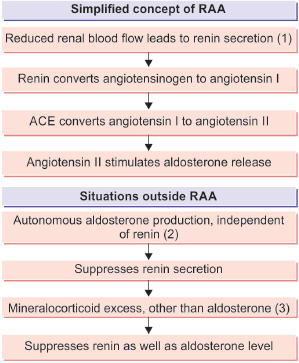
- e. Useful in the evaluation of hypokalemia due to renal loss and in the presence of hypertension. This evaluation helps one to decide (1) whether aldosterone secretion is secondary to reduced renal blood flow, renin secretion leading to aldosterone secretion or (2) increased aldosterone is because of autonomous secretion of aldosterone from adrenal gland which in turn suppresses rennin levels or (3) due to mineralocorticoid excess other than aldosterone.
- Simplified concept of renin–angiotensin–aldosterone (RAA) axis is as follows:
THG06-008
An 8-year-old boy, recently diagnosed to have acute lymphoblastic leukemia (ALL) and started on chemotherapy presents with a serum potassium of 7.2 mEq/L.
a. What do you suspect in this child?
b. What other biochemical abnormalities can occur in this child?
c. List two causes of pseudohyperkalemia.
d. What are the drugs used to treat hyperkalemia?
Answer
- a. Tumor lysis syndrome.
- b. Hyperuricemia, hyperphosphatemia, and hypocalcemia.
- c. Thrombocytosis, hemolysis, tourniquet application, and cold storage
- d. Treatment for hyperkalemia is as follows:
| Drug | Dose | Mechanism |
|---|---|---|
| Calcium gluconate (10%) | 0.5–1 mL/kg with 5% dextrose | Cardiac stabilization |
| Sodium bicarbonate (7.5%) | 1–2 mEq/kg IV | Intracellular shift |
| Insulin and glucose | 0.1–0.2 U/kg of insulin with 0.5–1 g/kg glucose | Intracellular shift |
| Salbutamol nebulization | <1 year: 1.25 mg 1–5 years: 2.5 mg >5 years: 5 mg |
Intracellular shift |
| Polystyrene sulfonate | 1 g/kg/dose | Increased excretion |
THG06-009
Fill up the blanks.
a. Predominant cation in extracellular fluid (ECF) is __________ and intracellular fluid (ICF) is __________.
b. The ECF volume is determined primarily by ___________ ion.
c. Ratio of ICF volume to ECF volume reaches the adult levels by the age of_________.
d. Formula to calculate total body water (TBW) is ___________.
Answer
- a. Predominant cation in ECF—sodium; predominant cation in ICF—potassium (remember predominant anion in ECF is chloride and ICF is phosphate)
- b. The ECF volume is determined primarily by sodium ion
- c. 1 year of age
- d. 0.6 × body weight (BW)
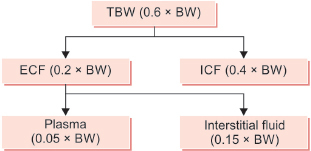
Composition of total body water.
THG06-010
A 7 year-old-male child presents with diabetic ketoacidosis (DKA). Blood sugar is 300 mg/dL and serum sodium is 134 mEq/L.
a. Calculate corrected sodium in this child.
b. What is the osmolality of plasma and formula to calculate the same?
c. What is effective plasma osmolality and list two ineffective osmoles?
d. What is osmolal gap?
Answer
- a. Corrected sodium = Measured sodium +
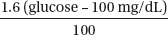
- In other words, for every 100 mg of sugar above 100 mg, sodium falls by 1.6 mEq. That means blood sugar rise is 200 mg above 100. 2 × 1.6 = 3.2 when added to 134, corrected sodium is 137.2
- Substituting the above values, corrected sodium value comes as 137.2 mEq/L.
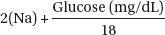
- b. Osmolality of plasma is 285–295 mOsm/kg. It is calculated as:
- Osmolality = 2(Na) +

- Osmolality = 2(Na) +
- c. Since urea is an ineffective osmole, only plasma glucose level is taken into consideration which is called as effective plasma osmolality.
- Effective osmolality =
- Ineffective osmoles are urea and ethanol.
- Effective osmolality =
- d. When the difference between the measured osmolality and calculated osmolality exceeds >10 mOsm/kg, it is called the Osmolal gap. It indicates the presence of unmeasured osmoles such as ethanol, methanol, ethylene glycol, etc. To quote an example, when a child with altered consciousness, also has high anion gap metabolic acidosis and osmolar gap, this indicates poisoning due to substances such as ethanol, methanol, or ethylene glycol.
THG06-011
Answer the following questions regarding intravenous fluids.
a. What is the number of calories provided by glucose in the maintenance fluid?
b. Calculate the total fluid requirement in a day in a child weighing 15 kg. What is the drop rate per hour if a macrodrip set with a drop factor of 15 is used for infusing the maintenance fluid?
c. What is the amount of sodium and chloride present in NS, dextrose normal saline (DNS), ½ DNS, RL and Isolyte P?
d. Why are hypotonic fluids best avoided as intravenous (IV) infusions?
Answer
- a. 17 cal/100 mL. This provides approximately 20% of the normal calorie needs in a day which is enough to inhibit ketones production and protein degradation.
- b. As per Holliday-Segar formula, this child requires 1,250 mL of maintenance fluid per day (100% TFI) which comes as 50 mL/h. There are two types of IV infusion sets—micro and macro sets. In a micro drip set, each mL is made up of 60 drops/min. Here if the rate is set at 10 drops/min, it will provide 10 mL/h. 50 mL/h means we have to set up 50 drops/min. In macro drip sets, approximately 15 drops make 1 mL. Using a macro drip set divide mL/h by 4 to get number of drops/min. Here substituting the values, considering 15 kg—total fluid requirement is 50 mL/h—when using a macro drip set, 13 drops/min to be used. But one should remember that critical medications like insulin, adrenaline or dopamine cannot be given through micro or macro sets. It should be infused only in syringe pump or infusion pump.
- c. Composition of various fluids is as follows:
| Fluid | Na (mEq/L) | Cl (mEq/L) | K (mEq/L) | Lactate | Dextrose |
|---|---|---|---|---|---|
| NS | 154 | 154 | — | — | — |
| DNS | 154 | 154 | — | — | 5% |
| 1/2 DNS | 77 | 77 | — | — | 5% |
| 1/2 NS | 77 | 77 | — | — | — |
| RL | 130 | 109 | 4 | 28 | — |
| Isolyte P | 25 | 22 | 20 | — | 5% |
- Remember, DNS, ½ DNS, and Isolyte P contains 5 g of glucose in 100 mL.
- d. When hypotonic fluids are used for IV infusions it will result in hyponatremia which will push water into red blood cells (RBCs) resulting in hemolysis.
THG06-012
A 3-year-old male child with weight of 10 kg and height of 95 cm [weight for height (W/H) <−3 standard deviation (SD)] presented with history of multiple episodes of loose stools. On examination he was dehydrated with normal sensorium and bilateral pedal edema.
a. What will be the status of sodium and potassium in this child?
b. What is the preferred route of dehydration correction in this child?
c. List four clinical signs to identify shock in this child.
d. Compare sodium and potassium concentration between rehydration solution for malnourished (ReSoMal) and low osmolarity rehydration solution (ORS)?
e. How will you prepare ReSoMal using a low osmolarity ORS?
Answer
- a. In a child with severe acute malnutrition (SAM), there will be an increase in cellular sodium and depletion of total body potassium and hence their diet should be low in sodium with supplemented potassium and magnesium for the first 2 weeks of rehabilitation.
- b. Oral or nasogastric tube feeding using ReSoMal. IV fluids are used only when a child is having shock, altered sensorium, or unable to drink orally. IV fluid of choice is 0.45% of NS with 5% glucose or RL with 5% glucose.
- c. Lethargy, thirst, cold clammy skin, weak or absent pulses, and reduced urine output.
- d. Sodium and potassium content in ReSoMal versus low osmolarity ORS is as follows:
| Parameter | ReSoMal | Low osmolarity ORS |
|---|---|---|
| Sodium | 45 mEq/L | 75 mEq/L |
| Potassium | 40 mEq/L | 20 mEq/L |
- e. Preparation of ReSoMal:
- Step 1: Take one sachet of WHO standard ORS and mix in two litres of water
- Step 2: Add 50 g of glucose to that
- Step 3: Add 60 mEq of potassium in either of the following way:
- a. Potclor syrup 45 mL or
- b. IV KCl solution 30 mL to be mixed with this solution for oral use
THG06-013
Answer the questions raised regarding the management of diarrhea.
a. What is the composition of low osmolarity ORS?
b. What is the mechanism of action of low osmolarity ORS?
c. What is super ORS?
d. What is the mechanism of action of green banana diet in a child with diarrhea?
Answer
- a. Composition of low osmolarity ORS is as follows:
| Electrolyte | Concentration (mmol/L) |
|---|---|
| Sodium | 75 |
| Potassium | 20 |
| Glucose | 75 |
| Chloride | 65 |
| Citrate | 10 |
| Total osmolarity | 245 |
- b. Acts through sodium glucose cotransporter 1 protein (SGLT1) in jejunum which actively transports both the sodium and glucose which results in improved water reabsorption from the gut into the body to maintain the osmotic balance.
- c. ORS fortified with amino acids such as L-alanine, glycine, glutamine, or addition of oligopeptides enriched starch from rice powder (instead of glucose).
- d. Green banana has high content of amylase-rich starch which is fermented by the colonic bacteria into short chain fatty acids which stimulate salt and water absorption from the gut.
THG06-014
A 4-year-old boy, recently diagnosed to have minimal change nephrotic syndrome, on treatment with steroids has come for follow-up. He does not have edema and is in remission. Laboratory values showed serum albumin 4 g/dL, serum total cholesterol 300 mg/dL, sodium 132 mEq/L, potassium 4 mEq/L, chloride 103 mEq/L, and bicarbonate 24 mEq/L.
a. What is the cause of hyponatremia in this child?
b. List two conditions which present like the above said condition.
c. What happens to serum osmolarity in true versus pseudohyponatremia?
d. How to diagnose pseudohyponatremia?
Answer
- a. Pseudohyponatremia is due to hypercholesterolemia.
- b. Improper sampling, hyperglycemia, hyperproteinemia, and increased osmolar agents like mannitol. In these conditions, these substances reduce the water fraction of plasma. In other words, the total plasma volume raises hence sodium value is erroneously measured as low (remember total body sodium is normal in these conditions).
- c. Serum osmolarity is low in true hyponatremia whereas it is normal or high in pseudohyponatremia.
- d. By using direct ion-selective electrode (ISE) method which measures the sodium in total serum.
THG06-015
A 5-year-old male child brought with complaints of polyuria and polydipsia. His vitals were stable, capillary blood glucose (CBG)—80 mg/dL, urine routine, and renal function test (RFT) were normal. Urine and blood ketones were negative.
a. List two differential diagnosis.
b. Name any four conditions associated with the probable diagnosis?
c. What is triple response?
d. What is the test done to confirm central diabetes insipidus (CDI)?
Answer
- a. Diabetes insipidus and psychogenic polydipsia.
- b. Craniopharyngioma, Langerhans cell histiocytosis, sarcoidosis, lymphocytic infundibulo-hypophysitis, trauma, congenital malformation, and familial/genetic central DI. Central DI of unknown etiology is classified as idiopathic.
- c. Triple response is due to pituitary stalk injury from traumatic brain injury or in a neurosurgical procedure. Initially there is a central DI followed by SIADH and finally established central DI. The initial phase of central DI is due to stunning of arginine vasopressin (AVP) neurons and severing of downstream nerve terminals in the posterior pituitary followed by SIADH due to unregulated release of vasopressin from the remaining degenerating neurons followed by an established DI as the damaged neurons can no longer produce AVP.
- d. Water deprivation test.
THG06-016
A 4-year-old girl admitted in pediatric intensive care unit (PICU) with complaints of fever, altered sensorium for 3 days, and one episode of generalized tonic clonic seizures (GTCS). Child is being treated as acute central nervous system (CNS) infection. Investigations measured were serum sodium—124 mEq/L, potassium—3.5 mEq/L, chloride— 98 mEq/L, bicarbonate—22 mEq/L, serum osmolarity—260 mOsm/kg, urine sodium—58 mEq/L, urine osmolarity—310 mOsm/kg, and urine output—1.5 mL/kg/h.
a. What is the most probable diagnosis?
b. What will happen if you rapidly correct sodium in this child?
c. What is the mechanism of action of the drug used in this condition?
d. What happens to serum sodium levels in diabetes insipidus (DI) and syndrome of inappropriate antidiuretic hormone (SIADH)?
Answer
- a. This child, with a background of meningitis, has hyponatremia with euvolemia (urine output is normal). Serum osmolarity is low hence it is true hyponatremia, urine osmolarity is more than serum osmolarity, and urine sodium is 50 mEq/L which indicates natriuresis despite low serum osmolarity—fits into SIADH.
- b. This child is symptomatic for >48 hours, hence chronic hyponatremia. This child should be corrected slowly (6–8 mEq/day correction) as rapid correction will result in osmotic demyelination.
- c. Vasopressin (v2) receptor antagonist.
- d. DI—hypernatremia and SIADH—hyponatremia.
THG06-017
A 5-year-old boy with nephrotic syndrome is admitted with complaints of edema, lethargy and altered sensorium for 1 day. Child did not have shock. The fundus examination showed papilledema. His initial blood investigations showed serum sodium—124 mEq/L, potassium— 3.5 mEq/L, chloride—98 mEq/L, and bicarbonate—22 mEq/L.
a. What is the type of hyponatremia in this child?
b. What is the CNS complication expected in a child with acute hyponatremia?
c. How to correct acute symptomatic hyponatremia?
d. Name two formulas used in correction of hyponatremia.
Answer
- a. Acute hyponatremia—hypervolemic hyponatremia due to low intravascular volume.
- b. Cerebral edema.
- c. 3–5 mL/kg of 3% saline in euvolemic and hypervolemic hyponatremia. In hypovolemic hyponatremia 20 mL/kg of NS over 30–60 minutes. The goal is to increase the sodium up to 5 mEq/L from the baseline values which is enough to correct the symptoms. This is done in addition to stabilize the A, B, C, and control of seizures.
- d. Adrogué–Madias formula, Barsoum–Levine formula, electrolyte free water clearance, and Nguyen–Kurtz equation.
THG06-018
An 8-year-old child with traumatic brain injury was admitted in PICU. On day 2, the child developed polyuria and also appears to be dehydrated. Serum sodium—130 mEq/L, potassium—3.8 mEq/L, chloride—104 mEq/L, bicarbonate—20 mEq/L, serum osmolarity— 210 mOsm/kg, urine sodium—182 mEq/L, and urine osmolarity— 310 mOsm/kg.
a. What is the diagnosis in this child?
b. What is the pathogenesis of this condition?
c. How will you treat this child?
d. How many mEq of sodium is present in 1 ml of 3% saline?
Answer
- a. Polyuria with hypovolemia hyponatremia, low serum osmolarity, and high urinary sodium excretion—cerebral salt wasting.
- b. Increased atrial natriuretic peptide (ANP) which inhibits AVP and aldosterone causing natriuresis.
- c. Sodium and water replacement using isotonic saline and fludrocortisone.
- d. 1 mL of 3% saline = 0.5 mEq sodium.
THG06-019
A 4-year-old male child with symptoms of acute gastroenteritis for 1 day presented with lethargy, reduced oral intake, and reduced urine output. After initial assessment, the child was found to have compensated shock. Laboratory investigations revealed CBG—68 mg/dL, serum sodium—170 mEq/L, potassium—4 mEq/L, chloride—110 mEq/L, bicarbonate—20 mEq/L, urea—22 mg/dL, and creatinine—0.5 mg/dL.
a. What is the type of hypernatremia in this child?
b. List two causes of seizures in a child with hypernatremia apart from sodium disturbance.
c. How will you treat this child?
d. List two indications of renal replacement therapy (RRT) in a child with hypernatremia.
e. What is the maximum correction of sodium allowed in this child?
Answer
- a. Hypovolemic hypernatremia as evidenced by the presence of dehydration and high sodium levels.
- b. Intracranial bleed, venous sinus thrombosis, and hypocalcemia.
- c. Stabilize airway breathing and circulation. Give oxygen. Since this child is in compensated shock, give bolus with NS at 10–20 mL/kg over 30–60 minutes and further boluses if needed to be decided as per clinical status. This should be followed by fluid infusion consisting of deficit correction plus ongoing loss replacement plus daily maintenance. Free water deficit can be calculated as 4 mL/kg × (current sodium − desired sodium). In other words, deficit and maintenance together can be given as 1.25–1.5 times the maintenance. Fluid of choice is 1/4 − 1/2 NS or 1/5 NS.
- d. Serum sodium persistently >180 mEq/L, multiple electrolyte abnormalities, and acute kidney injury.
- e. 8–12 mEq/day. The rate of fall should not exceed beyond 0.5 mEq/h.
THG06-020
A 2-year-old male child was brought with concerns of motor development delay. The child had no seizures in the past. Antenatal, natal, and postnatal period were uneventful. Examination revealed generalized hypotonia, wide open anterior fontanelle, widened wrists, and double malleoli. Investigations showed serum calcium—6.2 mg/dL, phosphorus—1.4 mg/dL, alkaline phosphatase—1,845 IU/L, parathyroid hormone (PTH)—630 pg/mL, 25-hydroxyvitamin D3—26 ng/mL, and 1,25-dihydroxyvitamin D3—very low.
a. What is the diagnosis in this child?
b. What is the confirmatory test of the above said condition?
c. How will you treat this child?
d. Rickets associated with alopecia and ectodermal defects is ___________.
Answer
- a. This child has features of rickets with low serum calcium and phosphorus, high alkaline phosphatase, high PTH and normal 25-hydroxyvitamin D3, and a very low 1,25-dihydroxyvitamin D3—Vitamin D dependent rickets type 1 (VDDR type 1).
- b. Molecular testing for CYP27B1 gene mutation.
- c. Active vitamin D3 (1,25-dihydroxyvitamin D3) at a dose of 0.25 µg/day along with calcium with or without phosphorus.
- d. Vitamin D dependent rickets type 2 (VDDR type 2).
THG06-021
A 1-year-old girl came for regular follow-up. Child was found to have widening of wrists and rachitic rosary and investigations showed serum calcium—7.1 mg/dL, phosphorus—1.2 mg/dL, alkaline phosphatase—1,280 IU/L, PTH—380 pg/mL, 25-hydroxyvitamin D3— 32 ng/mL, and serum magnesium—1.9 mg/dL.
a. What is the diagnosis in this child?
b. When does rickets develop in the above said condition?
c. Name two conditions predisposing to the above diagnosis.
d. What happens to urine calcium and phosphorus in this condition?
Answer
- a. This child has clinical and biochemical findings of rickets with a normal 25-hydroxyvitamin D level—suggestive of calcium deficiency. There are two reasons, if a child with rickets show normal serum 25 OH vitamin D levels—1) VDDR type 1. 2) Dietary calcium deficiency. In very low calcium intake groups in tropical population dietary calcium deficiency may play a synergistic role by accentuating the need for vitamin D.
- b. When the dietary intake of calcium is <200 mg/day.
- c. Celiac disease, intestinal abetalipoproteinemia, and small bowel resection.
- d. Low urine calcium and high urine phosphorus due to secondary hyperparathyroidism.