THG13-001
A 6-month-old boy brought by his mother to the outpatient department (OPD) with complaints of reddish rashes more over face, extensor aspect of extremities with sparing of diaper area associated with irritable cry for past 1 month. On further probing, mother revealed that the father also has similar complaints for which he is on treatment for long duration. Clinical image is shown below.
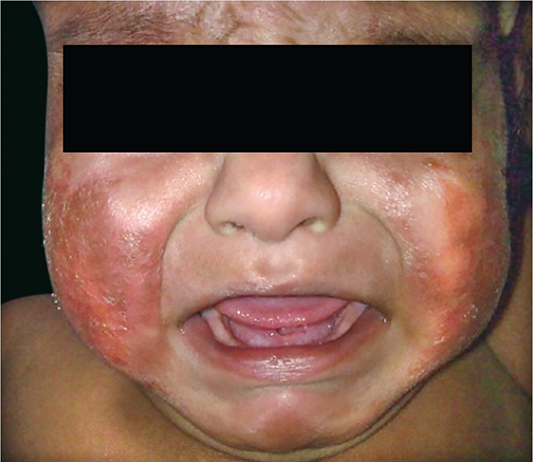
a. What is the probable diagnosis?
b. What are the three features that must be present to diagnose this condition?
c. What is the scoring system used?
d. Name any two pharmacological and nonpharmacological management.
Answer
- a. Atopic dermatitis
- b. Must have 3 out of 4 features:
-
- Characteristic rash and distribution—erythematous plaques with oozing/crusting
-
- Pruritus
-
- Chronic relapsing course
-
- Family history of atopy
-
- c. SCORing for Atopic Dermatitis (SCORAD)
- d.
- Pharmacological: topical corticosteroids and topical calcineurin inhibitors
- Nonpharmacological: allergen trigger avoidance and moisturizers/emollients
THG13-002
A follow-up case of atopic dermatitis (AD), who previously had been in remission, now came to the OPD with complaints which are suggestive of a relapse. Now, he did not respond to topical steroids and tacrolimus and became refractory to pharmacological management.
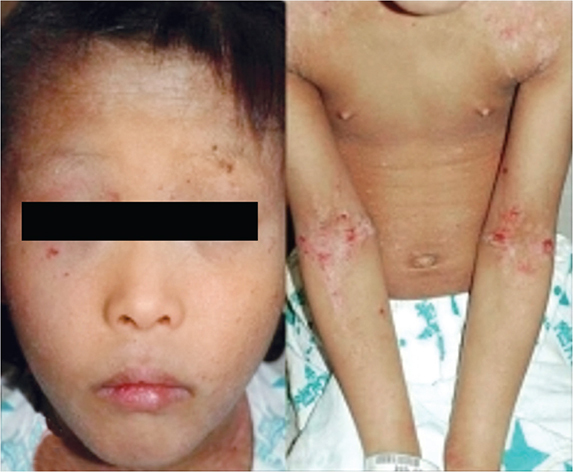
a. What is the next available treatment option?
b. Name any two biological agents and their action used in AD.
c. Mention the type of inheritance of AD.
d. What is the typical clinical appearance and locations of rashes at different ages?
Answer
- a. Options include—phototherapy, oral immunosuppressive drugs like cyclosporine, azathioprine, methotrexate, and biological agents.
- b.
- IL-4 receptor antagonist—dupilumab
- Anti-IgE antibody—omalizumab
- c. Autosomal dominant
- d. Age-specific clinical distribution:
- Infants: lesions mainly on face and extensor surfaces of limbs
- Childhood: polymorphous, particularly in flexural folds
- Adolescents: lichenified and excoriated plaques at flexures, wrists, and eyelids
THG13-003
A 10-month-old girl came to vaccine clinic for measles, mumps, and rubella (MMR) vaccine. After few minutes of vaccination, she became irritable, developed generalized hives, and noisy breathing. She was rushed to the emergency department. You are the on-call resident attending the patient.
a. What is your diagnosis?
b. What type of hypersensitivity reaction is this condition?
c. What are all the systems expected to involve in this condition?
d. What is the dose and route of the lifesaving drug you would use to treat this patient?
e. Mention one differential diagnosis and justify with two differences.
Answer
- a. Anaphylaxis
- b. Type 1 hypersensitivity reaction
- c. Respiratory system, skin, circulatory system, and gastrointestinal system
- d. Epinephrine, 0.01 mg/kg of 1:1,000 concentration (max 0.3–0.5 mg), given intramuscularly on the anterolateral aspect of thigh
- e. Vasovagal syncope. Differentiating features:
| Feature | Anaphylaxis | Vasovagal Attack |
|---|---|---|
| Respiratory system | Bronchospasm (wheeze), laryngeal edema (stridor) | Normal |
| Skin | Red, hot, and itchy wheals / urticaria | Pale, clammy, and cold |
THG13-004
A 5-year-old child with known peanut allergy accidentally ate peanuts while eating in a restaurant. He developed anaphylaxis and rushed to the emergency room (ER). After administering adrenaline, he did not show any signs of improvement as respiratory distress worsened. Heart rate (HR)—130 beats/min, peripheral pulses were weak, and cold peripheries with blood pressure 70/20 mm Hg. While taking history, he had a similar episode in the past which was life-threatening.
a. What is the next best step?
b. How do you manage respiratory distress in this patient?
c. Comment on his blood pressure. What orders will you give to the ER nurse?
d. After appropriate airway, breathing, and circulation measures, he still did not show any improvement. You are suspecting refractory anaphylaxis. What is the management now?
e. He recovered after 2 days with intense treatment in pediatric intensive care unit (PICU). Now planning to discharge the patient. What is the home management plan for this kid?
f. How long can you keep home prepared adrenaline at home and with what precautions?
Answer
- a. Repeat intramuscular (IM) adrenaline (after 5–15 minutes).
- b. Provide high-flow O2 by high-flow nasal cannula (HFNC), plan for intubation if needed. If stridor is present, give nebulized epinephrine @ 0.5 mL/kg. If wheeze is present, give nebulized salbutamol @ 0.15 mg/kg.
- c. He has hypotension (decompensated shock). Establish intravenous (IV) / intraosseous (IO) access, give normal saline (NS) bolus 20 mL/kg by rapid push technique; if no improvement, give second bolus. Prepare for IV epinephrine infusion.
- d. IV epinephrine/norepinephrine infusion at 0.05–1 µg/kg/min; consider IV glucagon bolus (especially if on beta-blockers).
- e. Parental counseling, prescription of EpiPen (green color: 0.15 mg for infants/young children <25 kg; yellow color: 0.3 mg for older children >25 kg), or home-prepared IM epinephrine kit.
- f. 3 months at room temperature with strict protection from light and extreme heat.
THG13-005
Food hypersensitivity is a broad term which refers to any untoward reactions following intake of certain foods.
a. What are the two types of food hypersensitivity?
b. What is FPIES and FDEIA?
c. Mention the difference between FPIES and FDEIA.
d. Mention any two tests that can be used in diagnosis.
e. How do you manage?
f. What are the newer strategies to counter food hypersensitivity?
Answer
- a. Immune-mediated and non-immune-mediated
- b.
- FPIES: Food protein-induced enterocolitis syndrome
- FDEIA: Food-dependent exercise-induced anaphylaxis
- c. FPIES is non-IgE mediated (cell-mediated GI inflammation) whereas FDEIA is IgE-mediated.
- d. Serum-specific IgE, skin prick tests, and oral food challenges.
- e. Strict avoidance of offending foods, parental education, and prefilled adrenaline auto-injectors as emergency medications.
- f.
- Desensitization—oral immunotherapy (administering small but gradually increasing doses to induce clinical tolerance)
- Extensive heating/baking of milk and eggs
THG13-006
A 4-year-old boy presented to the OPD with complaints of recurrent cold. His mother complains that he is snoring in the night, feels always sleepy in the morning, and his academic performance has declined in the past 6 months. She feels that his cold symptoms are present throughout the year.
a. What is the most probable diagnosis?
b. How do you classify severity of the condition, and what category does this child belong to?
c. Mention any four common allergens.
d. Mention two blood investigations you will order.
e. How do you manage this kid?
Answer
- a. Allergic rhinitis
- b. Classification:
- Mild intermittent
- Mild persistent
- Moderate-severe intermittent
- Moderate-severe persistent
- This child belongs to moderate-severe persistent allergic rhinitis.
- c. Aeroallergens (outdoor and indoor), house dust mites, cockroach debris, pet dander, pollen, molds, tobacco smoke, and drugs (e.g., aspirin).
- d. Total eosinophil count (TEC) and total serum IgE (along with allergen-specific IgE).
- e. Intranasal corticosteroids ± intranasal antihistamines ± leukotriene receptor antagonists (e.g., montelukast).
THG13-007
Match the following:
| Column A | Column B |
|---|---|
| a. Interleukin-4R (IL-4R) antagonist | i. Mepolizumab |
| b. Anti-immunoglobulin E (IgE) antibody | ii. Crisaborole |
| c. Janus kinase (JAK) inhibitor | iii. Dupilumab |
| d. Phosphodiesterase-4 (PDE-4) inhibitor | iv. Abrocitinib |
| e. Anti-IL-5 antibody | v. Omalizumab |
Answer
- a - iii (IL-4R antagonist — Dupilumab)
- b - v (Anti-IgE antibody — Omalizumab)
- c - iv (JAK inhibitor — Abrocitinib)
- d - ii (PDE-4 inhibitor — Crisaborole)
- e - i (Anti-IL-5 antibody — Mepolizumab)
THG13-008
A school going child presents with features suggestive of allergic rhinitis (AR). He has a positive family history of atopy.
a. How do you confirm your diagnosis?
b. Mention four signs of AR.
c. What eye findings one can expect in AR?
d. What is the drug of choice in mild intermittent AR?
e. What is the controller medication of choice and what is the minimum recommended age?
Answer
- a. Allergic rhinitis is diagnosed based on detailed history, characteristic clinical signs, and confirmation of allergen-specific IgE (by skin prick testing or serum-specific IgE).
- b. Signs of AR:
- Allergic shiners (infraorbital dark circles)
- Dennie–Morgan folds (infraorbital skin creases)
- Allergic salute and transverse nasal crease
- Cobblestone appearance of posterior pharyngeal wall
- Boggy, pale, or bluish inferior turbinates
- c. Allergic conjunctivitis, vernal keratoconjunctivitis, and keratoconus (due to chronic eye rubbing).
- d. Second-generation oral antihistamines (e.g., cetirizine, levocetirizine, fexofenadine).
- e. Intranasal corticosteroids; minimum recommended age is >2 years.
THG13-009
Q13.9
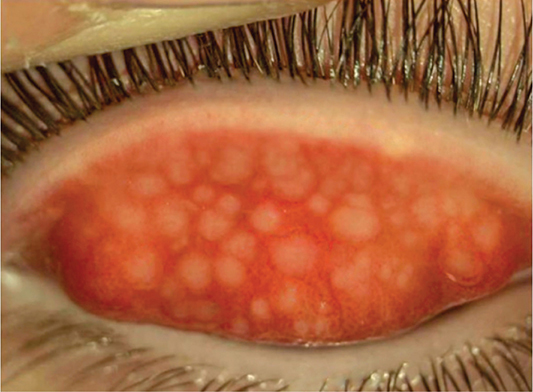
a. Describe the findings in the given image and mention the probable diagnosis.
b. Eyes are common targets in this spectrum of disorders. Why?
c. What is the treatment of choice?
Answer
- a. Cobblestone appearance (giant papillae) of upper tarsal conjunctiva; Diagnosis: Vernal keratoconjunctivitis (VKC).
- b. Due to high vascularity, rich mast cell density, and direct environmental exposure to common aeroallergens.
- c. Topical mast cell stabilizers / dual-action antihistamines (e.g., olopatadine) and short-course topical corticosteroids (e.g., fluorometholone, loteprednol) under ophthalmologic supervision.
THG13-010
A school going boy develops rashes after eating prawns for the first time. He presents to you with rashes and intense itching. On examination, he is alert, hemodynamically stable with normal vital parameters. Systemic examination was normal. Clinical image as shown below.
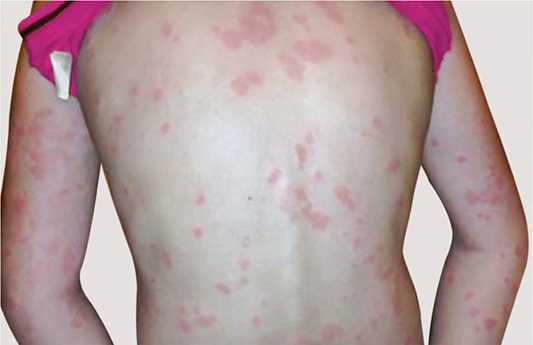
a. What is your diagnosis?
b. What are the three typical features?
c. What are the common infections that can cause this condition?
d. What is dermatographism?
e. What is the drug of choice?
f. What is the role of steroids?
Answer
- a. Acute urticaria
- b. Three typical features:
-
- Sharply circumscribed superficial wheals/edema surrounded by erythema
-
- Intense pruritus
-
- Transient nature (individual lesions resolve within 30 minutes to 24 hours without scarring)
-
- c. Infectious causes:
- Bacterial: Streptococcal, Staphylococcal, and Mycoplasma
- Viral: Hepatitis B, Epstein–Barr virus (EBV), and Coxsackievirus
- Parasitic: Ascaris and Strongyloides
- d. Also known as urticaria factitia; a physical urticaria where wheals appear in the exact pattern where skin is stroked with a blunt object.
- e. Second-generation H1 antihistamines (e.g., cetirizine, fexofenadine, bilastine).
- f. Short course of oral corticosteroids is reserved for severe acute urticaria or cases refractory to high-dose antihistamines.
THG13-011
A 13-year-old adolescent presents with episodic attacks of lip swelling, swelling of hands and foot. Episodes started during childhood and became much more severe as the child grew up. They initially resolve within 1–2 days; however, duration of each attack is variable.
a. What is the most likely diagnosis?
b. What type of inheritance is this condition?
c. What is the pathogenesis?
d. What is the most feared complication?
e. What is the treatment of acute attacks?
f. What agents can be used as prophylaxis?
Answer
- a. Hereditary angioedema (HAE)
- b. Autosomal dominant
- c. Low functional levels or deficiency of plasma C1-esterase inhibitor (C1-INH), leading to uncontrolled bradykinin release.
- d. Laryngeal edema causing fatal airway obstruction.
- e. Purified C1-inhibitor concentrate (20 U/kg IV), icatibant (bradykinin B2 receptor antagonist), or ecallantide (kallikrein inhibitor).
- f. Tranexamic acid (antifibrinolytic) and attenuated androgens (e.g., danazol) or plasma-derived C1-INH / lanadelumab for long-term prophylaxis.
THG13-012
A 8-year-old boy presented with fever for >1 week, altered sensorium, and seizures. He had neck rigidity, Kernig’s sign was positive, and diagnosis of meningitis was made. He was starting on antibiotics and antiepileptics (phenytoin). After starting phenytoin, he developed generalized rashes which spread rapidly along with burning sensation. He also had multiple ulcers over mouth and nose.
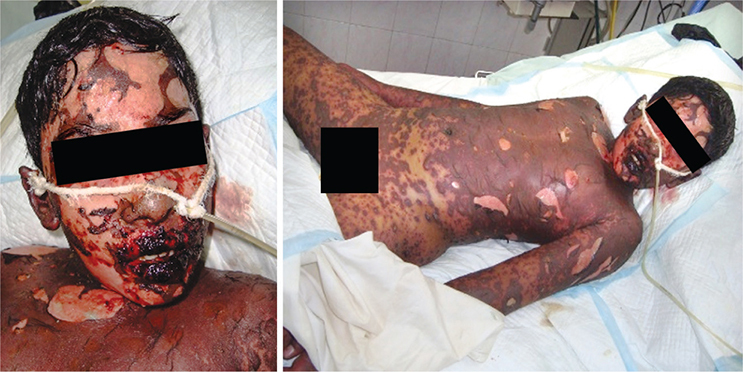
a. What is the likely diagnosis?
b. What is the name of more severe form of this condition and how do you differentiate both?
c. Name four common etiologies.
d. Mention four complications.
e. What is the treatment?
Answer
- a. Stevens–Johnson syndrome (SJS)
- b. Toxic epidermal necrolysis (TEN). Differentiation by body surface area (BSA) epidermal detachment:
- SJS: <10% BSA detachment
- SJS-TEN overlap: 10–30% BSA detachment
- TEN: >30% BSA detachment
- c. Common offending drugs:
- Antiepileptics (phenytoin, carbamazepine, phenobarbital, lamotrigine)
- Sulfonamides (cotrimoxazole)
- Nonsteroidal anti-inflammatory drugs (NSAIDs)
- Allopurinol
- Antitubercular drugs (ATT)
- d. Dehydration/hypovolemia, secondary bacterial sepsis, severe ocular cicatrization / visual loss, respiratory tract sloughing, and permanent skin scarring/pigment changes.
- e. Immediate cessation of offending drug, admission to burn/PICU unit, fluid and electrolyte management, sterile non-adherent wound dressing, aggressive eye lubrication, and immunomodulatory therapy (IVIg, systemic corticosteroids, or cyclosporine in select cases).