THG30-001
Q30.1
a. Fill in the blanks the following first five statements related to Integrated Child Development Services (ICDS)
i. To improve the ________ and _________ status of children in the age group _____ to ____ years.
ii. To lay the foundation for proper ________, ________, and ________ development of the child.
iii. To reduce the incidence of ________, ________, ________, and ________.
iv. To achieve effective ________ of policy and implementation among the various departments.
v. To enhance the capability of the mother to look after the _________ and _________ needs of the child through proper ____________ and ___________________.
b. Mention the names of the six main services in the package offered to children in this age group under the ICDS National Project.
Answer
- a.
- i. To improve the nutrition and health status of children in the age group birth to six years.
- ii. To lay the foundation for proper psychological, physical, and social development of the child.
- iii. To reduce the incidence of three childhood health issues, i.e., mortality, morbidity, malnutrition, and school dropout.
- iv. To achieve effective coordination of policy and implementation among the various departments to promote child development.
- v. To enhance the capability of the mother to look after the normal health and nutritional needs of the child through proper nutrition and health education.
- b. Six main services in the package offered under the ICDS National Project:
- Supplementary nutrition (to promote EBF for complete 6 months and timely initiation of complementary nutrition after completion of 6 months along with continued breastfeeding for first 2 completed years)
- Immunization
- Health check-up including growth and developmental monitoring
- Referral services
- Preschool nonformal education
- Nutrition and health education
THG30-002
Regarding national efforts to bring down the severe anemia Public Health Programme addressing nutritional anemia in children answer the following questions:
a. Initiated in 1970, the control program was called ________.
b. From 2011, this program is revised and termed as ________
c. Name three reasons for the revised strategy.
d. Who are all the beneficiaries of this revised Iron Prophylaxis Programme?
Answer
- a. National Nutritional Anemia Prophylaxis Programme
- b. National Iron Plus Initiative (NIPI) Programme
- c.
- No change in incidence for five to six decades
- Adolescents were not included
- Poor monitoring and implementation, poor coverage of beneficiaries, and poor compliance in taking medicinal iron
- d. Expanded to include beneficiaries from all age groups—children aged 6–59 months, 5–10 years, adolescents aged 10–19 years, pregnant and lactating women, and women in reproductive age group.
THG30-003
If an infant is not given exclusive breastfeeding (EBF) with mother’s own milk for first 6 months with continued breastfeeding along with appropriate introduction of complementary feeding subsequently, there is a risk of increase in infant mortality rate (IMR).
| Age of Cessation of Mother’s Own Milk Feeding | How Manifold Increase in Relative Risk of Infant Mortality Rate? |
|---|---|
| No colostrum from birth or discontinued before 2 months | ____ |
| 2–3 months | ____ |
| 4–5 months | ____ |
| 6–8 months | ____ |
| Beyond 8–12 months | ____ |
Answer
| Age of Cessation of Mother’s Own Milk Feeding | Increase in Relative Risk of Infant Mortality Rate |
|---|---|
| No colostrum from birth or discontinued before 2 months | 5-fold |
| 2–3 months | 3-fold |
| 4–5 months | 2.5-fold |
| 6–8 months | 2-fold |
| Beyond 8–12 months | 1.5-fold |
THG30-004
Given in the Table below are the National Family Health Survey, 2015–16 (NFHS-4) findings of perinatal mortality rate, neonatal mortality rate (NNMR), IMR, and under 5 mortality rate (U5MR) in 2015–16. Fill in the blanks of current status as reported in NFHS-5 survey undertaken between 2019 and 2021.
| Indicator (Ministry of Health and Family Welfare, GOI) | NFHS-4 (2015–2016) | NFHS-5 (2019–2021) |
|---|---|---|
| Perinatal mortality rate / 1,000 pregnancies | 36 | ____ |
| Neonatal mortality rate (NNMR) / 1,000 live births | 30 | ____ |
| Infant mortality rate (IMR) / 1,000 live births | 41 | ____ |
| Under-5 mortality rate (U5MR) / 1,000 live births | 50 | ____ |
Answer
The National Family Health Survey is conducted once in 5 years by Union Ministry of Health and Family Welfare, Government of India. This is a compendium of factsheets that highlights the key indicators providing estimates on population, health, family planning, and nutrition-related key indicators like fertility, mortality, maternal, child and adult health, women and child nutrition, domestic violence, etc. These indicators throw light on important aspects of family wellbeing of the population of different States and Union Territories.
| Indicator (Ministry of Health and Family Welfare, GOI) | NFHS-4 (2015–2016) | NFHS-5 (2019–2021) |
|---|---|---|
| Perinatal mortality rate / 1,000 pregnancies | 36 | 32 |
| Neonatal mortality rate (NNMR) / 1,000 live births | 30 | 25 |
| Infant mortality rate (IMR) / 1,000 live births | 41 | 35 |
| Under-5 mortality rate (U5MR) / 1,000 live births | 50 | 42 |
THG30-005
Answer the following questions with reference to World Breastfeeding Week:
a. Which week of which month is observed as the World Breastfeeding Week (WBW)?
b. What were the themes of the WBW for 2022 and 2023?
c. What are the main objectives to observe this every year?
d. What is the expected outcome and objective of 2023 WBW theme?
e. Enumerate five ways the government and private organizations can help working mothers to continue giving their own mother’s milk to their babies.
Answer
- a. First week of August (August 1–7)
- b.
- WBW theme 2022: “Step up for Breastfeeding: Educate and Support”
- WBW theme 2023: “Let’s make breastfeeding and work, work!”
- c. To enable the neonates and infants to be fed exclusively with initiating within first hour after birth colostrum and mother’s own milk then on till completion of 6 months of age with continuation of mother’s own milk up to 2 years of age with introduction of safe and risk-free complementary food of different variety (cereals, pulses, fruits and vegetables, and animal food) with increasing quantity, consistency, and frequency to promote optimum growth and development.
- d. 2023 year’s campaign focuses on promoting practices that can help support workplace-related breastfeeding in different countries. It will try to educate people and organizations that can help ensure that breastfeeding works for all women who work, whenever they work.
- e.
- Special leave for 6 months—1 year given by organizations both governmental and a few private institutions
- Expressing breastmilk before going to work to feed babies two to three times in their absence
- Setting up of special crèches
- Giving extra time during breaks to go and feed the child at home
- Child brought from home to be fed
THG30-006
National Iron Plus Initiative (NIPI) started by Government of India in 2011 replacing the National Nutritional Anaemia Prophylaxis Programme initiated in 1970, as there was no reduction in iron deficiency anemia. The new program advocates:
| Target Age Group | Frequency & Duration | Dose of Elemental Iron & Folic Acid |
|---|---|---|
| Infants (6–23 months) and Children (24–59 months) | ____ | ____ mg iron with 100 µg folic acid |
| Children (5–10 years) | ____ | ____ mg iron with 400 µg folic acid |
| Children & Adolescents (10–19 years) | Weekly throughout the year | ____ mg iron with 500 µg folic acid |
| Pregnant women | ____ | ____ mg iron with 500 µg folic acid |
| Lactating women | ____ | ____ mg iron with 500 µg folic acid |
Answer
| Target Age Group | Frequency & Duration | Dose of Elemental Iron & Folic Acid |
|---|---|---|
| Infants (6–23 months) and Children (24–59 months) | Biweekly throughout the year | 20 mg elemental iron with 100 µg folic acid |
| Children (5–10 years) | Weekly throughout the year | 45 mg elemental iron with 400 µg folic acid |
| Children & Adolescents (10–19 years) | Weekly throughout the year | 100 mg elemental iron with 500 µg folic acid |
| Pregnant women | Daily (started after first trimester) | 100 mg elemental iron with 500 µg folic acid |
| Lactating women | Daily for 100 days postpartum | 100 mg elemental iron with 500 µg folic acid |
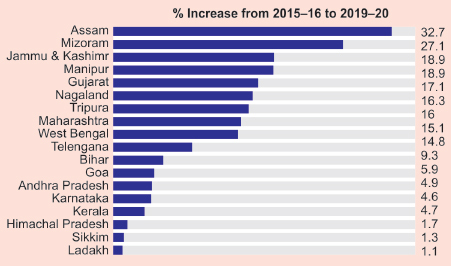
Anemia prevalence among under 5 years children percentage of increase over 4 years.
THG30-007
A nutrition scheme launched in many states in South-India including Union Territories of Pondicherry, got enhanced in August 1995, then again in 1997–98 to become applicable in the entire nation.
a. Name of the program.
b. Mention two essential objectives to launch this program in primary schools.
c. Number of calories and protein provided to:
i. Primary: Calories: ________; Proteins: ________
ii. Postprimary: Calories: ________; Proteins: ________
Answer
- a. Mid-day Meal scheme—National Programme of Nutritional Support to Primary Education
- b. The two essential objectives of this Mid-day Meal school program are:
- To improve enrolment of children to school, to improve their attendance, and ensure continuation of their education in classes to complete their school education
- To improve the level of nutrition among children
- c.
- i. Primary: Calories: 450 kcal; Proteins: 12 g
- ii. Postprimary: Calories: 700 kcal; Proteins: 20 g
THG30-008
Answer the following questions regarding LATCH scoring system.
a. Expand the LATCH scoring system.
b. Within how many hours after birth this observation scoring must be undertaken?
c. What is its significance?
d. What is the scoring rate allotted to each?
e. A score of above ________ has the highest sensitivity and reasonable specificity to predict successful breastfeeding rate.
Answer
- a. L: Latch; A: Audible swallowing; T: Type of nipple; C: Comfort (breast, nipple, mother, and baby); and H: Hold (positioning)
- b. Must be undertaken from the first feed if possible or to be done within 24 hours and again at the time of discharge.
- c. Used for identification and correction of breastfeeding problems.
- d. Each component has a score of 0, 1, or 2 with a total maximum score of 5 × 2 = 10.
- e. LATCH score >6 at discharge is statistically predictive of successful EBF of babies with appropriate weight gain of >20 g per day. LATCH score >6 at discharge was significantly associated with higher EBF rate.
THG30-009
Note the following images and observe the differences. Answer the following questions regarding variations in the composition of breastmilk.
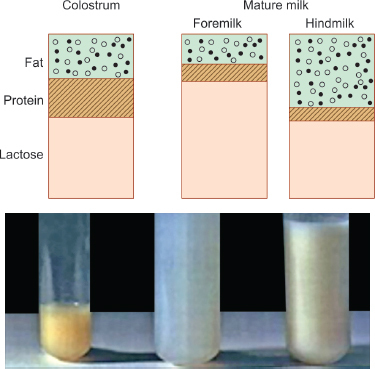
a. Why colostrum has more protein and what is its protective role?
b. Explain why there is such a variation in the foremilk and hindmilk.
Answer
- a. Feeding of colostrum is very vital to prevent neonatal sepsis and its associated neonatal mortality as the greater protein content is mainly due to the concentration of protective antibodies that provide passive immune protection to the neonates, many WBCs and vitamin A which again add to the protective effect against infections, and growth factors which give barrier protection in the gut and other mucosal surfaces.
- b. The foremilk is relatively watery with less fat and provides the much-needed water. The latter part of milk toward the end of feeding (hindmilk) has increasing fat which stimulates the satiety center in the hypothalamus and thus the neonate/infant sleeps after feeding without drinking excess. Whereas if the baby is switched between breasts too quickly, the baby gets only the watery foremilk fraction without much fat and thus feels hungry more often.
THG30-010
The WBW being celebrated in the first week of August 1–7 every year by more than 120 countries. Answer the following questions regarding breastfeeding week.
a. What is the breastfeeding week slogan in the year 2007?
b. The percentage of deaths prevented by initiating of breastfeeding within 1 hour and if fed after 1 hour after birth but before the end of 24 hours are the same—True or False?
c. If early breastfeeding rate in NFHS-4 2015–16 was 41.6, what is the early breastfeeding rate for NFHS-5 2019–2021?
Answer
- a. Slogan for the year 2007 is “Breastfeeding: The 1st Hour Saves 1 Million Babies”, highlighting the importance of initiating direct mother's milk feeding within an hour after birth.
- b. False, initiation of breastfeeding within an hour saves significantly more lives; initiation after 1 hour even if before 24 hours still carries elevated risk.
- c. Nearly same: 41.8%.
THG30-011
Observe the image and answer the following questions.
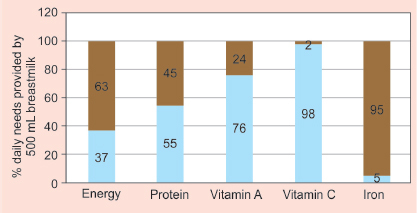
a. Why breastfeeding needs to be continued beyond the first year along with complementary foods from variety of foods?
b. Which represents contribution by continuing breastmilk—gray or light blue?
Answer
- a. By continuing to feed the child in his or her second year along with complementary food, the child gets from mother’s milk: 37% of energy, 55% of quality protein, 76% of Vitamin A, and 98% of Vitamin C.
- b. Light blue
THG30-012
Answer the following questions related to national health program.
a. Name the program of Government of India to control diseases borne by mosquitoes and other insects?
b. State the “seven diseases” that have been taken up by government in war footing for several years?
Answer
- a. The National Vector Borne Disease Control Programme (NVBDCP)
- b. Malaria, dengue, lymphatic filariasis, kala-azar, Japanese encephalitis, chikungunya, and scrub typhus in India.
THG30-013
Answer the following questions regarding “RBSK”.
a. What is the common objective of Rashtriya Bal Swasthya Karyakram (RBSK)?
b. What is the focused main ambitious objective envisaged in this RBSK national program?
c. What are the other ministerial agencies seeking strong convergence to implement this program in an effective manner?
Answer
- a. To improve the overall quality of life of children and provide comprehensive care to all children in the community.
- b. To detect early by screening of children from birth to 18 years of age for four Ds—Defects at birth, Diseases, Deficiencies, and Development delays, spanning 32 common health conditions for early detection and offer free treatment and management, including surgeries at tertiary level.
- c.
- Ministry of Women and Child Development for screening children in the age group of 0–6 years enrolled at Anganwadi centers.
- Ministry of Human Resource Development for screening children enrolled in Government and Government-aided schools.
- Health facilities by doctors and during home visits by Accredited Social Health Activists (ASHA).
THG30-014
Answer the following questions on POSHAN Abhiyaan:
a. The objective of POSHAN Abhiyaan, launched on 8th March 2018 by Government of India?
b. Who is the nodal officer in the district for monitoring nutritional status and quality standards?
Answer
- a. To improve and maximize the nutritional outcomes of children and adolescent girls mainly in a phased manner, by adopting a synergized and result-oriented approach.
- b. The District Magistrate (DM) is the nodal officer. The DM supervises and monitors the activities of the District Nutrition Committee.