VVK22-001
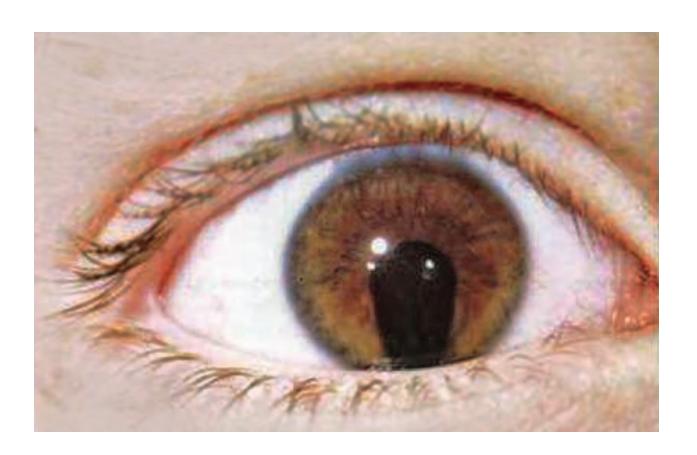
a. What is the diagnosis?
b. Enlist 2 acquired and 2 congenital conditions leading into this eye problem.
c. What can be the clinical symptoms due to above defect?
Answer
- a. Coloboma (iris) of right eye (typical inferonasal keyhole defect).
- b.
- Acquired:
- Eye surgery (surgical iridectomy)
- Trauma / blunt injury to the eye
- Congenital:
- CHARGE syndrome
- Cat eye syndrome
- Patau syndrome (Trisomy 13)
- Treacher Collins syndrome
- Acquired:
- c.
- Blurred vision
- Decreased visual acuity
- Photophobia / light sensitivity
- Double vision (diplopia) / ghost images
VVK22-002
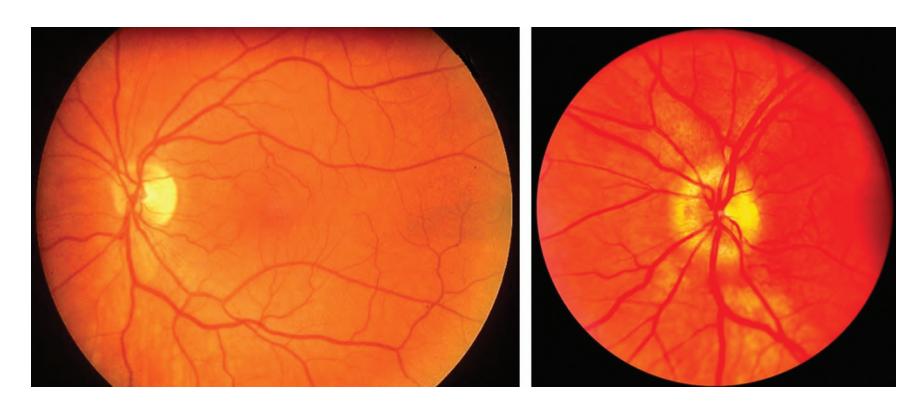
a. Describe the eye findings.
b. Enlist three causes.
Answer
- a. Papilledema / Optic disc edema:
- Hyperemia / erythema of the optic disc
- Elevation / swelling of the optic disc
- Blurring / obscuration of disc margins
- Engorged retinal veins / loss of venous pulsations
- b. Causes of raised intracranial pressure leading to papilledema:
-
- Space-occupying lesions (brain tumor, tuberculoma, abscess)
-
- Idiopathic intracranial hypertension (pseudotumor cerebri)
-
- Meningitis / encephalitis / hydrocephalus
-
- Intracranial hemorrhage / venous sinus thrombosis
-
VVK22-003
A 2-month-old infant presents with bilateral cataracts.
a. What is the most common identifiable inheritance pattern for bilateral cataracts?
b. Enlist 2 other common causes of bilateral cataracts.
c. What is the optimum time to operate on a patient with bilateral dense congenital cataracts?
d. What is the preferred treatment for congenital cataracts in a 2-month-old infant with compliant parents?
e. What can be the complications if it is left untreated?
Answer
- a. Autosomal dominant
- b. Any 2 of:
- Metabolic: Galactosemia, diabetes mellitus, Lowe's syndrome, hypocalcemia
- Congenital intrauterine infections (TORCH): Rubella, CMV, Toxoplasmosis, HSV
- Chromosomal anomalies: Down syndrome, Edwards syndrome
- c. As soon as possible (ideally within 6–8 weeks of life / before 10 weeks of age to prevent irreversible amblyopia).
- d. Lens aspiration / lensectomy with posterior capsulotomy and anterior vitrectomy, followed by optical correction with contact lens or aphakic spectacles (and occlusion therapy).
- e. Irreversible stimulus-deprivation amblyopia and sensory nystagmus / strabismus.
VVK22-004
Match the following:
- a. Kayser-Fleischer rings
- b. Cherry red macular spots
- c. Kinky hair
- d. Arcus juvenilis
Options:
- i. Familial hypercholesterolemia
- ii. Tay-Sachs disease
- iii. Wilson disease
- iv. Menkes syndrome
Answer
- a. Kayser-Fleischer rings — iii. Wilson disease
- b. Cherry red macular spots — ii. Tay-Sachs disease
- c. Kinky hair — iv. Menkes syndrome
- d. Arcus juvenilis — i. Familial hypercholesterolemia